Murphy’s Lens: From Kabul to Kolkata, Seamus Murphy makes every photograph an intimate encounter
Every life is in many days, day after day,” James Joyce had written in Ulysses, his seminal 1922 novel. “We walk through ourselves, meeting robbers, ghosts, giants, old men, young men, wives, widows, brothers-in-love, but always meeting ourselves.” The words remind Seamus Murphy of photography. “As a photographer, you put yourself out there, you meet your fellow humans and you meet yourself,” he says. “You are part of the great human condition.”

A fragment of Joyce’s words becomes the fitting title of an ongoing exhibition of Murphy’s works, titled Life is in Many Days, at Museo Camera, Gurugram. Curated by Zelda Cheatle, the showcase assembles his photographs from Afghanistan, Ireland, the US, Russia and India. It spans three decades of work, monochromatic and colourful images, and encounters with a multitude of peoples and cultures, evoking a quality Murphy himself describes as poetic realism.
Losing Memory
16 Oct 2026 - Vol 05 | Issue 42
The making of a medical and social emergency
“Photography, at its best, can be poetic. It can be lyrical. It can be hu manistic. It can be angry, it can be many thanks—it can be very emotional,” Murphy tells Open on the eve of the exhibition’s opening. Smartphones may have made photographs ubiquitous but they have become little more than a recording mechanism. “What distinguishes photography from that or even AI will be the intention of the picture, the intention of the photographer—the soul of the photographer.”
Murphy began taking photographs years before AI or Instagram and even the advent of digital photography. His work and news assignments have taken him around the world, tracking stories that made headlines and went beyond them. Take for instance, an assignment that took him to Sierra Leone in 2000 during the civil war. He found a group of people taking refuge in a stadium who turned out to be athletes aspiring to make it to the Sydney Olympics. Their hopes and struggles became the story. “I would always be looking on the edges, for the stories that would interest me,” Murphy says. “I wanted to know why something was happening, but also what was going on before and what would happen after.”
One sees reflections of this practice across Life is in Many Days. Some of Murphy’s most well-known images are from Afghanistan which he has visited since 1994. A burqa-clad woman in the Takhar province of Afghanistan photographed in November 2000 tells one story of women in the country.
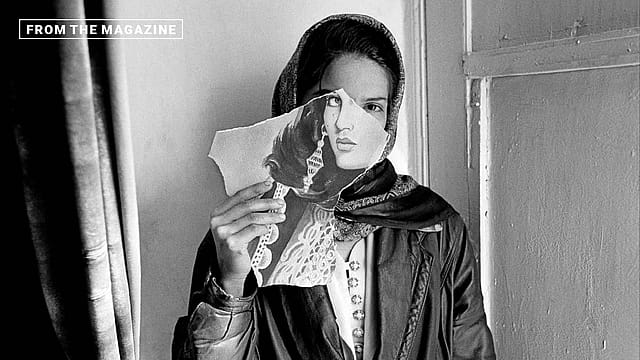
It may bring the Taliban’s treatment of women to mind, though captions remind that the garment has a longer history. In contrast, a photograph from 2002 at the National Gallery in Kabul depicts a woman in a headscarf and a leather jacket. Her face is half-hidden too but cheekily so with a torn image of a woman (one of the images that were confiscated by the Taliban).
Murphy's works have earned him seven World Press Photography Awards and landed his images in eminent collections such as The Getty Museum. He has also turned them into books. A Darkness Visible: Afghanistan chronicled the country’s tumultuous history based on his trips between 1994 and 2007 while I Am the Beggar of the World focused on Afghan women and their lives through the prism of their traditional Landay folk poetry. Shifting his gaze to books opened up new possibilities for his photographs. “I realised that these were a whole different set of values, and the pictures that I didn’t choose for the media were the very pictures that were perfect for the book.”
Others books by Murphy include The Hollow of the Hand (2015), made with his longtime collaborator, musician and poet PJ Harvey; and The Republic (2016), which brought him back home to Ireland. “I wasn’t looking for the Ireland I had left—that would be too retro. But I did want to go back with the eyes of the child who had grown up in Ireland,” he says, remembering his early years in a predominantly white, Catholic society. “I loved my Irish childhood but I also remembered how difficult it was and how strict the society was.”
The Republic became Murphy’s way to record things that were disappearing as well as the new changes. If a 1998 photograph of horse riders in Ballinastack evokes some of the magic Murphy recalls of Ireland, a 2021 photograph captures change in the Forty Foot swimming place at Sandycove Beach, which had been exclusively male until a group of women protested against it in 1974.
A more recent book, Strange Love published in 2025, is shaped by Murphy’s travels to Russia and the US and his attempt to juxtapose the relation ship and perceived sense of differences between them. Images from the series are among the more recent works on display at Museo Camera along with a number of photographs from Kolkata over the past few years. Murphy visited Kolkata for the first time around 2017 with his children and wife, Smita, who had grown up in the city, and vividly remembers the train ride to Howrah and taking one of the city’s classic yellow Ambassador taxis across the bridge. Since then, they often live in the city and Murphy has been photo graphing its neighbourhoods and people. Even as Life is in Many Days is mounted on display, Murphy is eager to head back to Kolkata and continue his work.
Murphy may be a world-travelling photographer but his body of work is not shaped by the quest for new destinations. It is built on revisiting and documenting the same places and people. “It’s not photography for photography’s sake,” he says. “I have to have a project in mind.” In Afghanistan, for instance, he has photographed the Ba Deli family since 1994, witnessing their lives and losses through the years. He is now working on a documentary film about them. Besides Afghanistan and Kolkata, he also hopes to continue working in Ireland.
Photography has transformed in the wake of a cultural shift that seems to have left much of humanity on an obsessive hunt for the next great photo-op. Ironically, photographers are struggling with a host of disruptions, from generative AI and market saturation to shrinking publications and the pressures of social media. Would Murphy become a photographer today? The question returns him to the years when he discovered his love for images, and when photography was a competitive pursuit yet rife with opportunities. Yes, he says finally, he would still be a photographer. At a time when billions of photographs are clicked every day, photography can still reflect life in intimate, humane ways.
MOVING IMAGES
Seamus Murphy has also made documentary features and films, including:
A Dog Called Money (2019): Murphy’s feature debut, documenting his travels with PJ Harvey across Kosovo, Afghanistan and the US
The Peculiar Sensation of Being Pat Ingoldsby (2022): The film traced the life and work of Irish poet Pat Ingoldsby
A Darkness Visible: Afghanistan (2011): This multimedia documentary centred on Murphy’s work in Afghanistan
Let England Shake: 12 Short Films (2011): A series of shorts for Harvey’s album