Mumbai Mélange: Where Art Meets Fashion and Showbiz
Few things exemplify Mumbai better than its entrepreneurial spirit, restless energy, cosmopolitanism, towering skylines — and good ol’ Bollywood. Even Art Mumbai can’t resist the lure of showbiz. Starting November 12, the fourth edition of the annual event will transform Mahalaxmi Racecourse into a carnival of sorts, featuring a heady mix of artists and galleries, museums and institutions, curators and collectors, art lovers and other familiar faces. Art will take centrestage but Nakul Dev Chawla, one of the event’s cofounders, notes, that there will also be “musical performances, an unforgettable fashion spectacle and a surprise panel with Karan Johar”. He adds, “While our target audience is primarily the art market, what sets Art Mumbai apart is that it captures the diversity and dynamic spirit of this city.”

Mumbai has been home to some of India’s biggest artists and galleries. It is not entirely surprising that Art Mumbai—founded by Dev Chawla along with Minal and Dinesh Vazirani, and gallerist Conor Macklin—has evolved into one of the city’s most highly anticipated events in just a few years. Its scope has grown rapidly—the debut edition in 2023 had 48 Indian and 5 international galleries. In comparison, this edition features 94 exhibitors, including 73 Indian and 21 international galleries. Top Indian galleries such as Nature Morte, DAG, Experimenter, Chemould Prescott Road, Vadehra Art Gallery and several others are gearing up to showcase marquee names from their roster, providing a glimpse into their robust line-up as well as a multiplicity of themes, styles and materials. Expect works by recognisable figures like Zarina Hashmi, Pablo Picasso, FN Souza or Anish Kapoor to mid-career and emerging names—Neerja Kothari, Arshi Irshad Ahmadzai and Varunika Saraf, among others.
Championing pre-modern and modern Indian art and the masters behind historical movements remain central to DAG’s ethos. The gallery exhibited its ‘Iconic Masterpieces of Indian Modern Art’ series last year. This time, its booth will boast another unparalleled collection. Visions Across Time maps the journey of the Indian art from the 18th to the 21st century, summoning pivotal figures across history who helped shape Indian modern art—from early Western artists such as Thomas Daniell and Edward Lear to Indian counterparts like MV Dhurandhar, SL Haldankar, Bikash Bhattacharjee and MF Husain.
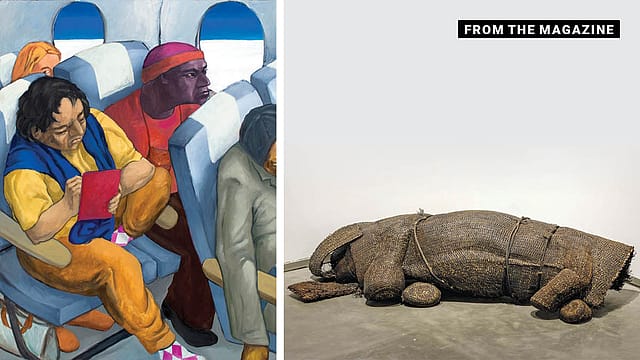
The New Delhi-based Vadehra Art Gallery is displaying works by Nalini Malani and Sudhir Patwardhan—two artists who call Mumbai home. For nearly half a century, Patwardhan (77) has obsessively and empathetically depicted the everyday lives, struggles and experiences of the common Mumbaikars. One of his newer paintings, Sketcher on a Flight, will be on view at the Vadehra booth. “It is inspired by an actual sighting of an artist busy sketching on an iPad on a flight that Sudhir was on,” shares Roshini Vadehra, the gallery’s director, who is equally thrilled about showing two landmark paintings by Malani from 1970 rarely seen by the public. Originally exhibited at Pundole Art Gallery in 1971, these predominantly abstract compositions depart from her usual practice. “At the time, Nalini lived in the same neighbourhood as VS Gaitonde and parallels can be drawn between their use of forms, textures, and shapes,” explains Roshini. She adds that while Gaitonde’s abstraction veered towards idealism, Malani’s conveys “a dystopian sensibility”.
Another New Delhi gallery, Shrine Empire, is attempting to give fairgoers something more than the typical fair with its booth divided into two parts. A show titled Bearing is an entirely monochromatic experience, taking the colour black and its absence as a source of inspiration in one part. The second features a one-of-a-kind collaboration between lyricist Javed Akhtar and the brother-sister duo, Moonis and Baaraan Ijlal. Based between Delhi and Bhopal, Baaraan painted the series When No One Moves? in response to Akhtar’s Urdu couplets from his book Sabrang. Shrine Empire’s cofounder, Anahita Taneja, promises this is a “special project: where Baaraan’s paintings will hang in custom-made structures (designed by her and Moonis), with Akhtar’s searing lines “Woh cheekh ubhri, badi der goonji, doob gayi (The scream emerged, endured for a long time, and drowned)” as the guiding light.
Like Akhtar’s anthology, Baaraan’s work in When No One Moves explores urban angst, class conflict, personal loss and grief. This is her first collaboration with Akhtar though it has been years in the making. Her father Ijlal Majeed is a poet and she has always embedded his poetry—and words that of other Urdu greats like Mir Taqi Mir, Faiz Ahmed Faiz, Saadat Hasan Manto and Rajinder Manchanda Bani—into her work. “As children, we went to mushairas where my father recited poetry. At home, the weekly baithaks brought together poetry and prose, which were read aloud and discussed,” recalls Baaraan who will be in conversation with Akhtar and cultural theorist Ranjit Hoskote at Art Mumbai’s Speaker Series. “What makes this collaboration particularly compelling is how poetry and painting enter into a dialogue, each offering a different way of witnessing and understanding the world around us,” observes Anahita Taneja.
Among international galleries, Perrotin, Richard Saltoun, Night Gallery, Rizq Art Gallery, Niru Ratnam and Rajiv Menon Contemporary are all set to make their Art Mumbai debut. Leading players like Lisson Gallery and Galleria Continua, which have participated previously, are returning to deepen their engagement with Indian art and expand their collector base in the local market. “There is a palpable sense of possibility in this region,” acknowledges Ellie Harrison-Read, the London-based director of Lisson Gallery, which will showcase works by Anish Kapoor, Christopher Le Brun and Tony Cragg. She adds, “Beyond market growth, what feels exciting is the increasingly international outlook of India’s collectors and institutions and the dialogue this creates across different practices.”
The Sculpture Park is being billed as a major highlight. Themed Material and Memory, it will include installations by artists like Divya Mehra (a sculpture shaped like an oversized plastic takeout bag), Sakshi Gupta (an animal twisted into a carpet) and Teja Gavankar (two ter racotta cones inspired by Vedic philoso phy). “The material itself becomes part of the conversation—what it carries from the past, how it is transformed, and what new meanings an artist can give it,” says Art Mumbai cofounder Minal Vazirani.
Last year, A Tyeb Mehta retrospective held in collaboration with the Kiran Nadar Museum of Art (KNMA), Saffronart Foundation and Tyeb Mehta Foundation earned rave reviews especially for its curation and scholarship. This year, KNMA has joined hands with Saffronart Foundation to spotlight the pivotal contribution of women in vernacular art traditions. Voices from the Earth: Women, Nature, Power, as it is called, will examine “how these artists reinterpret cultural memory and negotiate their relationship with the world,” according to Vazirani.
There is a stronger focus on foundations, with KNMA, Saffronart Foundation being joined by others like the Dabriwala Foundation of the Arts, Chennai Photo Biennale, WWF-India, Dot Line Space and The Cycle. For instance, the Dabriwala Foundation is unveiling its storied family collection, which includes highly valued works by Gaitonde, Akbar Padamsee, Ram Kumar and SH Raza. With its nocturnal palette, Raza’s Congo from 1965 is worth looking at and so is Padamsee’s Rouen, a fine example of his Parisian years in the 1950s-60s.
The collection was started by Rajendra Dabriwala in the 1970s, initially focusing on the Bengal School. His son, Surbhit, deeply interested in Indian and South Asian Modern Art, brought his own taste to the legacy. Today, the foundation’s mission is to place these works at the core of art education and help reshape a landscape dominated by Western art. “As a family, we have never collected just names and have always looked for fine examples of the artist’s philosophy and contribution to art history,” says Surbhit. “Launching at Art Mumbai lets us ask people to see these works as knowledge and not simply for their auction value.”
Art Mumbai was envisioned partly to encourage patronage and guide institutions and individuals towards amassing meaningful collections. Its goal is to become an annual hub—not just a marketplace—where cultural enthusiasts can gather, discover, understand and ultimately, invest in art. “We didn’t imagine how wholeheartedly the art fraternity and the city would embrace the event,” reflects Minal who has always felt that its emphasis on a friendly crowd, a passionate group of galleries, high-quality art, insightful conversations and a sense of camaraderie would make collecting feel personal rather than intimidating.
“A healthy art market needs more than sales,” argues the art world veteran, who is also cofounder of the auction house Saffronart. “It needs galleries that invest in artists over the long term, institutions that build knowledge and collections, transparent transactions, and opportunities for people to encounter art before they decide to acquire it.”
Art Mumbai 2026 runs from November 12-15 at Mahalaxmi Racecourse, Mumbai