In the Buddha’s Shadow
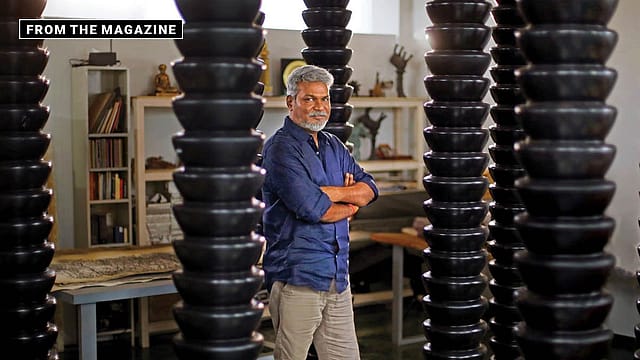
The Vessels of Absence stands in a corner of artist GR Iranna’s studio in Okhla, New Delhi —a distinct installation in a room filled with paintings. Dozens of empty bowls are stacked to make towering pillars connected by wires. Step into the network of pillars and Buddhist chants fill the air—sonorous and transportive. “Sound has its own form. I may not understand the chanting but it has a form,” says Iranna. It is the sound of emptiness, he says. “And I used begging bowls [the bhikshu patra traditionally used by Buddhist monks] to make the structure, which symbolises a renunciation of the ego. They are the pillars of renounced egos.”
Sound is one of Iranna’s new artistic experiments at Whisperings from Transcending Meadows, his new solo exhibition at Bihar Museum in Patna. Presented in collaboration with Gallery Espace, which represents the artist, the showcase comprises the artist’s recent paintings and sculptures contemplating the human condition at the crossroads of modern life, nature and spirituality. Weeks ahead of the exhibition’s opening, Open met Iranna at his studio where the exhibits were being prepared for their journey to the museum. Bihar Museum has been on a winning streak recently: it ranked ninth on the list of the world’s 100 best museums in 2026 by travel guide Worth a Journey, beating institutions such as The Louvre and Museum of Modern Art. For Iranna, it was the spiritual and cultural history of Bihar that made him agree to the proposal by Anjani Kumar Singh, director general of the museum. “I’ve grown up visiting ashrams, listening to scriptures and music, reading poetry—I find the same sensibilities in Bihar,” he says. “I have done a lot of work centred on Buddhist philosophy, on monks—so, I was excited when I was offered a show here because I’d been doing this over many years. For me, Bihar is the Buddha. It is the Nalanda. It is knowledge, culture, and power.”
These qualities are also the questions that frame Whisperings from Transcending Meadows. Revisiting many of Iranna’s signature techniques, materials and motifs, while adding experiments and interventions to the mix, the exhibition—and its title—draws from the verses of 12th century Kannada poet Allama Prabhu. It invokes the concept of bayalu—the void—and a single blade of grass growing with it. Iranna reads out the poem in Kannada and its translations in English to explain this “vast emptiness” where life transcends maya, ego and superficial rituals. The exhibition hopes to evoke an experience of being and feeling one with the bayalu, a philosophical undertaking not anomalous for Iranna, whose art has often pondered the impermanence of life and referenced the spiritual as well as the natural.
Whisperings from Transcending Meadows continues this exploration, often examining the perspective of life beyond the human lens. Take trees for instance, whose forms and quasi-abstract interpretations abound in the exhibition. Trees held an intimate significance for Iranna long before he became an artist. “Trees were my life,” says Iranna, who comes from a family of agriculturists in Karnataka. “I grew up in the soil and I can still remember its fragrance, especially when the earth was wet. I grew up in the trees, climbing them, eating and sleeping on the branches,” he recalls. A particular memory remains of the mango orchards, where the trees with sprawling branches offered a canopy under which to sleep. It is perhaps that protective space Iranna evokes in the tangled mass and dense branches of the painting titled The Many in the One. In the sculpture A Fragile Balance, a branch standing on a concrete plinth is shorn of leaves, yet continues to bloom with flowers. The Wound in Reason is another sculpture, crafted from bronze PUC, where a tree trunk is split to reveal its ‘spine’—its inner life.
Or see The Witness whose strokes—painstakingly drawn, applied and layered—bring to mind the growth rings that mark the passage of time and the age of a tree. Inside Iranna’s studio, its fine painterly features are not the only aspects that arrest the gaze. It is also the sheer size of the work, a quadriptych that takes up the entire length and breadth of a wall and requires a minor entourage to mount it. It is massive and multilayered—revealing deposits of colour as one looks closer—reminiscent of what Iranna may have seen in the ancient El Árbol Del Tule (Tree of Tule) during a visit to Mexico a decade earlier. He compares the experience to witnessing something godlike. “This tree had witnessed wars, religion, people. And here it was, witnessing me—still growing and flowering,” he says. “What I saw there was not a tree but an aura.”
This is an exhibition in pursuit of auramaxxing its artistic subjects, be its trees or begging bowls, which appear in the sound installation as well as the painting, Flowers from Begging Bowl. Another leitmotif is the wooden khadau, also known as paduka and traditionally worn by monks in India. In an exhibition packed with large-scale paintings and installations, one of the largest is a wall made from wooden khadau, many burnt and decrepit. For Iranna, a wall has as many meanings as a tree—it can be both constructive and divisive, and it can also serve as a witness to history.
The khadau, which are also incorporated in the sculpture A Small Insistence, have been part of Iranna’s works before—appearing most notably in Naavu (We Together), a large installation that was showcased at the Venice Biennale in 2019. It is also another motif that anchors the exhibition in Buddhist philosophy. Take the paduka for instance; Iranna has brought this Buddhism item on his canvas on earlier occasions, seen in works like Bhikshu and The River of Red (both 2011). The Buddhist monk does not appear in figurative form in his new works, but the significance of their practice is repeatedly suggested. Apart from the begging bowl and the paduka, a series of works centres on scriptures. To create the ashen and golden effect on the verses portrayed in The Scream from Ethereal Poems, and emphasise the ephemerality of life, Iranna employed a technique of burning the paper.
Sites of spiritual significance, such as the Buddhist stupas of Bihar, and old monuments are also witnesses, holding the weight of time in their structures. As the artist says, visiting historical monuments, he can “hear the scream” of the building. His art is an expression of that scream. In the painting Lost Golden Stories in Ash, the bleak ashen surface of the massive monument occupying the canvas (rather, the tarpaulin) reveals a basecoat of gold.
Another prominent motif that reappears from Iranna’s practice across several works in the exhibition is the scaffold, the support structure used during the construction and repair of buildings. In What We No Longer Know How to Hold, Iranna scaffolds stupa and monument-like structures. In another painting, he scaffolds a tree. It is possible to see these structures and imagine the role of an artist—to build, repair and continue upholding the structures, ideals and knowledge that make our existence meaningful. Like the bayalu, the canvas is a wide empty space—ready to absorb and embrace the artist. Whisperings from Transcending Meadows asks us to consider the profusion that is revealed when we push the margins of life beyond the material and the illusory. In the series titled Mystic Poems under the Secret Ash, the concrete hue is but just a façade. The closer one looks, the more colours and layers become visible beneath the vast, grey spaces. There is fullness in this void.
(Whisperings from Transcending Meadows is on view till February 4, 2027 at Bihar Museum, Patna)