Building Blocks
Fuzzy white bushes of bui dot the sandy grounds in and around Kaner Retreat, a desert botanical resort situated in Dera village—a couple of hours’ drive from Jodhpur. The bui is nicknamed desert cotton for its fluffy floral spikes that are used as stuffing for quilts and furnishing. It also serves as fodder for animals and is a natural soil-binder. The akra plant, which leans against fences and trees, too has a multitude of uses. A perennial shrub with thick, fleshy, bluish-green leaves and lavender-tined flowers, it secretes a milky-white latex—the sap is poisonous yet also imbued with medicinal value when applied topically. Its pods can be processed into a thick yarn that is used to make clothing and blankets.
And then there is the khejri, the state tree of Rajasthan, which grows aplenty across the garden of Kaner Retreat and in the oran (sacred grove) that flanks the property. Many might recognise its pods, called sangri and used in local dishes but fewer might know that its bark has historically fed people during times of drought. So sacred is this tree that in the 18th century, when the Maharaja of Marwar ordered for the trees to be felled, the Bishnoi community led by Amrita Devi hugged the trees to save them. More than 363 members of the Bishnoi community lost their lives in what has come to be known as the Khejarli massacre of 1730—the precursor to the Chipko movement.
Contrary to popular notions, the desert has its own vocabulary of abundance. Its sun-scorched, windswept lands are homes to a staggering variety of shrubs, herbs and grasses—some bear flowers and berries, others are leguminous and many are fortified with thorns. But each of them sustains life in a region where conventionally-known vegetation is elusive and water is arguably more precious than diamonds.
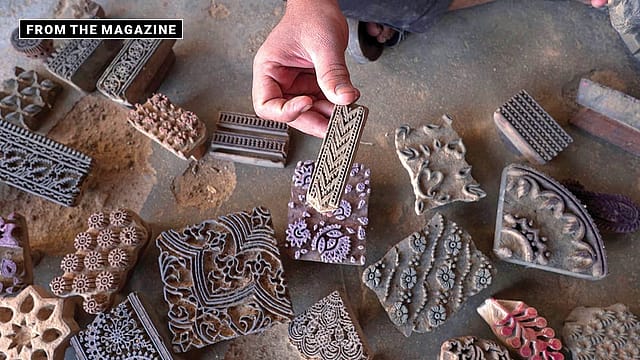
Intrinsic to local cuisine, culture and community living, these singular desert botanicals are the hero inspirations for the Marwar Block Print Revival Project—an ambitious undertaking to rediscover the hand-block printing traditions of the region. At the end of October, over a week, Kaner Retreat transformed into a venue for the first public showcase of the project. On display were archival designs, documents and botanical paintings, handmade wooden blocks and swatches of restored prints. The bui, the akra and the khejri appear along with other local species such as ker, sonamukhi and kheemp as well as more families plants like mango, marigold, methi (fenugreek) and poppy. These motifs have multiple variations, each unique to different communities living across the region. Beyond botanicals, the patterns also include animals and birds, human figures, geometrics and abstracts—the exhibits comprising a mere teaser of a project that assembles over 400 recreated prints drawn from contemporary hand block printing practices as well as designs that have been lost and forgotten for close to a century.

This is a textile project with deep roots in the region’s landscape and culture, says Madan Meena, artist, researcher and folklorist who leads the Marwar Block Print Revival Project. Over the past few years, he has pored through documents and archives, recovered designs from burnt and discarded wooden blocks and travelled through villages in searing temperatures to meet artisans and elderly community members to document historical prints that have been lost to time, changing markets and mechanisation. It is a memory-keeping project as well as an attempt to recreate them for contemporary use. “Today, we mass-produce block prints—a craft that was never meant for mass-production,” he tells Open. “We have simplified the prints and lost our artisanal skills. But these prints are our identity.”
An artist known for his contemporary—often cheeky—take on miniature art, Meena considers crafts as knowledge systems. “If a craft dies, a language dies,” he once told this writer who has followed his work and multidisciplinary projects over the past few years. Whether it is recording folk music, contemporising Kota textiles or mapping brooms, all of Meena’s endeavours are anchored in a deep engagement with traditional hand-making skills and folkloric traditions. It is an interest interlinked with his training as an artist, and the Meena community to which he belongs. Trained as a fine artist, he pursued his PhD from the University of Rajasthan on the “Art of the Meena Community”, focusing on the paintings and relief work seen in the facades and interiors of Meena homes. He showcased the art form at exhibitions, created by women from the community, and published two books on the subject.
These engagements brought him to the attention of the late Komal Kothari. A Padma Bhushan-winning folklorist and ethnomusicologist and his organisation Rupayan Sansthan - Rajasthan Institute of Folklore. Among other projects, Meena curated a display of indigenous brooms which went on to be exhibited at the Arna Jharna Museum near Jodhpur. Meena considers this learning crucial to his subsequent career trajectory. “My visits to the museum, and interacting with the folk musicians who used to come there and learning more about Komalda’s work changed my perspective. I went from being a painter towards research, and folklore became my area of interest,” he says. It was during this time that Meena had his first brush with block prints—adorn the cloth covers of old books. He went on to create similar catalogues and got an opportunity to work with block printers in Pipar.
Meena gradually diversified into other projects, including a documentation of the Tejaji Ballad, sung by the mali (gardeners) community of Thikarda. In 2013, GN Devy, the cultural activist, literary critic and academic who founded the People’s Linguistic Survey of India (PLSI) sought out Meena for a language documentation project in Rajasthan. He went on to join the Bhasha Research and Publication Centre, Vadodara (also created by Devy) and later became Honorary Director of Adivasi Academy, a research institute for indigenous knowledge in Chota Udepur, Gujarat. Here, he promoted the cultivation of cotton and indigo and also spearheaded the Kasota Project which revived a loinloom textile worn by Adivasi men in the area.
Meena continues to be a trustee at Bhasha Centre, and also serves as an executive member of Kota Heritage Society, which has envisioned the Marwar Block Print Revival Project. Meena’s knowledge of block printing traditions deepened during his years of research as well as teaching at the Indian Institute of Craft & Design, Jaipur where he worked with master artisans and communities to bring traditional knowledge into design learning.
The scope of the Marwar Block Print Revival Project is not limited to the printed cloth. “We recognise block printers but who knows about the block carvers?,” asks Meena. “Their contribution is equally important.” Blocks can speak even louder than textiles. “The first impression is the carving—the design says which region it is from. The depth of carving tells you how old it is,” he says. “The answer to who the block carvers might be lies in their handles. The shape of the handles and carvings on it could be used to identify the maker.” If a print is a work of art, so is the block and the handle bears its maker’s signature.
As part of his research, Meena has also collected several items of textiles. The exhibition included traditional skirts and safa (turbans) from rural communities, large jajam (floor spreads used for community gatherings and village panchayats), cloth bound books, odhnis and small textiles used as home. The project has mapped local geographies from homes to water bodies to learn how printing communities practices their crafts. It has traced languages and dialects to follow the journey of various designs between places and communities. Besides historical records and community engagement, Meena has also used resources such as British photographer Elizabeth Simson’s images of rural Rajasthan made over three decades to track vintage designs. The choice of Kaner Retreat as the setting of exhibition is two-pronged. Like Meena’s work, the resort is inspired by the region—its community live and unique bounties. Meena’s longstanding association with the property precedes the exhibition—he has also curated a collection of over 800 pieces of desert pottery for the resort’s Kaner Clay experience.
The project has come to be realised with grants and sponsorships from INDICA’s Centre for Embodied Knowledge (CEK), Samagata Foundation and Neo Foods Private Limited as well as the support of Kaner Retreat and Burgoyne Original Masters (BOM), the cultural patronage initiative by apparel brand Burgoyne. “We are rooted in textile heritage and material exploration which aligns with the ethos of this project,” Aparupa Ray Ganguly, curator and creative consultant for BOM tells Open. “Our aim is to foreground Meena’s work and give the project wider visibility. It’s a commitment to the textiles but also engaging with the stories, materials, inherited knowledge and craftsmanship of this heritage.” Victoria Singh, founder member of the Kota Heritage Society has also noted the importance of the project in “reconnecting traditional printers with global markets, creating the foundations for a genuine revival and new opportunities for younger generations.”
Reviving textiles is integral to the project but Meena dislikes being labelled as a revivalist. “I am a researcher,” he says, noting that his interest lies in bringing to light the small objects of monumental importance for village communities and common people. “In urban homes, a broom is hidden away,” he says. “But this is an object without which community life can’t exist. It is knowledge that deserves to be preserved and respected.”
This goal echoes the project. “I want to see designers to value these prints for their heritage as much as their beauty. These prints are as modern as the designs made today,” Meena says. “Printers stopped making these designs because nobody demanded them. The purpose of this project, and the publication, is not only to revive the designs but their intricate and complex recipes.” But Meena is also quick to note that for block print he has rediscovered, there are numerous others he has not been able to identify. As printing units closed over the last century, their origin stories have been erased. By his estimate, around 10,000 prints are entirely forgotten.
The Marwar Block Print Revival Project will be developed in a multi-volume publication of swatch books, texts and archival materials that will bring the designs into public domain. It will also credit the artisans who have worked on the prints—not only master craftspeople but also small practices tucked away in remote areas and villages. For Meena, the success of his undertaking does not lie in documenting the past. It is meant to be realised in breaking hierarchies and achieving what he describes as the democracy of design.