Riding into History
Howrah Bridge is rarely empty. Connecting Kolkata to Howrah city—and perhaps, more pertinently—the Howrah Junction railway station—it is one of the city’s most recognisable sights and always thronged with people and vehicles. It was no small stroke of serendipity when Ananth Padmanabhan spotted the yellow-and-blue taxi on the bridge on its own. Even the human presence was quiet, just a few pedestrians walking through the pavement. Padmanabhan clicked a picture, capturing the taxi speeding through the play of sunlight and the shadows cast by the cantilever bridge’s massive fixtures. It may have well taken him back to January 1998 when he arrived in the city—then Calcutta—for the first time and saw a “long line of yellow cabs” outside the railway station.
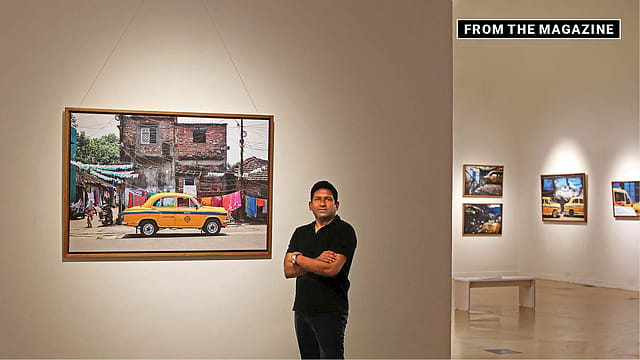
The photograph of the yellow taxi, so quintessential to Kolkata, was the protagonist of No Refusal, a recent exhibition of photographs by Padmanabhan who juggles his fulltime occupation as CEO of HarperCollins India and a writer along with a passion for photography. An exhibition of 32 images captured over decades, some as recent as this year, narrated a story of the Ambassador cars—originally black and tallow and then yellow-and blue—which the city adopted as its standard taxi. It is a visual documentation of a vehicle as well as the city it inhabits. “Calcutta is a million images happening simultaneously—wherever you look,” says Padmanabhan whose fascination with the car also comes from a longstanding interest in automobiles. Growing up in Chennai and then moving to Delhi, where he still lives, Calcutta “was a place encountered in books and cinema”. As his visits to the city grew frequent, the taxi became a character moving through the city—its bright yellow body creating a colour-blocked effect with the red, blue and green colours of the city, and adding a bright spark even in the squalor of a garage.
Padmanabhan followed the cars like he might chase characters in a book, from bust streets to tiny lanes, from day to night, from railway stations like Sealdah to popular haunts like Park Street. “As I started to follow the subject, every time I would go there, I’d try to find both Calcutta and the car in the context that everyday people would see it,” says Padmanabhan. “Also special was the drivers—the people for whom it’s a possession, a livelihood, and the memories of the people travelling through their cars.” A special display in the exhibition was dedicated to the drivers, clicked in and around Sealdah station, and Padmanabhan has promised to share the photographs with them.
A self-taught photographer, Padmanabhan clicks images everyday—using either a Canon camera or the smartphone—and has worked on several long-term projects. It was a casual experiment that gradually transformed into a more dedicated pursuit around the turn of the millennium fuelled particular by a project in Chandigarh. A friend of his, an interior designer and architect, was building a project in Chandigarh and wanted to mount some of Padmanabhan’s photographs in the space. Committed to offering the best images possible, Padmanabhan took a train and landed in the city to see the construction. “After I went there, I said that it doesn’t make sense to have pictures of mountains or mist in a building in Chandigarh,” he recalls. “I shot the building as it was coming up, recording its construction both in colour and black and white. It was a shift for me from amateur photography to doing a commission, thinking about a story and creating the work.”

The project, titled ‘Inside Out’ is on Padmanabhan’s website in both versions—monochromatic and high on colour. He has dabbled in several other image-making endeavours since. Ladakh was among his first major projects and his photographs were featured in NDTV’s SOS Ladakh Project and the Religare Arts Initiative Exhibition. His first solo photography exhibition was in 2012, two years before his debut novel Play With Me was released. Titled Calcutta: Walking in the City, the exhibition surprisingly presented not photographs of the city’s streets or scenery but the inner working of an offset book printing unit.
Kolkata has been the epicentre of many of Padmanabhan’s photographic undertakings. No Refusal draws its name from the signage on taxis, which in itself is a somewhat ironic statement; as local residents and serial visitors will testify, the city’s taxi drivers will turn down potential rides without a moment of hesitation if it doesn’t suit their plans. Padmanabhan finds in the statement a similar juxtaposition—a city that itself refuses to change or bend to the will of anyone else. The exhibition featured photographs clicked across a number of neighbourhoods and occasions—positioned near Kali temples and idols of Durga, zipping through the dark or parked next to old, derelict buildings. Drivers peer from their seats, some smiling others curious. One got what Padmanabhan calls the “Mona Lisa” treatment, mounted on a red panel—not the car, but a close up of its taillight. Padmanabhan notes that it is not a crop but deliberately composed to turn attention to the component. As Padmanabhan mentions, a car enthusiast can identify a vehicle simply by its lights. “As I was doing the edit, I thought I needed a portrait. I wanted a small print and an ornate frame. I wanted to show that it can be made beautiful. For those who think it’s just a car, it’s not just a car. It means so many things to so many people.”
Some were spur-of-the-moment photographs and some were a labour of time and love. In one photograph for instance, he framed a taxi passing the statues of two icons—Gandhi next to Sheikh Mujibur Rehman—on a street close to Sealdah railway station. “I went to Sealdah because I wanted to see the taxi drivers get together,” he says, recalling that spotting the statues, he decided to spend some time at the site and make a few images.
These taxis, once so integral to Kolkata’s image and its way of life, are steadily disappearing from the streets. As with other cities, app-based taxis and newer modes of transportation are taking over. A single photograph in the exhibition swapped a yellow taxi for a white one, highlighting the loss of character that emerges when these vehicles are stripped off their colour. Padmanabhan adds that the exhibition was partly inspired by the fact that he sees fewer of the taxis with every visit to the city. “I thought it was a good time to remind people something that is such a cultural icon. You take this car out and Calcutta will be a little less Calcutta for me,” he says.
Padmanabhan says he might have a thing for yellow—the colour of not just the taxis but also the amaltas which he has photographed over several years. He also photographs wildlife and nature, though cities remain recurring inspirations. Apart from Kolkata, there is New York and Goa which he often visits. He hopes to make photographs of Mexico City one day. He photographs every day and builds longer projects over time. “You need to hold on to the things you want to get done,” he says, almost philosophically about adding photographs to collections as he gathers them through the years. No Refusal is a perfect instance of this long term commitment. Having mounted an exhibition, many have asked if the project will culminate in a photo-book.
Considering the fact that he writes and works in publishing, the question asks itself: how do his various pursuits inform each other? “All image-making informs each other,” Padmanabhan says. He observes that just as a novelist must add colour to a scene if they want the reader to imagine it in vivid detail, a photographer moves the audience into imagining the story lurking in a still image. “The greatest photographers are storytellers,” he adds. “Theirs is just a different medium.”