The Griefs of a Feminist
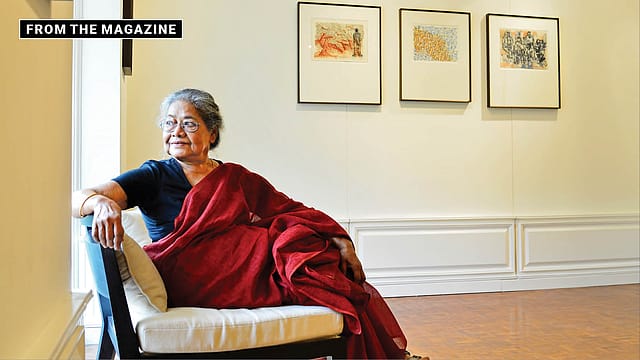
All works of art, whether it is a book, a song or a painting, are mirrors. In a way, the artist shows you the mirror and you see yourself in it.” These words by artist Arpita Singh, who died at the age of 89 on November 9, poetically define her singular practice. Through a six-decade career, Singh cemented her place as one of India’s foremost women modernists. A pioneer in her field, Singh won many awards and accolades—including the Padma Bhushan and the Lalit Kala Akademi Fellowship—and was one of few women artists from India to gain widespread recognition around the world.
Singh’s practice was divided in distinct phases, moving from figuration to abstraction to figuration once again. She also played with mediums, being equally adept at oil paintings, watercolours, murals, drawings and more. While she changed her modes and mediums more than once, the underlying message in her art remained steadfast: she was always a chronicler of the female experience of life.
The artist was no stranger to strife. Born in Bengal’s Baranagar in 1937, she moved to Delhi with her mother and brother in 1946 after the untimely demise of her father. She pursued a degree in Fine Arts at the Delhi Polytechnic from 1954-59, where she met her husband and fellow artist Paramjit Singh. They had one child, Anjum Singh, also an artist, who died in 2020, aged 53, of cancer.
It’s no wonder that Singh was preoccupied with human grief. Violence following Partition; the 1984 riots, which personally affected her as her husband belonged to the targeted Sikh community; the 2002 riots in Gujarat; wars around the world and more often played out in her evocative works. More pointedly, her works queried the effects of this wanton violence coupled with the weight of social expectations on women.

Over time, Singh developed a unique artistic grammar, creating vibrant and vivid oil paintings with strong narrative arcs, influenced by the Indian miniature tradition. Her use of bright colours and packed visuals covering every inch of the canvas added a layer of surrealism to her work, with humour and conflict placed hand-in-hand.
Some of her most famous works include Devi Pistol Wali (1990), where the protagonist dressed in a widow’s sari channels Mahishasura Mardini standing atop a slain man and wielding objects in multiple hands. Some bear the fruits of the Earth—a mango and a flowering plant. Others hold her veil in place above her head to display her demureness, and in one, a pistol is pointed at a man holding traditional weapons of war. Above, airplanes shoot down flowers as bombs. It’s the best example of Singh’s prowess in depicting the soft and strong sides of women.
Another famed work of hers is My Mother, painted in 1993, during the phase when India’s economy was undergoing a transformation through privatisation. It was also the year Mumbai was aflame with communal riots. The stern maternal figure here looks upon disapprovingly at the paraphernalia of a consumerist nation. Slain bodies in white shrouds, lined up in a row, stand out amidst the excess.
Her 2019 work, Is There Any Other Way to Return Home, depicts two women attempting to cross a road upon which convoluted symbols and daunting instructions appear. There is a grave sense of confusion in the scene, as one woman covers her face, perhaps feeling the futility of attempting to find the right path, while the other consoles her. The roads upon which they stand—and the surrounding areas—are awash in bright pinks, while the figures are clad in drab tones. The colour choice highlights the destitution of the protagonists as well as their stoic resilience in choosing to move forward even as they remain caught in the margins of history and memory.
The common thread in all these works is the female point of view. Through her women, Singh was unafraid to touch upon grave socio-political realities, while giving voice to her spiritual longing for rootedness. She often incorporated letters, numbers and texts in her art, to depict her love of reading and cultural nuances. Her technique of layering and building the narrative created a heavy, textured effect on the canvas, adding tension even as her choice of vibrant colours reflected joy and positivity.
A variety of factors influenced her art, including an early stint at the Weavers’ Service Centre in New Delhi and the Cottage Industries Restoration Program, which brought her in close contact with the textile industry and the prodigious skill of the weavers. Bengali folk tales played a strong role in her style of presentation after the 1990s. Singh also credited her husband with teaching her the use of colour to stellar effect.
As a founder member of the artists’ group ‘The Unknown’, she made a mark in its first show held in New Delhi’s INS Building in 1962. She was also part of the famed quartet—including contemporaries Nilima Sheikh, Nalini Malani and Madhvi Parekh—that gave voice to the Indian female art canon from the 1970s onwards.
Singh’s life work was presented in two sweeping retrospectives. The first, Submergence: In the Midst of Here and There, took place at the Kiran Nadar Museum of Art, New Delhi, in 2019, and the second, Remembering, was at London’s Serpentine Gallery in 2025. The latter introduced her distinctive practice to a wide audience and proved to be a prescient swan song to an artist who most assuredly left a mark on the sands of time.