Kochi-Muziris Biennale: Inside Ibrahim Mahama’s Parliament of Ghosts
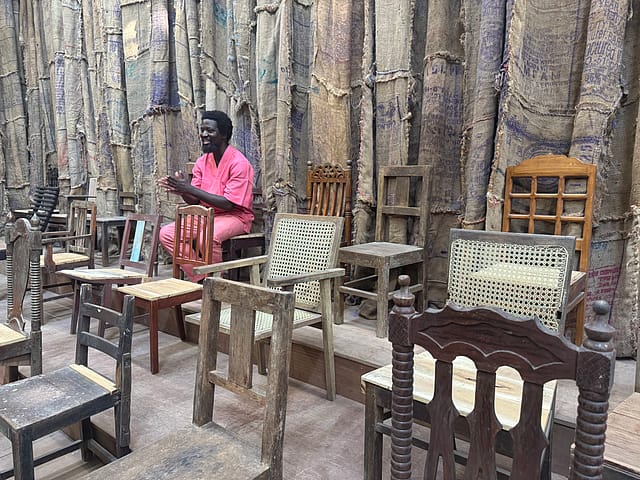
At the Kochi-Muziris Biennale 2025, Ghanaian artist Ibrahim Mahama transformed a hall at Anand Warehouse—an aging relic of Mattancherry’s mercantile past—into a Parliament of Ghosts, enclosing the space with towering walls of stitched jute sacks and arranging salvaged wooden chairs into a stepped arena for gathering, listening and collective presence. The sacks, sourced locally and bearing the stains, stamps and scars of trade, formed a dense architectural skin that carried with it the histories of labour, circulation and extraction embedded in everyday materials. Within this enclosure, the work functioned less as an object than as a civic instrument: a place designed to be occupied, not observed, where visitors were invited to sit, wait, speak. On December 13, Mahama, who had been in Kochi for weeks to oversee the project, delivered a public talk within the installation and took questions from the audience. An edited and abridged version of that conversation is reproduced here:
When we began thinking about this project, the first and most basic question was access: how do we access the material, and where does the material come from? For me, it was important not to ship something in from elsewhere, but to work with what already exists here. The material had to come from this place, not be sent to it.
That decision immediately opens up larger questions—about circulation, about labour, about why certain materials exist where they do, and who moves them.
To understand why I work with these sacks, you have to look at Ghana’s economic and colonial history. Cocoa was introduced in Ghana in the late nineteenth century, and by the 1870s it had become one of the most valuable commodities in the region. Ghana quickly became one of the world’s leading producers. To support this extraction, the British built railway systems that connected cocoa-growing regions to the coast. The sacks used to transport cocoa were pushed along these lines, taken to the ports, loaded onto ships, and sent to Europe. These routes were part of a much older network of trade and violence.
The Abandoned Kejriwal
01 May 2026 - Vol 04 | Issue 69
Brain drain from AAP leaves Arvind Kejriwal politically isolated
If you look at the forts and castles along the Ghanaian coast you begin to see how deeply material movement is tied to empire. According to archival records, even the stones used to build some of these forts were quarried in Europe and transported to Africa as ballast in ships before the transatlantic slave trade fully expanded.
So when I think about sacks, I don’t see objects. I see transport systems. I see logistics. I see how materials carry histories across oceans.
Between the late nineteenth century and the 1970s, the British also constructed Ghana’s railway infrastructure. Indian labourers were brought in to help build these systems. The railway workshops that emerged became some of the largest industrial repair hubs in West Africa. But their purpose was singular: to maintain colonial extraction.
These are not abstract histories. We grew up surrounded by these structures. And as artists of our generation, we are constantly asking: how do we respond to them? How do we live among these remnants without pretending they are neutral?
Art gives us a particular kind of freedom—not just expressive freedom, but the freedom to think through material itself. To trace how objects move, how labour is embedded in them, how they structure everyday life.
Independence in Ghana did not arrive quietly. Kwame Nkrumah insisted on “Independence Now”, not independence “in the shortest possible time”. He understood that political freedom had to be tied to economic control: of land, of minerals, of infrastructure.
In 1948, returning African soldiers, frustrated by rising prices and British economic control, set out to present a petition, the British opened fire, killing protesters. Nkrumah was arrested. That moment ignited the independence struggle. After independence, Ghana invested heavily in public infrastructure—silos, warehouses, distribution systems. Many of these structures still exist today, abandoned or repurposed. They remind us of both ambition and interruption.
This is where the sacks come back in. In Ghana, jute sacks are imported almost entirely by the state. Individuals are not allowed to import them directly. They are used once—primarily for transporting cocoa, because of cocoa’s value on the global market. After that, the sacks are sold into informal economies. They reappear in markets, carrying rice, maize, charcoal. They circulate endlessly.
What interests me is that these sacks are everywhere, but their origin stories are invisible. They are global objects, but treated as local waste. When I began working with them as an artist, I realised they function almost like an extension of the community. Politics is absorbed into their fibres. They carry stains, stamps, smells, residues of labour.
That’s how the idea of Parliament emerged—not as a formal institution, but as a gathering of material, labour, and bodies. A place where politics is lived, not performed.
At Kochi, I was particularly interested in how this Biennale functions as a space run by artists, for artists. When I arrived and saw how students from the art college were deeply involved in producing the work, it felt important. The form matters, of course—but so does placement, collaboration, and process. At the Venice Biennale in 2015, I worked with new sacks dyed by local textile workers in Ghana because texture and colour were central to the work. Here, in Kochi, I didn’t intervene in the material at all. The sacks arrived carrying Indian histories, Indian labour, Indian marks. That decision matters.
Even where the sacks are collected changes the work. In northern Ghana, for instance, sacks are used longer and are weaker, more worn. In urban centres, they are replaced more frequently. These choices, made long before anything enters a studio, already shape the artwork.
Ultimately, this is about responsibility.
The questions art faced in the twentieth century are not the same questions we face today. The conditions in Gaza, Sudan, and elsewhere force us to rethink what art can do, and what it must do. We are not experts. But we are not neutral either.
Art remains one of the few spaces where collective labour, attention, and time can still be mobilised without immediate extraction. That is powerful.
So the question is not simply what we show—but how we organise ourselves, our spaces, our materials, our labour. What does this place mean to the people who enter it? What does it ask of us?
This space is open. It will host performances, conversations, experiments. If you have an idea for what this space can do, let’s try it. Testing is part of the process. That, for me, is what art still offers: a way to think together, materially and critically.