Moving Archives: Documenting Memory and Medium
A round clock with a gilded frame and a green face, without numbers or markings, but only two spiky hands like wings. An artwork depicting a golden-black circle against a black background made entirely of ghungroo beads. Stacks of staple pins made in the likeness of miniature skyscrapers and other towering metal structures. These were among over 50 artworks by 22 artists on display at the recent Moving Archives exhibition in New Delhi’s Bikaner House.
“This project was conceived as a space for dialogue around archiving and documentation within contemporary art and historical spaces,” curator Ranjita Chaney explained. The aim of the exhibition was an attempt at understanding contemporary art histories that are still in formation, and to open a dialogue to discuss the trajectory of Indian contemporary art archives. Co-curator Ruchika Soi added, “The purpose of Moving Archives was an attempt at safeguarding lived memories and cultural continuities that shape how we understand our shared histories.” The exhibition explored archival work and artistic practice, presenting the archive as a living system made up of constantly evolving ideas, materials, and memories. This is a concept the pair have been deeply invested in. Chaney mused, “While we worked over this exhibition for more than six months, even before we got the artists together, Ruchika and I have been discussing and exploring this subject in its totality for 20 years.”
Losing Memory
16 Oct 2026 - Vol 05 | Issue 42
The making of a medical and social emergency

Some of the artists examined how old heritage works are over time lost and distorted or carelessly made into mundane modern devices. A case in point was Nandan Ghiya’s work Fragments. A cluster of three flat rectangular wooden sculptures, reminding one of letterboxes, with floral motifs but with impressions of parking stickers, and ‘Area under surveillance’ notices scattered over them. It was an apt and atypical way of illustrating the process of time in urban areas. Ghiya explained, “These are fragments of heritage demolition and encroachment. Their pixelated shapes allude to the idea of our obsession with posting online while neglecting their physical abuse. In future they may only exist as a digital archive.”
There were also framed sketches by several artists on display, showing works in progress and ideas in formation. Soi elaborated, “Artists don’t always have the time to actually write what they see and plan, and say why they are doing it. We wanted to get into the minds of the artists, and archive how they come upon things. We want to see their personal journeys in previous and current works.” This highlighted that works in process, not just the final art, should also be archived.
The anti-clock installation by Shailesh BR, was given the name as it had only winged hands, and no numbers. It moved in the opposite direction of time. Another work by the artist was an illuminated installation showing ‘00:00 pm’, instead of ‘am’. This was a new way of thinking about time and how to record it.
Another intriguing collection was Vibha Galhotra’s 365 Days. It showcased a collection of small bottles containing water from the river Yamuna, and her notes on display over the period of a year. Galhotra explained, “It became an archive of time, contamination, and lived experience, where the river and image merge into a porous map of memory and transformation.”
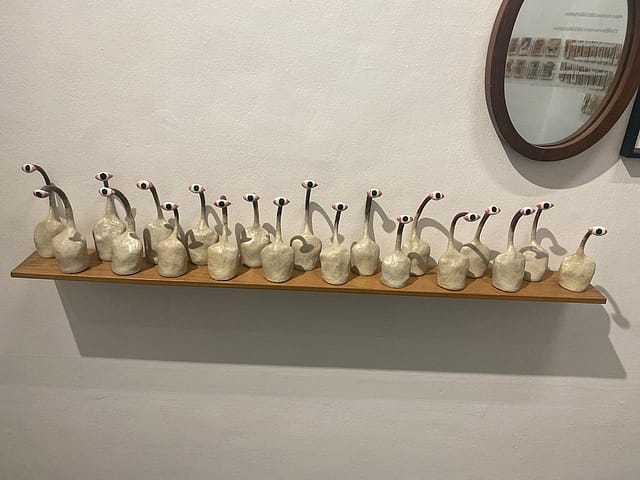
One of the more unnerving works comprised a procession of small papier-mâché sculptures, part of Preksha Tater’s The Silence of the Stare series, or ‘ghoodhna’ in Hindi. These were white structures, with long curving rods on which enamel almond-shaped eyes were balanced. The series was in response to the concept of staring. “The stare is very discomforting in any relationship or in general. We don’t realise it, but when people stare, the object of their gaze is silenced, even without saying anything the gaze silences,” explained Tater.
Archiving art and documenting processes take time and effort. However, as Ghiya said, “This process is extremely relevant to the timeline of contemporary art history and context building. It is also necessary to demystify art and understand artistic processes.” In addition to the exhibition, Moving Archives also hosted a symposium exploring the significance of documentation, the role of archiving in pedagogy and issues such as cultural preservation, intellectual property and the evolving role of technology. The panellists included Alkazi Foundation for the Arts curator Rahaab Allana, artist Arun Kumar HG and Eka Archiving Services co-founder Pramod Kumar KG as well as artists, scholars, policymakers and other experts.
(The recently concluded Moving Archives exhibition was on display until February 23, 2026, Bikaner House, New Delhi)