A Day With A Designer Anita Dongre: Threads of Inheritance
THERE ARE TWO ingredients to a good fashion show: design and drama. Anita Dongre knows how to blend both into a feast for the senses. In January, the designer and her team transformed the lush gardens of Vadodara’s Lukshmi Vilas Palace into a venue for the second edition of Rewild, a fundraiser-meets-fashion show presented by the brand to showcase its new collections while also facilitating patronage for animal welfare and biodiversity conservation. The palace, the world’s largest private residence and still home to the Gaekwad family which once ruled the state of Baroda, loomed in the background as models walked down a curving runway to original music performed by Mooralala Marwada, Karsh Kale, Raja Kumari and Monica Dogra. Urmila Matondkar and Dia Mirza and sat front row along with Radhikaraje Gaekwad, who co-hosted the show with Dongre, and a host of other guests from the city and beyond. It was the culmination of a day-long spectacle where guests toured the grounds, soaked in the sights and sounds of the palace, including a jaw-dropping collection of Raja Ravi Varma’s paintings, and attended talks and a fundraiser brunch.
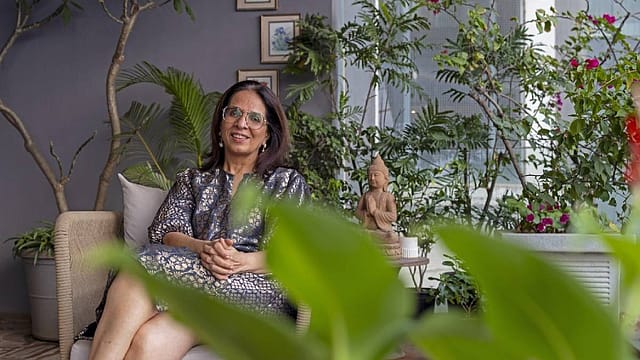
The showcase took months of planning and final days of incredible contingency management. As hundreds of guests, models, cast and crew poured into Vadodara for the show, Dongre and her team found their way out of cancelled flights, massive production requirements, last-minute delays and all the paraphernalia of a destination fashion presentation. “It took blood and sweat,” says Dongre, a few days after the show when she is back at work in Navi Mumbai, where her brand is headquartered. It is a calm setting compared to the days preceding the show, which she describes as a minor warzone—though having seen Dongre in the hours before the show, her steady demeanour would have belied the frenzy behind the scenes. “But once you do the show and it all goes well, you feel it was all worth it. It feels wonderful,” she adds. “The team gets excited and happy—it’s not just me but the entire team that does this. Seeing the joy on their faces gives me more joy than anything else in the world.”
Dongre has rarely been daunted by a challenge, not even when she started her eponymous brand out of her balcony in 1995 with a design degree from SNDT University, two sewing machines and unfettered ambition. Living in Mumbai, had grown up watching her mother sew clothes but fashion was still a young ecosystem in India and Dongre had little to no connection with it except the desire to be part of the industry. As the first woman in the family to pursue a profession, she found support in her siblings—a brother and sister—who helped her start and build the fledgling business. Jaipur, a city where she had spent many childhood holidays with her grandparents, became the inspiration for her very first collection. “I still have the very first clipping from a newspaper article that came out in the Sunday edition of the Times of India. I still remember how delighted I was with the announcement,” she recalls. A little more than 30 years later, Dongre says that not much has changed. “I am essentially the same person, with the same sensitivities and empathy. I am grateful that I now have a platform, but I also have a greater responsibility.”
Although Dongre has remained the same person, her brand has transformed into a fashion behemoth with multiple brands and extensions operating across different categories and price points. Even as she sharpened her eponymous label’s luxe vocabulary, Dongre went on to launch brands like AND in 1999 and Global Desi in 2007. Today, these two are among the country’s most well-known home-grown fashion brands with hundreds of points of sale spread across exclusive stores and large-format stores.
HER EPONYMOUS LABEL, and Grassroot—a sustainable, craft-based luxury brand she founded in 2015—are the heavy-hitters with a burgeoning international presence and a clientele that is nothing less than star-studded. Who wears Anita Dongre? Katrina Kaif, Priyanka Chopra, Shahid Kapoor, Ananya Panday and Shanaya Kapoor, as well as Mindy Kaling and Poorna Jagannathan. Kate Middleton, Beyoncé and Sophie Turner have also worn Dongre’s labels in the past. In tandem, Dongre has expanded her retail footprint beyond India. She opened her New York store in 2018 followed by Dubai in 2023. In late 2025, she turned her attention to Hollywood, opening a flagship store in Los Angeles’ Beverly Hills. The global impact is not just in terms of stores. When toy company Mattel launched its first-ever Diwali Barbie, it was Dongre who dressed the iconic doll—in a Moonlight Bloom lehenga set, miniaturised from her collection.

Dongre’s influence and clients may be spread across the oceans, but her heart and design grammar is deeply rooted in India. Traditional crafts and techniques recur across collections and garments, be it in a bridal lehenga or a mini dress. The brand’s line of Pichhwai art is among its signatures, along with gota patti, ajrakh, bandhani and kantha. For the Rewild 2026 collection, the brand incorporated macramé into designs for the first time inspired by the roots of trees—such as the 140-year-old banyan tree in Lukshmi Vilas Palace (which guests also visited as part of the showcase). Dongre has worked closely with SEWA (Self-Employed Women’s Association) for several years and the aari embroidery done by the organisation’s women artisans appears frequently in collections. With newer collections, especially Rewild 2026, Dongre is also focusing on younger fashion buyers with her designs. “I set out intentionally to be young and feminine, but I also wanted it to be easy because my vibe is always easy and simple. And yes, I definitely want to see my designs—the same designs—sell in Mumbai, Delhi, Los Angeles, New York or Dubai. As I travel across my stores, I see that, honestly, the consumer is the same. They appreciate what we’ve done and understand the emotion behind these clothes.” The collection also sparked nostalgia, of making clothes she would have enjoyed wearing as a girl in her 20s.
Dongre observes that much of what she is doing today bears impressions of the past—history, emotions, her belief system conflated with crafts, techniques and designs. Fashion is Dongre’s canvas, the maximalist expressions of a self-confessed minimalist. She rarely veers from a colour palette of neutrals, simple silhouettes and few accessories. She says that she has edited her possessions over the years to fit into a single wardrobe. In grand contrast, her brands abound in colours, embellishments and intricate embroidery. Design, as she says, is her gateway to the make-believe. “The more minimalistic I become, the more I enjoy doing what I do. I’m making beautiful art and craft for people to wear,” she adds. “But you notice a lot of simplicity too. I try to keep the designs very classic because I want them to be in a woman’s wardrobe forever; I want her to give them to her daughter.” Dongre often meets women wearing her archival designs and few things measure up to this satisfaction. “When somebody comes wearing something from a very old collection, it amazes me how timeless it looks and how fresh and relevant [it is]. I think that’s when I pat myself on the back and say: well done.”
DONGRE’S LOYAL CLIENTS also know that when they wear her designs, they embody her values. Her brands have gained prominence not only for their designs or business success, but for the robust values of sustainability and social good woven into the fashion house’s DNA. The Rewild shows are shining examples. The debut edition of Rewild, hosted in Jaipur in 2023, supported elephant conservation and highlighted the work of artisans who use the invasive Lantana camara weed to make their products, essentially curbing its growth. “We are just beginning and learning as we go along,” says Dongre, speaking of engaging with organisations such as Dasra and GivingPi to support grassroots engagement. “These are people I truly admire because they work on the ground selflessly. And I wanted their stories to be shared with the media, and with the world.”
Dongre and her team have also engaged with tree plantation drives, forest protection, setting up community tailoring units and working with women artisans to boost their livelihood as well as skills. The brands’ designs are cruelty-free, particularly accessories which use no leather, and spotlight natural materials. On an operational level, the company has invested in reducing energy consumption, wastewater treatment, textile and plastic recycling and several other measures. Fashion is both creative expression and a means of empowerment for Dongre. “Fashion is a platform that gets many eyeballs, and I think fashion can become responsible towards driving change,” she says. “When you wear something, are you not making a statement? Clothes do make a statement about who you are as a person, what you stand for, what you want and how you want to express yourself in the world today.”
At a time when Indian fashion brands and couturiers are inking corporate partnerships, brand Anita Dongre is family-run, still involving her siblings and more recently, her son Yash. Dongre has built her design practice in congruence with her business. “I learnt on the job,” she says, laughing that she has made enough mistakes to write an entire book about them. “There have been lots of ups and downs and every mistake is essentially learning.”
Creativity goes hand in hand with the responsibilities of running the business—of creating new collections, of feeding the many categories that comprise a brand’s offering, of ensuring the well-being of her growing team. Some days feel heavier on her shoulders, but those are few and far in between. All these years later, Dongre still thinks of work as her temple and her meditation. “There are two things that excite me: creating something new and being a designer in India. This country is so huge and there is so much more to explore that one lifetime is less,” she says. “I take pride in sharing what India has to offer with the rest of the world.”