Marina Abramović: I’m a Bridge
“There are so many different forms of art. Performance is one of the most difficult, the most immaterial, and the most real.”
–Marina Abramović
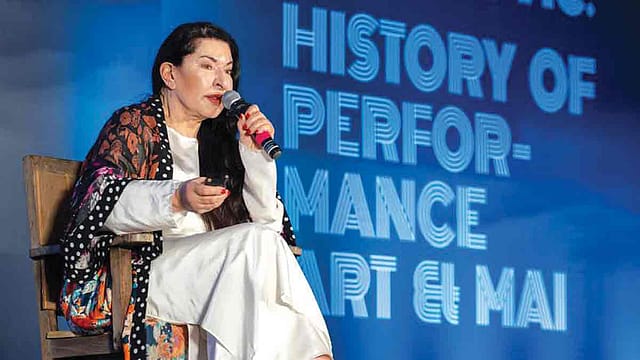
THE MOST INSPIRING and effective living legend of contemporary performance art, Marina Abramović addressed a packed audience at Willingdon Island auditorium—one of the venues of Kochi- Muziris Biennale (KMB)—on February 10 by invitation of the Kochi Biennale Foundation and curator Nikhil Chopra, supported by Meha Patel. Her workWaterfall is on view at the Island Warehouse on Willingdon Island. It engages deeply with space and its atmosphere with this cascading flow, which symbolises endurance and purification. It underscores Abramović’s lifelong exploration of stillness, intensity and human experience through performance and installation art.
Abramović was born in Belgrade on November 30, 1946, which at the time was part of Yugoslavia (today, the capital of Serbia). Her parents were part of the Yugoslav Partisan resistance during World War II, a background that later influenced her discipline and approach to endurance and performance in her artistic practice.
In Kochi, before beginning, Abramović invited the audience into a simple breathing exercise. Hundreds closed their eyes together, taking slow, deep breaths, settling into silence. For a few minutes, the auditorium seemed suspended in collective stillness. Only then did her lecture begin, accompanied by visual and audiovisual material tracing the history of performance art and the Marina Abramović Institute (MAI)—her artistic journey.
Her reflections on performance art, intuition, ritual and the spiritual dimensions of practice were deeply moving. During her time in Kerala, she spoke of the body as both instrument and portrait—every gesture, from head to toe, and the senses carrying meaning. Bridging the East and West, she reminded us that nature itself is a teacher and that art ultimately connects to spirit and inner transformation. It was not simply a lecture, but a shared experience; an invitation to slow down and reconsider how art touches life. She spoke about the works of Piero Manzoni in the 1960s through to MAI in 2026—six and a half decades of performance art history with values.
For the first time, I witnessed more than 1,100 people in Kochi sitting in complete silence, patiently waiting and peering through every available space, eager to experience a lecture by this living legend of performance art.

The Kochi Biennale Foundation eventually had to close entry as the event was completely sold out—not for exclusivity, but simply to manage the overwhelming crowd. Yet, those determined to attend found their way in and spent two intense hours immersed in Abramović’s reflections and work.
One unforgettable moment came when a silent documentation of her earlier performance with former collaborator and companion Ulay was screened. Suddenly, Abramović filled the hall with a piercing scream, recreating the intensity of that work. The audience erupted in applause, sharing a rare collective moment of memory and energy. It revealed how deeply audiences connect with performance as a living practice.
Across Fort Kochi and Mattancherry, the Biennale continues to transform the city into a living cultural map. Over time, the scale has expanded. This edition brings together 30 venues, including eight collateral venues, and numerous parallel spaces hosting diverse programmes.
The Kochi Biennale Foundation has embraced the wider creative community with remarkable openness. Most encouraging is the confidence shown by the public. Families return each edition, students volunteer, and communities feel ownership of the spaces around them. It is now an institution nurturing new generations of learners, artists, and cultural practitioners.
Another milestone has been the activation of Willingdon Island as a Biennale venue for the first time. As I arrived there, visitors from across the world walked the streets, many discovering them for the first time. An island once seen primarily as an industrial zone had suddenly become a cultural gathering space. To witness such joy and engagement with creativity in a new part of the city was deeply moving.
Inside the vast industrial hall, Abramović’s immersive work creates a meditative environment where sound and image merge across architectural scale. Visitors sit, walk slowly or lie down, absorbing the atmosphere. Chanting, stitched portraits and the sheer volume of space create an experience where time feels suspended, showing how art reshapes perception.
Following the Biennale opening in December, Abramović’s February programme drew audiences travelling directly from the India Art Fair in Delhi and from across the country and world. Nearly 80 years old, Abramović walked in with grace and held an auditorium of artists, performers, filmmakers, students and creative minds in complete attention. This is precisely what a biennale should do—bring the creative community together in a shared space where ideas circulate freely.
What stays with me most, however, is the love and generosity of people here. Even as roles change and individuals step away, the warmth of the community remains. A biennale initiated and shaped by artists, sustained by communities, has grown into something larger than any individual. The trust built with the people of this land remains its greatest strength.
The impact now reaches beyond Kochi. Many institutions and cultural initiatives across the state and beyond draw inspiration from what began here, attempting to build their own platforms for art and dialogue. When artists, communities, patrons, and organisations come together with commitment, cultural transformation becomes possible.
Moments like Abramović’s presence become possible only when the creative community stands united, strengthened by collaboration and shared vision, ensuring that art remains accessible, challenging, and alive. In the end, what we witness is not merely an exhibition, but a city learning to celebrate creativity as part of everyday life. Kochi’s streets, waterfronts and heritage structures now carry memories of encounters, performances and conversations that stay with visitors long after they leave.