Masters' Strokes: Rohit Chawla photographs India's finest artists in the solitude of creation
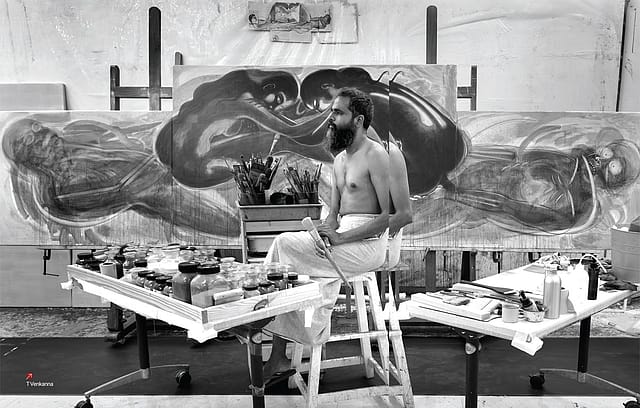
T VENKANNA IS A model of stillness. A paintbrush in hand, surrounded by paints and pigments, he sits in his Hyderabad studio looking away from the camera. Behind him looms one of his works of art whose intensity seems almost at loggerheads with its creator. Four figures locked in coitus—men splayed out, thrusting themselves into women who in turn sink into each other’s arms—evoke a scene where sex is the patina coating something far more violent. As with much of Venkanna’s sexually-charged art, it compels the viewer to keep looking just as much as it makes them want to turn away.
To Rohit Chawla, who made this photograph, the artist is a refreshing voice in a country squeamish about sex. “An artist like Venkanna surprises me with his humility and talent—the fact that a man living in a joint family, with very traditional parents in Hyderabad, creates the most wonderful erotic and provocative works,” he says. Venkanna is one of the 62 artists in Chawla’s new book, Portrait of An Artist (280 pages, `2,500), published by Mapin Publishing in association with Kiran Nadar Museum of Art. The culmination of a decade-long undertaking, which had Chawla slipping inside the studios of India’s most legendary artists and brightest emerging names, the book features more than 100 photographs with much of the accompanying text by writer and curator Kishore Singh.

Leafing through the book is akin to walking along a Hall of Fame gallery dedicated to Indian art. Think Amrita Sher-Gil, MF Husain, Anjolie Ela Menon, Manjit Bawa and FN Souza to Krishen Khanna, Arpita Singh, Nalini Malani, Atul Dodiya, Subodh Gupta, Jitish Kallat, Shilpa Gupta and Gigi Scaria among several others. The dizzying multiplicity of artistic practices finds common ground in the setting of the portraits— the artists’ studio. Each studio is as different as the artists themselves are from each other, yet there is a shared sentiment towards the spaces—a view of the studio as playground and sanctuary, as workspace and home. “For me, my studio is a place of meditation,” says Subodh Kerkar while Ganesh Haloi compares his studio to a garbhagriha, “a place where new life is born or created.” If Jagannath Panda calls his studio “a place of archival memory”, Nilima Sheikh defines hers as, “a place I go to feel peace with myself in some ways.”
Making a photograph with an artist is a distinctly collaborative endeavour. “Artists understand the visual medium so they will not let you do something they are not in agreement with,” says Chawla. “They are acutely aware of where they want to position themselves, and mindful of how I photograph them. There’s also a part of them that wants to be playful with the camera.” The studio is central to an artist’s practice and Chawla has worked to formulate a consistent visual language for the portraits while celebrating the individuality of every artist and their journeys. The results, he observes, are unexpected portraits, distinct from the profusion of airbrushed, highly choreographed photographs we see today, particularly of celebrities. “It often seems like a collaboration between the celebrity and the photographer in creating a synthesised fantasy of themselves. Whereas these artists’ pictures are real, and authentic—no makeup, no styling,” he adds. “The most important of my practice is authenticity. If I am lucky enough to capture the vulnerability in an artist, that’s a bonus.”
A SENSE OF intimacy threads the photographs, and a quest to capture what the studio and their practice means to each artist. Bharti Kher stands half hidden behind her canvases which are also turned backwards—offering nothing of what she is working on. A fitting image of an artist who calls the space “a place of wonder that holds all its secrets until it is safe for them to emerge.” Sudhir Patwardhan’s workspace is his refuge, where he stands at rest perched next to a painting of a figure sleeping. The colours spattering GR Iranna’s apron seem to spill out of the canvas behind him. Many artists frame their practice within their homely lives, such as Arpita Singh whose studio is separated by a bookshelf (she is a voracious reader) or Madhvi Parekh who has positioned her studio right next to the kitchen, canvas and paintings sharing space with a refrigerator—framing her practice within a homely life. A similar scene emerges in Jyoti Bhatt’s home, where he is photographed working on his dining table—it serves double duty as his studio.
Each portrait carries a story, and sometimes a story within a story. Take for instance, Krishen Khanna, one of the world’s oldest living artists who turned 100 last year. Chawla notes the privilege of having interviewed and photographed him in his centennial year. “He quoted Yeats and recited Chaucer, he sang a Punjabi song,” recalls the photographer. In the photograph, Khanna sits chuckling, surrounding by sculptures of bandwallas who have been recurring figures in his art. Tucked in his fragile hands, is an old photograph of himself and his wife—shot by Tyeb Mehta. Chawla’s portrait becomes a portal to Khanna’s inner life. “The camera hones the power to see more in a person or a situation,” says Chawla. “My photography stems from my need to trespass into a life and get to know the person first-hand—be it a politician, an author, a musician or an artist.”
Over the decades, Chawla has built an oeuvre spanning advertisements, editorials, the documentary and the artistic. There have been images driven by deadlines and commissions, and others made slowly and gradually— culminating in exhibitions such as Banned, Untangling the Politics of the Hair and most recently, Wanderlust or books such as the 2025 title, Rain Dogs. Portrait of an Artist is such a labour of love, shaped by curiosity as much as reverence. “I am intrigued by creative practitioners, and I (also) learn from them,” he says. He cites examples like Venkanna, who surprises him with his humility as much as his talent, or Shilpa Gupta’s ability to blend activism with aesthetics. “To qualify as an artist, you have to master a particular craft,” he observes. “Most of Shilpa’s works are political interventions, but she does it with a finesse and craft which I, coming from an advertising background, appreciate. I like things produced beautifully.”
In sharing these intimate stories and imagery, Portrait of an Artist makes a critical argument. This is Chawla’s endeavour to posit the value of art in times when its transactional aspects often make bigger news and the question of what constitutes a work of art offers increasingly amorphous answers. “The art business is the most diabolical business I know,” he says. “We talk about art being pure, but it has become relegated to commerce. Yes, there is great art, created by great practitioners, once in a while. But most of the business is media-pumped. This book is also my attempt to remove the chaff from the wheat.”