In the shadow of the epic: The Ramayana’s quiet witnesses take the stage
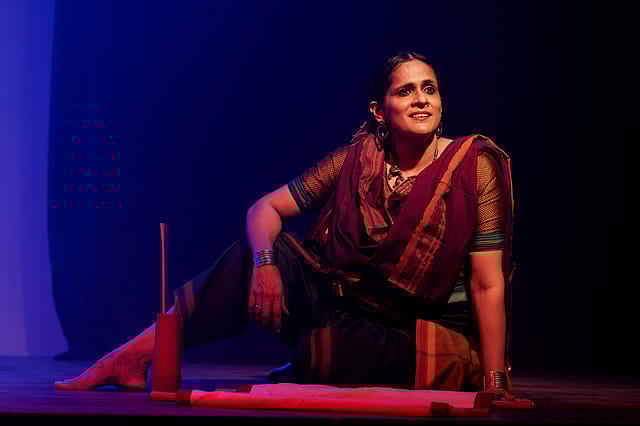
In the Ramayana, they stand just outside the blaze of the hero’s arc. A sister who is left behind without farewell. A nurse remembered only as the crooked whisper that altered a kingdom. A demoness reduced to appetite and mutilation. A queen who grieves after the fire has consumed her world. A counsellor whose wisdom arrives too early to matter. A daughter given away to a sage so destiny may proceed.
What She Said, written and directed by Gowri Ramnarayan, performed by Aarabi Veeraraghavan, Sunandha Raghunathan and Akhila Ramnarayan, turns toward these half-lit figures—Urmila, Manthara, Surpanakha, Mandodari, Tara, Shanta—framed by the Ramayana only in relation to fathers, husbands, brothers, kings. In Aham Sita, Ramnarayan’s earlier dance-theatre production with Priyadarshini Govind, Sita was at the centre of the story while Ramnarayan stepped intermittently into the lives of the women who surrounded her—Urmila, Ahalya, others whose presences flicker and fade in the epic. “I became fascinated by these women whose stories are so partially told or mentioned only very briefly in the epic.”

Losing Memory
16 Oct 2026 - Vol 05 | Issue 42
The making of a medical and social emergency
Take Urmila. When Lakshmana vows to follow Rama into exile, the text makes clear where his priorities lay: “In his mind there was nothing dearer, not even his wife.” Ramnarayan restores the human cost of that displacement. Her Urmila is scholar, dancer, archer, daughter of Janaka, yet perpetually “one step behind” Sita, the miracle child. When exile comes, Lakshmana does not consult her. Service supersedes marriage. The epic records the decision, the play records its afterlife.

If Urmila embodies invisibility, Manthara embodies infamy. Valmiki introduces her watching Ayodhya’s coronation preparations and positions her as the catalyst that turns Kaikeyi against Rama’s anointment. Before she speaks, she is described as “hunchbacked… crooked, sinful, determined upon evil”. In Ramnarayan’s rendering, Manthara is not a crooked whisperer but a political mind at work, fiercely loyal, parsing inheritance and promise in a kingdom that had already begun to betray its own vows. Rather than absolve her, the play contextualises Manthara.
Surpanakha’s case is even more revealing. In the Aranya Kanda she is introduced as “Kamarupini kamarta…virupa bhimadarsana”—able to assume forms, maddened by desire, deformed, terrifying to behold. Her sexuality is rendered grotesque before it is rendered dangerous. When Lakshmana cuts off her nose, the mutilation moves the plot forward but it does not provoke moral inquiry. Ramnarayan’s Surpanakha, who reclaims her name, Meenakshi, refuses the caricature. She reframes the forest as homeland, invoking her grandmother Tataka’s defence of territory. The violence done to her becomes not only personal humiliation but political trespass. “These Aryan men who pride themselves on being noble and great suddenly cut off her nose. That’s because she belongs to the Dhanava race, so it doesn’t matter,” says Ramnarayan. Yet Surpanakha eventually recognises that vengeance—the chain of events leading to Sita’s abduction—was not justice. She is a wounded witness and a belated philosopher.
What is striking about What She Said is not only who speaks, but how. The play resists spectacle. There are no elaborate sets. The structure relies on extended monologues, in the form of testimony rather than dialogue, stitched together by soulful live ragas by a young musician, Srividya Vadlamani. The music functions as emotional subtext, entering where dialogue would be excessive and silence too stark.
The epic’s action happens offstage; what we witness is the aftershock. Take Tara. In the Kishkindha Kanda, she counsels Vali against reckless combat, articulating what is prudent. He dismisses her. The duel proceeds. After Vali falls, Rama supplies the justification. Ramnarayan lingers in that fissure between insight and authority. Her Tara does not merely mourn; she interrogates—on fratricide, political opportunism, the moral alchemy by which an arrow loosed from concealment becomes righteous. Tara, Ramnarayan says, was her most challenging character. “What would her feelings be when Vali is killed by this great hero from behind a tree? And then he tells Sugriva he should marry Tara while he himself is trying to reclaim his wife from Lanka with Sugriva’s help. So he is endorsing doing what Ravana did, which was to take another’s wife. All those anomalies and strange paradoxes intrigued me.” Yet Ramnarayan is not here to judge the men. “I am looking at the world from a woman’s point of view. The Ramayana is an epic written with a male gaze.”
Mandodari is granted one of Ramayana’s most powerful laments. Standing over Ravana’s body, she recognises the root of his fall: “Nāsti kāmāt paro ripuḥ”—there is no enemy greater than desire. It is a line of devastating clarity. Yet it arrives after ruin. She diagnoses; she does not govern. Ramnarayan expands that moment into sustained interiority. Mandodari loves Ravana, warns him, understands him—and sees that he was undone less by Rama’s arrow than by the venom within. The epic allows her grief; the play frames the long ache of foresight ignored, counsel dismissed, catastrophe foreseen and yet unstoppable.
Shanta is perhaps the most radical reclamation. In the Bala Kanda, she appears only thrice: as Dasharatha’s daughter given in adoption to Romapada; as the young bride of Rishyashringa given in marriage to help end a drought; and finally, standing beside her husband when he performs the Putrakameshti sacrifice that leads to Rama’s birth. In the epic, Shanta exists to move destiny forward. In the play, she grows into philosophical clarity. When Rama meets her again, she speaks of action without attachment to outcome, of sorrow as the root of life. “The entire epic is about sorrow,” Ramnarayan says. “Not that men don’t suffer. But women bear greater suffering.” Shanta becomes the still centre of that insight.
What She Said does not dismantle the Ramayana. It does not demonise Rama. Even in his controversial, repentant appearance, he is rendered human. The play’s project is to restore interiority to those the epic names but does not dwell upon. To reveal how dharma, when narrated from one vantage point, can eclipse other truths. In doing so, Ramnarayan reminds us that it is a living argument. “Myth gives you a tremendous advantage,” she says. “You don’t have to spend time setting up the story or introducing characters—you can move straight to the point you want to make. And when you subvert something familiar, the impact is sharper. The shock is more powerful.”
The play is not austere in a forbidding way. There are moments of irony, flashes of wit, even sensual description. The tonal palette is wider than polemic. Lament, satire, longing, indictment, acceptance coexist throughout the play.
In many contemporary retellings of the epic, Sita becomes the obvious site of rebellion—a temptation What She Said resists. She is present everywhere, yet she does not dominate the stage. Through Urmila’s shadowed childhood, we see how adoration can eclipse a sister. Through Surpanakha’s humiliation, we see how Sita becomes the axis of male honour. Through Mandodari’s reflection, Sita becomes the catalyst that reveals Ravana’s fatal flaw. Through Tara’s scepticism, the rescue of Sita appears inseparable from the political alliance Rama forges with Sugriva. Through Shanta’s philosophical maturity, Sita’s suffering becomes part of a larger meditation on action and consequence. Crucially, the play does not deny Sita strength. The other women do not resent her as rival; they interrogate the system that turned her into an emblem of purity, honour and war.
The play suggests that epics endure not because they are fixed, but because they can absorb dissent without collapsing. These women do not overturn Rama’s story. They deepen its faultlines. They remind us that righteousness can coexist with collateral sorrow and that heroism can cast a shadow. And it is in that shadow that the epic finally meets its witnesses.
(‘What She Said’ will be staged at Bengaluru International Centre on March 8, 7pm-8.30, as part of a series of events for International Women’s Day)