In his centenary year, Satish Gujral’s works continue to resonate with contemporary zeitgeist
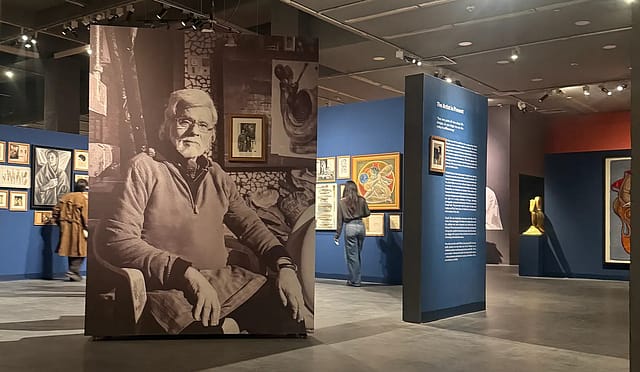
One cannot separate Satish Gujral, the man, from Satish Gujral, the artist. To say that art was merely a way of life for him—as it is for most creative people—is to diminish the overarching role of his artistic practice in defining who he was as a person. Yet Gujral didn’t consciously choose art as his vocation and profession. When an accident in childhood left him deaf and physically impaired due to acute osteomyelitis (an infectious bone malady), his father, Avtar Narain, sought to help his son find meaning and purpose in life. This happened first through books, and later through an education in applied arts.
It was a practical decision whose consequences surpassed all expectations. The sheer force of Gujral’s talent would make him a household name in India and an artist of renown in international circles. It earned him various accolades including the Padma Vibhushan. As son and co-founder/director of the Gujral Foundation, Mohit, puts it, “He was a true polymath—an artist who moved seamlessly across disciplines, scales and ways of thinking, guided by intellectual independence and emotional honesty.”

Zeroing In on ECI
09 Oct 2026 - Vol 05 | Issue 41
Constitutional legitimacy versus political opportunism
To celebrate the centenary year of his birth, a series of events are being organised across multiple destinations. The most sweeping is the multi-venue exhibition by the Gujral Foundation. Curated by Kishore Singh, Satish Gujral: A Century in Form, Fire, and Vision, has been brought to life in collaboration with the National Gallery of Modern Art (NGMA), the Ministry of Culture and the Government of India. It showcases dozens of Gujral’s paintings, drawings, sculptures, murals, personal memorabilia and more, paying ode to his seven-decade journey as an artist. Complimenting this exhibition is an architectural retrospective curated by Rhea Sodhi at The Gujral House, which was the artist’s home from 1970 until his demise in 2020, and is now open to public as a space for exhibitions, conversations and gatherings.

Other programming includes the book launch of Masterpieces at the Jaipur Literature Festival; an installation at the India Art Fair 2026; architecture and design showcase at CEPT, Ahmedabad; retrospectives at NGMA, Bengaluru; and a concluding exhibition at the National Museum, Chandigarh. A smaller, more intimate presentation of works was presented recently by RGAL | Raseel Gujral Art Legacy, in collaboration with Dhoomimal Art Centre, at Bikaner House, drawn from her private collection for acquisition, while HarperCollins India re-released Gujral’s autobiography A Brush With Life, originally published in 1997.
The NGMA Delhi showcase focuses heavily on the intermingling of Gujral’s life with his art. Mohit explains, “This exhibition was not conceived as an anniversary gesture or a market-facing retrospective. It evolved over several years and grew out of a recognition that Satish Gujral consciously chose to remain outside the commercial gallery system, preferring to work on his own terms across disciplines and geographies.” It begins with an immersive recreation of the river Lidder in Kashmir whose water flows fast and furious in a film clip played across four walls. Gujral’s voice in Hindi and English describes this location as the site of his fateful accident. One exits from here into neatly divided sections, each dedicated to a period of his life.
The first shows his early years spent at home and later at the Mayo College in Lahore. Here, Gujral’s classmates were orphan boys or those from a class quite distinct to his own, learning indigenous crafts to eke out an honest living. At first disdainful of and uninterested in the curriculum, Gujral later came to appreciate the value of this hands-on and multifaceted training, as it allowed him to experiment with material and medium uninhibitedly.
Mumbai (then Bombay) and its prestigious Sir JJ School of Arts was his next destination. Gujral found his voice as a painter here, honing this skill over the next decade, largely influenced by two key events. The first was the Partition of India, in which Gujral helped his politico father in the heavy task of evacuating Hindus and Sikhs from their native Jhelum, which fell in Pakistan, to the other side of the border. The human suffering he witnessed, matched his own quiet suffering, and the unbridled violence resulted in deeply moving, poignant works of art like Mourning En-Masse where groups of women hide their tears and turmoil behind their customary ghoonghats and an angsty self-portrait where his angry visage emerges from within skeletal remains. The inherent darkness and trauma of these paintings became his calling card.
The other key event was a scholarship to be an art apprentice in Mexico. Overcoming setbacks of political upheavals in the host country, and personal challenges such as his lack of prowess in English and Spanish, he fraternised with artists like Frida Kahlo, Diego Rivera and David Alfaro Siqueiros. This interaction gave him the confidence to experiment with ideas, mediums and materials, and earned him a reputation in India and abroad. Upon his return home, he made a series of famed portraits, such as the controversial one of Lala Lajpat Rai, on loan for this exhibition from the Parliament, and others of Jawahar Lal Nehru and Indira Gandhi.
He also met and married Kiran Gujral who would play an instrumental role in his life, as muse, fierce advocate and connect to the world. Love and happiness translated into a new series of works made in the abstractionist style, filled with colour and vivacity. These included large murals made with ceramic, stone and metal, on the walls of institutional buildings across Delhi and Punjab. While making these murals, Gujral often wished he could design the building to fit his artistic vision, ascribing to the philosophy of American architect Frank Lloyd Wright whom he met on his travels. Wright believed that good buildings didn’t need art to decorate their walls—they were alive with momentum, making them works of art in themselves.
Gujral felt the call of architecture despite a lack of formal training. When, against all odds, his designs were picked by a committee to build the Belgian Embassy in Delhi, he undertook it with zeal. Eight of his most famous architectural works, including the Al Moughtara farmhouse in Riyadh, Ambedkar Sthal in Lucknow and his own Solah Number Gujral House in Delhi’s Lajpat Nagar, are explored through photography, drawings, blueprints and write-ups at the Gujral House exhibition.
Alongside, Gujral continued to experiment with sculptures in unique mediums. The terrifying years of the emergency imposed by Indira Gandhi and the anti-Sikh riots of 1984 following her death, led to his burnt wood sculptures. The charred forms, which Gujral called ‘brunt wood’ were moulded into abstract shapes to showcase destruction. However, they were also adorned with tiny talismans like cowrie shells—a depiction of hope. Another pertinent time was around his cochlear implant surgery in the early 2000s, which allowed Gujral to hear. Though he later chose to have it removed, the period preceding the surgery filled with anticipation and the implant’s brief presence in his life resulted in colourful and vibrant art depicting sound visually.
Gujral refused to ascribe to artistic groups, never stuck to a signature style, nor pandered to the crowd. He sought extremities in texture, which he achieved by using unusual techniques like painting on rough textured canvases with manufactured acrylics, creating one-of-a-kind paper collages, or designing ceramics in his own kiln. This need for pronounced tactility in his work mirrored his personality, where feeling wasn’t restricted to mere sensory play—it meant immersion with all one’s being.
“He refused to be absorbed into any single discipline, ideology, or commercial structure,” says Mohit. “His hearing impairment was never a limitation in the conventional sense; if anything, it sharpened his resolve and heightened his sensory awareness. It deepened his engagement with form, material, and the human condition, demonstrating that what are often perceived as handicaps can lead to greater perceptual intensity and emotional depth.” His father, he adds, “trusted his inner voice over external opinion and worked with the conviction that fashion is temporary, and history is the ultimate judge.”
(SG100 | Retrospective Exhibition is on view at NGMA Delhi and the Architectural Retrospective is on at The Gujral House, New Delhi, till March 31)