Raghu Rai (1942-2026): India’s Visionary
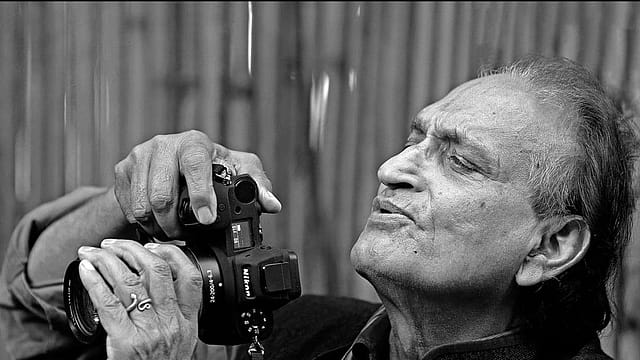
There was an old superstition that many cultures believed in the early days of photography. In the process of clicking a photograph, many believed a camera snatched part of the soul. Raghu Rai may have made sense of the idea, in a way that only a photographer could. “When I take a person’s portrait, I am trying to capture the aura of the person, the person’s spirit in the picture,” he had written in the foreword of his book, People (Aleph Book Company, 2016). “I am trying to get the truth of that person to emerge in the photograph.”
This intention recurred in Rai’s photography through a lifetime of seeing the world through a camera lens and a distinct eye. Take Indira Gandhi, for instance, whom he photographed from the early years of her first tenure as prime minister until her death in 1984. Gandhi’s power radiated in his photographs—gazing at the camera while surrounded by party workers, working late at night in her office gleaming in the darkness, and rising like a titan among the crowd upon taking back power in 1980. Or Mother Teresa, whom Rai met and photographed for the first time in 1970, human yet also deific, holding a child, or the Dalai Lama wrapping his shawl on his palace rooftop—a man who seemed to loom as large as the mountains behind him.
But Rai, who died on April 26 at the age of 83 from cancer, did not come to be seen as one of India’s greatest photographers simply because he captured the majesty of powerful subjects. He could also evoke the extraordinary in the everyman. One might recall his 1996 photograph at Mumbai’s Church Gate Railway Station, which became the stuff of viral content before such a concept even existed: three men reading newspapers, their aura of calm juxtaposed with the swell of crowds (Rai described it as a deluge) that passed them. He saw the intrinsic stateliness in a family of painters who had come to work at his home in 1980 and grit in the eyes of boatsmen in Kolkata in 1996. Photographer and curator Prashant Panjiar counts Rai, along with others such as Kishor Parekh and S Paul (Rai’s older brother) among the pioneers of photojournalism in India. “I always felt that he was a romantic at heart and deeply connected with an India that he loved and imagined. His style of making images was an epic way of storytelling.”

But before political and spiritual protagonist of Rai’s first photograph, clicked in 1965 after an adventurous chase around the village. Rai was 23 years old and trained not in any artistic discipline, but rather in civil engineering. Paul, his older brother, was already a photographer and Rai had borrowed a camera from one of his friends. The picture of the donkey appeared in the Times, London, and the young photographer made his way into newsrooms, joining the Statesman in 1966 as chief photographer and working there for a decade. This stint coincided with many of his early iconic photographs—from the corridors of power, at public rallies, in intimate moments, and at celebrations as well as grave tragedies. He also received accolades, including the Padma Shri in 1972 for his work on the Bangladesh war of the previous year. This was also the decade when his works caught the attention of French photographer Henri Cartier-Bresson who nominated him into Magnum Photos. Rai was the first Indian member of Magnum and the only one for many years (until Sohrab Hura’s nomination in 2014).
“Rai operated in the golden age of photojournalism—the press card era,” says photographer Asha Thadani, “a golden ticket that accessed the corridors of power and the epicentres of tragedy.” Thadani, whose works often focus on marginalised communities and denotified tribes, notes that many of the images of those years were made possible by the privilege of institutional access—to bear witness to the movement of power. “In the 1960s and ’70s, if you didn’t have that privilege, India wouldn’t have a visual record. Raghu Rai’s contribution was essential because he built the national archive when no one else could,” she adds. “If he hadn’t used that access, large parts of India’s post-colonial transition [the political shifts, the faces of leaders, the immediate aftermath of tragedies] would simply be a blind spot in our history.”
In the decades when Rai worked, during the late 1990s, photojournalism indeed thrived and ushered generations of significant image-makers. Photographer Pablo Bartholomew, Padma Shri recipient and winner of several photography awards, was among those who rose in prominence during that time. Bartholomew started as a photographer while he was still a teenager and came into photojournalism in the ’80s, working on several assignments with Rai and other contemporaries. “I came in at the tail-end of the golden years of photojournalism, which is when the magazines were flush with funds, when they gave assignments quite liberally—and there were many days to work on a story,” he says. “They invested in getting stories and keeping a photographer/journalist in the field for much longer so that complexity could be unearthed rather than just a representational image.” With different technologies and timelines, it was a different rigour. “You had time to think, to explore and to put out a layered image.”
PANJIAR, WHO WORKED with Rai at India Today, too, observes the privileges that allowed photojournalists to flourish and develop a strong body of work. “Magazines spent on newsgathering, they sent us to the field and they gave us space.” Having Rai helming the photo department was an added advantage. “Raghu had a larger-than-life status and that gave us clout as well. I was the youngest photographer but I’d get enough space because photographers had a certain kind of status. We were allowed to argue for our stories, fight for what we thought was right—we were in a very good time in photojournalism.”
By the turn of the millennium, photojournalism was beginning to change as their space in publications changed—and even shrank—as did opportunities for photographers working in newsrooms. Rai came to be known as a photographer whose work was akin to art and collectibles. “Even while he was a photojournalist, his photos were being collected,” says Panjiar. “People saw those as images they would like to have or hang on their walls. He had a certain status in journalism as well as an artist—even before the art gallery boom in India.”
Bartholomew notes that Rai mapped a distinct trajectory from photojournalism to gallery spaces because of his singular position, especially as department head at India Today. “The media machinery allowed him to work consistently on stories that were of interest to him. The books then came out of that.” Bartholomew adds that Rai expressed his voice through his books, beginning at a time—in the late ’70s and ’80s—when coffee-table books were highly coveted and many photographers created such tomes. “In Raghu’s case, I’d say that he probably overproduced. His early books were much more startling but it became formulaic and some of his later books became more of the same,” he says. “But if you see the sum total of his work, it’s an incredible body.” In the future, Bartholomew hopes that Rai’s works will continue to be studied—reassessed and reconsidered.
RAI’S BODY OF work—vast and touching upon a variety of subjects—has come to occupy a place of varying importance for different people. Thadani describes the photojournalism of that era as extractive but adds that “Rai’s contribution was taking this ‘functional’ medium and injecting it with a sense of poetry and soul. In an era where the distinction between a photographer and a photojournalist barely existed, he brought soft art into hard news. And that is his true significance.”
“Rai’s street photographs of a modernising India from the 1960s to the 1990s are arguably his most important works. They reside in our nation’s collective conscience as an incontestable testimony about the secular nature of its citizenry which has been eroding thereafter,” says Devika Daulet-Singh. “He was deeply interested in secularism as a practice and how it simply existed around him. He photographed a Muslim woman praying and the immersion of Durga with similar curiosity and attention.” Rai was among the artists and photographers represented by PHOTOINK, the photography gallery and publishing platform Daulet-Singh founded in 2001. She also co-curated, with Roobina Karode, the 2024 exhibition at Kiran Nadar Museum of Art titled A Thousand Lives, which focused on Rai’s analogue photography from 1965 to 2005. Daulet-Singh adds that he actively resisted any attempts to partition his archives, re-caption his images or other means of appropriation to serve sectarian interests. “He spent his life making visible the unseen, the ordinariness of life and drawing attention to the adjacency of different faiths without genuflection.”
Associated most often with portraiture, Rai also photographed landscapes and landmarks like the Taj Mahal, seeking out new angles and perspectives. One of his aerial photographs of the monument, clicked in 1985, caught MF Husain’s attention. According to an anecdote in Picturing Time: The Greatest Photographs of Raghu Rai (Aleph Book Company, 2015), he had asked then Air Force Chief Hrishikesh Mulgaonkar to arrange for him to fly over the monument with two men holding him in a harness-like arrangement as he clicked away.
He was rarely, if ever, seen without a camera but Rai also cultivated other hobbies which lent to his body of work. “Apart from taking photographs which was his life’s purpose and great joy, Rai was also an avid gardener,” says Daulet-Singh. He bought a piece of land outside Delhi to escape the cacophony of city life,” she says. “He spent his life bearing witness to the world and returned to Baliawas to put his hands to soil with saplings from those travels. He even planted a chinar sapling from Kashmir at his farm.”
Rai’s green thumb culminated in Trees, a 2015 exhibition and publication presented by Delhi’s Art Alive Gallery. “He captured vast expanses across the country and was keen to bring this body of work to life as an exhibition. He had already presented some works in monochrome from this series and wanted to exhibit this body of work in full colour. After many discussions and meetings, we finally decided to present it in 2015,” recalls Sunaina Anand, founder of Art Alive. “Rai viewed trees as silent witnesses to everything that has unfolded over time. For him, they were living monuments—the very soul of nature. He shaped a whole generation’s understanding of modern India through his powerful photography, and this body of work carries a similar strength in its quiet, contemplative presence.”
Rai’s legacy is also rooted in his ability to engage with people. In the hours and days after his death, social media was flooded with posts of younger photographers—some who had met him only once or never—speaking about Rai’s influence on their lives and work. “There are many photographers who take great photographs but there are very few mentors and teachers who people can connect with,” says Aditya Arya, photographer and founder-director of Gurugram-based Museo Camera. Arya had known Rai for decades since his uncle and photographer Kulwant Roy first took him to Republic Day shows in Delhi where Rai was among the photographers present. Arya still has the note Rai wrote in the visitors’ book when he first visited Museo Camera in 2021 (“Wah!!! Kya baat hai,” the note said) and says that he would often come to Museo Camera and interact with people, generously offering constructive criticism. “He would sit with youngsters and speak to them. He would not hesitate to express his displeasure but he was also full of encouragement.” At a time when photography is more common and casual than ever, Arya says that Rai espoused the importance of thinking before clicking. “His pictures are beautifully composed and visualised,” he says, with reverence. “In this part of the world, there was nobody quite like him.” ty and movie stars or common people on the streets