The Sky Is Not the Limit, says Subodh Gupta
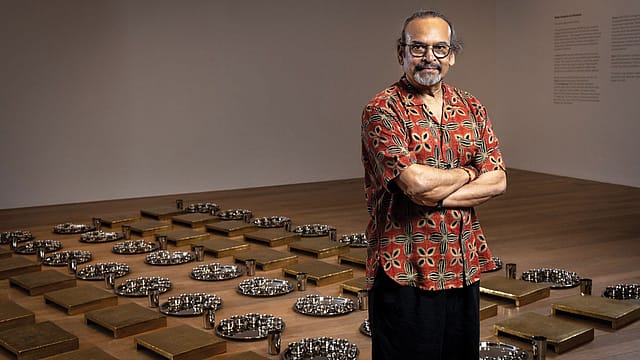
FROM HIS BEGINNINGS as a graphic artist at Nav Bharat Times in Bihar and early aspirations toward theatre, Subodh Gupta has gone to become an artist who has negotiated the distance between the everyday and the exalted, elevating one of the most ubiquitous objects of the domestic sphere, the steel utensil, into the language of contemporary art. In transplanting the familiar from the kitchen into the white cube, he altered the terms on which Indian material culture could be read as artistic subject matter.
With Ek Mutthi Aasman (A Fistful of Sky), his new solo show at Mumbai’s Nita Mukesh Ambani Cultural Centre (NMACC), curated by Clare Lilley and presented by Nature Morte, Gupta does not simply respond to this formative experience but rather constructs a narrative like of a storyteller, starting from childhood impressions to future aspirations, and playing with space and design. On how his early experiences formalised the exhibition, Gupta says “I spent five years in theatre, travelling to small towns like Jamshedpur and Rampur, performing with groups in those places. That experience really helped me understand people, human relationships, friendship, and the social networks we build around ourselves. The people who surrounded me during that time, and the time spent with them, all fed into what you see in this show.”
Lyrical in its reading, the title Ek Mutthi Aasman establishes the exhibition’s emotional tone before one has even crossed the threshold. Spread across four floors of Art House, NMACC, the show invites audiences to trace Gupta’s trajectory as one might follow a dream, the longing of a young boy gazing upward, willing into existence a life he has yet to live. His body of work unfolds with a structural logic, dissecting itself across distinct stages of memory, encounter, architecture, and lived experience.
EACH FLOOR OF THE show reveals a different stage of artistic exploration, and the exhibition, even with its large-scale works, does not lose its thread, nor do the works overpower one another. “I felt completely free to place my work the way I intended to,” says Gupta. It is that sense of authorial ownership that one feels moving through the floors, cajoling a reconstruction of memory and labour.
His work, School, spread low across the floor, is an installation of stainless-steel utensils arranged in front of a brass platform, a reconstruction of a local school classroom. It functions as both document and elegy; an ode to a younger self, to the textures of an ordinary Indian childhood that shaped the artist long before the world came to know him. “School is not only abstract, and not only about labour and ritual.” Gupta says “The work comes from memories of my childhood, sitting on the patla, eating meals together in my hometown. It reflects everyday moments of gathering, whether to eat or sometimes even not to eat, but simply to sit together. These small rituals, in celebration or in loss, are central to the work.
Placed next to it, Stupa, a floor installation of variable dimension rendered in old utensils of aluminium and plaster, calls forth not merely the aesthetic heritage of Buddhism, but the tradition of knowledge carried across centuries and geographies. One might initially read the work as a straightforward invocation of Bihar’s Buddhist legacy, Gupta’s native land and that biographical thread is certainly present. Yet the work refuses a singular reading. “The thought of the work came to me during my first visit to Ladakh. I saw many stupas across the landscape and was deeply struck by them, it felt like encountering an installation within the landscape itself. When I asked local people about their meaning, I learned that they are built in memory of someone, often holding a trace of their presence. That understanding stayed with me” he says.
“When I work with old aluminium utensils, I am working with objects that have belonged to people I may never know,” Gupta adds. “Some may still be living, some may have passed on, but something of their lives remains in these objects. For me, the work became a way of remembering, of honouring ordinary lives and finding in everyday objects something worthy of reverence.”
The idea of dream, shelter and memory has been an essential anchor to his artistic enquiry, an inkling of which you can witness at the second floor of the exhibition. One enters to find an installation of charpoys distributed across the space, shrouded beneath mosquito nets. The net is an object of modest necessity, a thin membrane of protection drawn over the sleeping bodies of those for whom it is the only available shield against the night. Here, Gupta retains that social charge while repurposing the net as a curatorial device: a gauze that partially obscures, that filters the gaze, and in doing so, transforms looking itself into an act of intention. The viewer must choose to peer inside. What lies within is memory, disaggregated and distributed across each cot with the associative logic of a dream. Grass. Broken stone structures. A tap with running water. An archival video, drawn from the artist’s early travels. Each element is discrete, yet together they compose a fragmented autobiography. Gupta does not narrate his past so much as he constructs its textures, inviting the audience to move between cots as one might move between recollections: slowly, non-linearly, with the awareness that meaning accumulates only in the aggregate.

The third floor marks another tonal and conceptual departure. Where the lower floors were governed by intimacy and autobiography, here the work expands outward, reaching toward the historical and the monumental. Three tall, freestanding sculptures in aluminium, mosaic and fibre glass dominate the space, their vertical presence reconfiguring the room. The works bear the unmistakable residue of architectural thinking; columns, pillars, load-bearing forms and carry within them an echo of Greco-Roman antiquity and animal figures like a moose and ostrich. Gupta arrived at these forms before ever visiting the sites that appear to have inspired them. He says, “I have never seen a moose in my life, and I think that says something about the world we are living in today, where we are so bombarded with digital images that you feel like you have already been somewhere you have never actually been. It is a strange feeling, of recognition without experience. So why not pick up the things I have never encountered, the things that have attracted me precisely because I have never been there?” The work, Kingdom of Earth is particularly illustrative in this regard. One face of the work is immediately recognisable as Gupta’s own, the accumulation of material that has long defined his language, while the opposing face surrenders to mosaic. The work stages a conversation between the artist’s established visual identity and something subliminal. Gupta’s interest here is not merely in ruins as aesthetic subject but in what ruins mean: the persistence of form after function has ceased, the way civilisations leave their trace behind long after their flesh dissolves.
Gupta reserves for last what may be his most formally inventive gesture. A kinetic installation, Faith Matters on the fourth floor, animated by a moving belt, assembles the familiar vocabulary of his practice into a work that refuses stillness. Rooted in Gupta’s longstanding interest in food and culinary history, the movement becomes a metaphor for the manner in which food travels across geographies, cultures and generations. The utensils and tiffin boxes are vessels of transit, carrying the histories of the distances, both physical and emotional, they have crossed.
“This show is really an extension of me and my mind. Everything that I observe, feel, the question of who I am, all of that comes into this exhibition. So, in that sense, this show reflects my current practice, of what I carry within myself at this point in time,” says Gupta. In Ek Mutthi Aasman, he resists the temptation to turn inward entirely. While the personal and the nostalgic provide emotional foundation, his gaze widens, reaching toward the global, the urgent and the unresolved. The exhibition unfolds with the structural logic of an opera, as a succession of scenes, each distinct in mood and preoccupation yet bound together. The four floors constitute different acts, each introducing a new emotional key, concerns and enquiries. Yet the whole remains unified, threaded together by experience and observation—much as one does not grasp an opera in its overture alone but in the fullness of its unfolding.