Remains of time: Discarded Material Finds New Life As Artwork
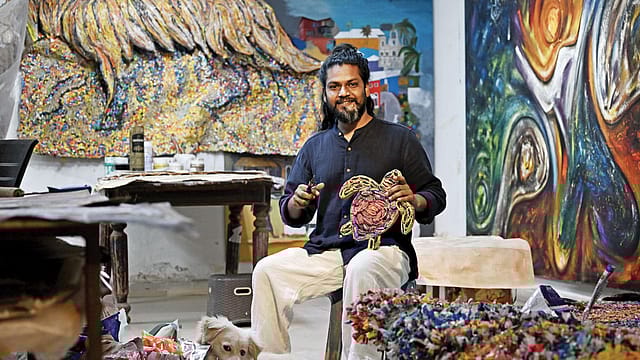
IDEAS OF RECYCLING and upcycling were deeply ingrained in the mind of Mumbai-based artist Smriti Dixit from childhood. If a set of clothes were outgrown, they would be passed along to a younger sibling, cousin or neighbour. Old bedsheets and tablecloths would be repurposed as napkins, dusting cloths or potlis to cart larger items around. Buttons, toys and other sundry items would be innovatively used in and around the house. “We never threw anything away. Everything could be brought to life for a different purpose and used again. Sustainability is a buzzword now, but it has always been the way of life in India,” she recalls.
To breathe new life and accord purpose to a discarded item is the mark of a true creator. No wonder then that visual artists are drawn to recycling waste materials, found objects and their own dismantled works. While Dixit finds her art meditative, Manveer Singh aka Plasticvalla, finds purpose in his practice. As a child, Singh never had money for store-bought toys and other items, so he crafted himself kites, clay cars and other objects. This hands-on approach made him an artist. In 2018, he began creating art from plastic when he learnt that ragpickers, who search dump yards for salvageable items, consistently overlook multi-layered plastics (MLP), which then accumulate in landfills. “This realisation impacted me deeply. No one wanted to touch this material that was contributing significantly to environmental degradation. I decided to transform these into art sculptures, compelling viewers to confront what society often ignores,” he explains.
Singh collects plastic waste through a hands-on, door-to-door approach in his neighbourhood, by distributing Habit Changer Boxes (created in his studio) to over 400 homes and segregating waste materials at source, streamlining the entire process. In transforming these works of art, he draws inspiration from how the art relates to the specific site, with local folk-art traditions, surrounding landscape, nature, architecture, and the space itself playing a large role. “I created a snow leopard to be displayed in Spiti Valley, depicted Himalayan griffon vultures and paragliders at Bir Billing, and represented an urban landfill-inspired landscape for Delhi in relation to the Ghazipur dump, which was titled Futuristic Earth Core and displayed at the Manekshaw Centre, New Delhi,” he explains. At the heart of it is Singh’s love of nature. From his first painted landscapes on canvas, art became an emotional outlet, a way to capture the beauty of nature. “Over time, that feeling transformed into a powerful devotion, inspiring me to give back to the environment,” he adds.

ON SIMILAR LINES are the practices of young artists like Anuja Dasgupta, Mrugen Rathod, Harmeet Singh Rattan, Sidhant Kumar, Lakshita Munjal, Vedant Patil and more. They recently presented their work at Bitter Nectar, the third instalment of the annual ‘Sustaina’ exhibition, brought to life under the leadership of artist duo Thukral & Tagra and in collaboration with the Council on Energy, Environment and Water (CEEW). The artists used untreated canvas and wood made from agricultural waste, and discarded towels and bedsheets sourced from hotel enterprises, among other recycled materials, to create works which brought attention to the effects of climate change on rural India.
A love of nature and its preservation also pushed Tara Lal, founder of the cultural platform Aranyani, to create a unique work of art. The Aranyani Pavilion, a sculptural structure, found a temporary home in the green environs of Sunder Nursery this February. Made with recycled Lantana Camara wood— the invasive wood species which now covers over 13 million hectares, threatening 44 per cent of India’s forest cover—this structure sought to contribute to forest restoration and biodiversity conservation. Jasmine, neem, tulsi and bakul adorned its borders to perpetuate the idea of a living landscape.
“Each element of lantana-crafted furniture or panel used in the pavilion is a testament to responsible design, where renewal and restraint replace excess,” says Lal. “This pairing of lantana below and indigenous plant species above is the Pavilion’s central statement—that through intentional repair, even what has been damaged or overtaken can regenerate; that land, when tended to, grows back. By using lantana here, the Pavilion makes visible the scale of this invasion and reclaims it.”
In keeping with the mandate for recycling, the pavilion and its parts were repurposed after the Sunder Nursery viewing. The main structure found its permanent home at The Rajkumari Ratnavati Girls School in Jaisalmer; the edible plants moved to the Gardens of Hope in Nizamuddin Basti, where a group of women run a network of kitchen gardens, and the remaining plants went to the environmental NGO, Swechha.
The idea of repurposing what is used and thrown, is also the main thrust behind the work of artist Mukesh Sharma. He began working with recycled materials in the early 2000s. “At that time, I was interested in exploring the interrelationships between technology, memory, and material culture, while also attempting to craft a distinctive visual language through layered and complex textures,” he says. Sharma now creates sculptures, installations and paintings using and inspired by e-waste, particularly computer and laptop keyboards. A noteworthy piece from his recent solo exhibition, titled Decoding Digital DNA, was a veiled curtain made entirely with keys from keyboards, with the occasional (and very rare) red key making a disruptive appearance between the sea of black and white.
Using recycled and old materials allows me to explore transformation, sustainability, and the relationship between the digital and physical worlds. Through this, objects forgotten by time reappear in a new conceptual context, with different forms and new meanings,” he says. “The process of hand-cutting keyboards—grinding them, arranging them into microscopic grid-like structures and collages, layering textures, and carefully reassembling them, almost like beads—became a site of constant experimentation. This process unfolds layer by layer with sensitivity and an awareness of mortality, just like the human body itself.”
DISCARDED OBJECTS CARRY traces of human use, data, time and labour, while simultaneously urging us to reflect on the state of the environment. For Sharma, this fascination is not with “discarded objects” alone, but with the questions they raise about technological memory, cultural meaning, human labour, and environmental impact, as well as the tension between tradition and modernity.
Sourcing the material is a common part of these artists’ creative process. It’s evident in Dixit’s focus on recycling her clothes and in Singh’s Habit Changer Boxes. Sharma also enjoys scouring through the collections of scrap dealers. Giving new life to discarded materials by reimagining their history and possibilities, creates a dialogue between the past and the present. As Sharma puts it, “Essentially, recycling in art connects memory, creativity, and environmental consciousness, offering the opportunity to bring discarded objects back to life in meaningful ways.”