In Arunachal Pradesh, a women-led restaurant is reviving forgotten Monpa recipes
The phursing gombu is a deceptively simple dish. Traditional to the Monpa community of Arunachal Pradesh, it is made of corn flour roasted on open flame and hand-shaped into a bowl. This edible bowl contains a dark liquid—an oleoresin extracted from the Chinese laquer tree, which is known as the phursing in the Monpa dialect and gives the recipe its name.
At Damu’s Heritage Dine in Arunachal Pradesh’s Chug Valley, the phursing gombu is a hero dish, among a host of other items that has brought the Monpa cuisine into the spotlight and on travel itineraries. Helmed by a group of eight women, the restaurant serves traditional and innovative dishes using local produce and has drawn a stream of tourists from around India and overseas to the valley since it opened last year.
Recently however, it was Damu’s that set out on a journey. In November, a small team from the restaurant landed in New Delhi for a week of popups and culinary collaborations—whipping up a tasting menu to accompany the cocktails at Sidecar, hosting a pop-up at The Kunj, and learning to make Japanese sando at the Shokupan. For Rinchin Jomba, head chef at Damu’s, the visit has opened up a world of possibilities. “I have enjoyed seeing and learning new things,” she says in Hindi. “We serve only lunch at Damu’s, but we learnt to make sandos and we could introduce something like it at breakfast.”

The Abandoned Kejriwal
01 May 2026 - Vol 04 | Issue 69
Brain drain from AAP leaves Arvind Kejriwal politically isolated
Jomba, who lives with her husband and daughter, has always been enterprising. “Before I joined Damu’s, I was also part of an SHG (Self-Help Group) and I started a homestay with their support which I continue to run,” she says. She has also, like many others in the village, worked in the farms. “A lot of corn and millet grows in the village, but we did not really know how to use it in meals,” she adds, recalling a cooking competition hosted by the Krishi Vigyan Kendra in 2023 for which she made millet momos—a first, she notes, for the village—and clinched the first prize. “Now we even serve millet tacos and pancakes at the restaurant.”
Food anchors the big changes Damu’s aims to bring in Chug Valley and in the lives of the locals. In recent years, Arunachal Pradesh has come into the radar of travellers due to events like the annual Ziro Music Festival and popular tourist haunts like Tawang. Indigenous to the state, the Monpa community has historically been engaged in farming and rearing livestock. Urban lifestyles have left their mark on the region where organic and foraged food have steadily made way for processed foods and concrete homes have replaced old stone houses. Farming practices, centred on barley, maize, buckwheat and millets, dwindled as farmers turned to more commercially-viable crops and forest lands began to be increasingly exploited.

Over the last two decades or so, WWF has been working in Arunachal Pradesh to enable Community Conserved Areas (CCAs), promote agroecology, and protect biodiversity. “Traditionally, until may be the last 30-40 years they were extracting forest resources sustainably,” says Nishant Sinha, WWF’s coordinator of community-based tourism in the area. In the present context, the use of equipment such as chainsaws leads to more trees being chopped and the overall demands of construction results in sand mining and excessive timber extraction.
“We are empowering the communities to become protectors or custodians of their forest,” Sinha adds. “And when we say that a community must preserve their forest, there needs to be some kind of financial incentives.” Eco-tourism often includes activities like nature walks and birding, but an initiative like Damu’s makes a multi-pronged impact—generating market linkages and livelihood for the community; creating a local business ecosystem; and bringing travellers to interact with locals, experience the culture and appreciate the value of conservation.
Largely cooked using locally-sourced organic and seasonal ingredients, a meal at Damu’s may include thukpa and soups; millet momo stuffed with meat or mashed potatoes; a corn pie with yak cheese known as churra gombu; buckwheat and millet pancakes; meat cooked with fresh ginger and butter; and dessi, rice fried with dried nuts and jaggery in ghee. Fresh produce abounds: water celery and Asian pears, red rice and millet varieties, ghee and butter made from yak milk. A salad incorporates oranges grown in the valley, their citrus flavour unexpectedly punctuated with popped corn and white kidney beans. The takto khazi is a handmade buckwheat noodle cooked with taro roots, water celery, fermented soybean paste and chillies.Its inclusion in the menu has revived buckwheat farming in the villages.
In creating the menu, the intention was to showcase Monpa cuisine not only to visitors, but also to bring it back into the consciousness of the community. The phursing gombu was among the traditional recipes unearthed during the process of setting up the restaurant—using a resin that is both rare and hazardous if extracted carelessly. Hardly practiced any longer, an old man is the only one in the village who knows how to procure it. Meanwhile, items such as tacos add a contemporary twist to the menu, developed through training and the mentorship of Guwahati-based chef and consultant Farha Naaz. “We don’t eat such a multi-course meal at home,” laughs Leike Chomu, Damu’s manager. “The women at Damu’s have been cooking all their lives. Chef Farah also showed them how to do plating and create fusion dishes with the ingredients.”
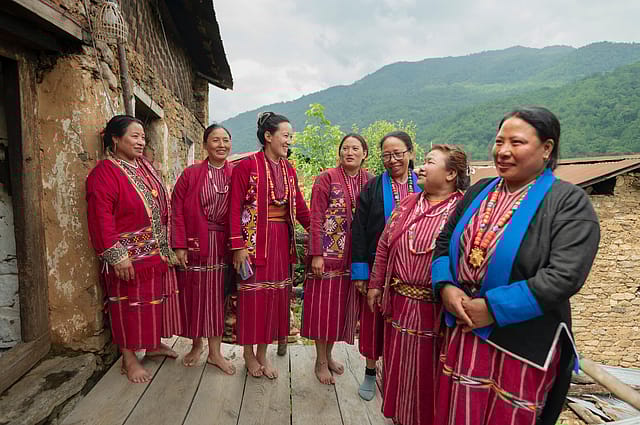
The lack of literacy among the majority of the team has not hindered their ambition or enthusiasm to learn—dressed up in traditional red ensembles, the women multitask as chefs, cultural custodians and storytellers who use food as a medium to narrate their histories and heritage. Sinha adds that the intention is to give the team more than just a nominal income. A lunch at Damu’s costs Rs1,500 per person: the restaurant has earned revenues up to Rs1.5 lakh in a month.Jomba adds that other villagers are happier with the attention the restaurant has brought to the valley. “We procure produce from locals and also retail some of the other items they make, such as baskets, at Damu’s so they can earn an income too.”
Baked into Damu’s culinary undertaking is also an endeavour to preserve other ways of being. The restaurant is housed in a 300-year-old house that belonged to Jomba’s parents. Once abandoned, the stone house is now decked up with traditional art and artefacts. Taking a leaf out of Damu’s, Chomu has transformed her own ancestral home into a living museum, displaying traditional serveware, earthen pots, baskets and bags, clothing and furniture many of which continue to remain in use. Visitors to the restaurant can make a detour to the museum for a deeper glimpse into the community’s way of life. “We are trying to show how they can adapt or convert their traditional homes into comfortable modern homes without trying to erect a completely new structure,” says Sinha, adding that these steps will strengthen tourism in the region as well.
As for Damu’s, the ambition is to hone the women’s skills and knowledge, and make them self-reliant through sustained mentorship. The event in Delhi has led to inquiries for similar popups in other parts of the country. If the women are keen to use such events to enhance the experience and dishes they offer at the restaurant, Sinha hopes to position the space at the heart of Chug Valley’s future. “We want to build Damu’s into such an entity in the next 10 years,” he says, “that if you are coming to Arunachal Pradesh and don’t visit the restaurant, you will be missing out.”