Desi Cringe: The spectacle of extreme wealth in ‘Desi Bling’ and the curious appeal of tasteless reality TV
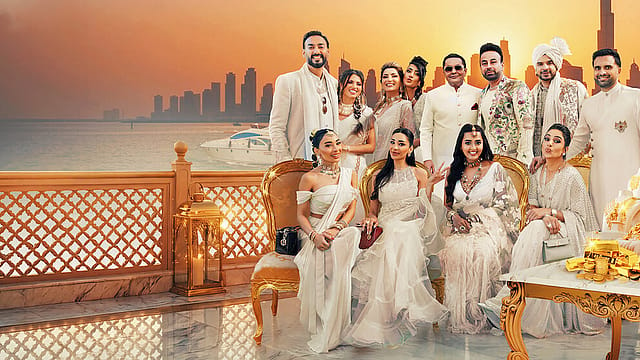
A few days ago, I returned home after a long dental procedure. To anaesthetise my senses as the local sedation began to wear off, I decided to watch Desi Bling, a reality show on Netflix that is a confluence of Gucci, bad taste, patriarchy and philistinism all set within the flash and dash of a peculiar Indian community in Dubai. It worked better than morphine.
The characters on the show were self-declared billionaires and apparently famous. Now, I am not much of a TV viewer—for weeks on end, I do not even turn on the television—and so for me to sit through three whole episodes of a show so grotesque was mystifying not just to myself but also to my children.

Losing Memory
16 Oct 2026 - Vol 05 | Issue 42
The making of a medical and social emergency
But before we examine that, let me tell you a little about the show. There are mostly four couples and three single women in Desi Bling. The men drive flashy cars, wear outrageous clothes with logo over logo over rhinestone logo, and are united in their mission to create an impression of the good life where patriarchy takes centrestage. The women contribute their bit: overdressing, wearing outlandish headgear and bizarre facial accessories, parading around in stilettos from lunch to lunch, sometimes with a doggy inside a Birkin. Their life’s mission: to get their men to pay for their good life, and for the single ones, hopefully to find such men. Nothing reminds you that gender stereotypes are alive, well and wearing Louis Vuitton, quite like Desi Bling.
Satish Sanpal is the star of the show. A self-made man from Jabalpur, he is on his second marriage to a beautiful wife Binda (Tabinda), who wakes him up each morning with a foot massage in their Burj Khalifa apartment. We get an image of him scrolling his phone in his Gucci or Versace night suit while Binda tells him she deserves a “Hermeees” bag because she has given him an extra-long massage that morning.
Satish rewards his wife routinely with gold; on their tenth anniversary, his gift is worth her weight in gold. Binda announces with some satisfaction, she has 40kg already. (Their daughter Bella wore a 24-carat gold dress to her first birthday party.) Satish’s largesse makes Binda overlook his partying night after night with other women, as long as it is a different one every week. “I trust him,” she tells the camera repeatedly. Binda however, does not like her husband’s proximity to his sons from his first marriage. She has no trouble informing you that he was married and simultaneously in a relationship with another woman when she met him, and that they have made a life together, apparently.
Satish is the sun and the rest of the cast revolves around him because he is a billionaire, and he makes it a point to remind you. He will also tell you, cheerfully, that his English isn’t good—but that hardly matters. “Paisa bolta hai,” he says. Money talks. And in Satish Sanpal’s world, it is the only language worth speaking.
His general self-mythologising is supported by the ‘boys’ who rally around him, sometimes on his yacht that has SSS monogrammed on cushions and every available surface. Sir Satish Sanpal, he tells you, is an honorific he has knighted himself with, “because if I don't respect myself, no one will.” Feathered showgirls show up on the yacht as the boys party in a show of forced bromance, but when they’re not living it up and popping champagne, they are complaining to each other about their women.
The ladies, meanwhile, meet over lunches to instigate each other, offer unsolicited advice and gossip. Between them all, it is like the entire Fashion Avenue of the Dubai Mall has exploded: Dior, Gucci, Chanel, jewelled watches, Cartier, Van Cleef...The men, incidentally, are not to be outdone—Van Cleef on their wrists and ears. Unisex luxury, at least, is thriving.
Two actors from Indian television, Tejasswi Prakash (Teju) and Karan Kundrra, hoping to start their new life in Dubai, are welcomed by Sir Satish and Binda who introduce them to the rest of the group. Teju initially appears to be the closest thing this show has to a normal person. This impression lasts approximately three minutes. She overreaches, overacts, and her repertoire of expressions (all of two) includes saying ‘SHUTUPPP’ loudly and indignation expressed through flared nostrils. Karan alternates between dressing up like a Big Sneaker (laces and all) and Big Bird from Sesame Street. At all times he wears more makeup than Teju, who is hoping to marry him so they can both terrorise the world with their strange fashion and ham acting.
There is also a woman with lips so puffed up they leave her nearly speech-impaired. Her name is Pamela—though Satish calls her Pomila and she doesn’t seem to mind it. She is the one with the dog that travels in a designer bag and licks caviar out of a can. There are other pets too: a baby goat inside an LV Speedy under the scorching sun, a surprise gift for one of two sisters (Alizey and Lailli Mirza) who look alike—not because of their DNA but because they share a cosmetic surgeon, and believe that ‘plastic is fantastic’.
Dyuti Parruck, also wealthy (obvs), is married to a Ukrainian woman, Iryna Kinakh. He is with her only because of the sex, he tells the camera, but is contemplating divorce because his Bengali mother has decided Iryna is not a caring parent to his children. Iryna complains she is more than just a mother, a woman, a wife—but Dyuti doesn’t believe those other roles are worthy of consideration. He married her because she became pregnant, and now she is asleep when their kids return from school. How annoying!
In the first few episodes, this ensemble of caricatures goes from a strange Holi party—everybody is dressed in theatrical clothes and there’s a sit-down lunch—to a birthday party followed by a Father’s Day party, a yacht party, a poolside party and inevitably, a Bollywood-themed party. Each feature the same eight people, dressed for the Met Gala, seated around the same glittering table, manufacturing the same argument in a different sequinned room.
The brief to the director seems to have been clear: tallest (Burj Khalifa from every angle), biggest (cars, jewellery), goldest, shiniest, VIP-est. Despite the razzmatazz and slick shots of Dubai, this vaudeville of wealth repels as much as it compels.
I wondered what made me sit through three episodes. Was it curiosity about what fresh absurdity awaited? Was it the hysterical performance of wealth? Or the primitive roles played by men and women who clearly believe they’re living their best life. Whatever the reasons, Desi Bling left an aftertaste like cup noodles—synthetic, unhealthy and oddly lingering.

While I searched for answers, I switched to David Attenborough’s A Gorilla Story, also on Netflix, to observe these fascinating primates in their natural surroundings in the mountains of Rwanda. There were hierarchies, alliances, rivalries, mating politics and grooming rituals. In other words, much the same plot. Yet the gorillas seemed more sophisticated. The silverbacks, even as they beat their chests to announce their superiority, did not live on a monogrammed mountain. They did not keep counting their wealth and weighing themselves in gold. They did not need bags and jewellery to signal their worth in the ecosystem.
I watched the documentary, riveted, and was left feeling a kind of awe for the great apes. I realised what had been nagging me about Desi Bling. Both shows are, in their way, anthropological viewing. But where the silverbacks work with nothing more than instinct, feeling and very high intelligence, Desi Bling is just vulgar—in every possible way.
Which brings me back to my original inquiry: We watch reality TV stripped of taste or values to feel shocked, superior, and revolted—ideally all three at once. ‘So bad it is good’ is what gets such shows the views. There is no veil of propriety, no values or performance of virtue—just a very basic instinct, and a very expensive jungle.
As the camera zooms into the eyes of Pablo, a baby gorilla, Sir Attenborough tells us, “These gorillas fill me with an overwhelming sense of wonder and fear. Fear, we may have missed something. Something important. A deeper understanding of who they are and what that might mean for us.” To watch Pablo and the other gorillas bond, love, care for each other, and fight—with nothing to prove and nothing to sell—is a genuinely moving experience.
While nothing about the cast of Desi Bling fills me with wonder, awe or fear, a show like this tells us something too. There is a new way to be wealthy—not conscious wealth, not conscious living, just wealth as spectacle, wealth as identity. Wealth as the point. There is a whole new class of people on this planet who live this way, loudly and unapologetically. And whether we like it or not, they are being watched. Unlike the gorillas, they know it.