The Sanskriti Museum of Indian Textiles and Everyday Art reopens in Delhi, preserving memories of the past and traditional design heritage
Today, in memories of one’s past, everyday objects rarely take centrestage. Toys are made of plastic, indestructible yet easily discarded. Writing instruments are sleek but mundane. The family’s lota is discreetly stored. The chakla-belan (rolling board and pin), once so intricately carved that it could be often turned on its back after use for display, are now often blank. Most household objects default to represent their utility, not their artistry.
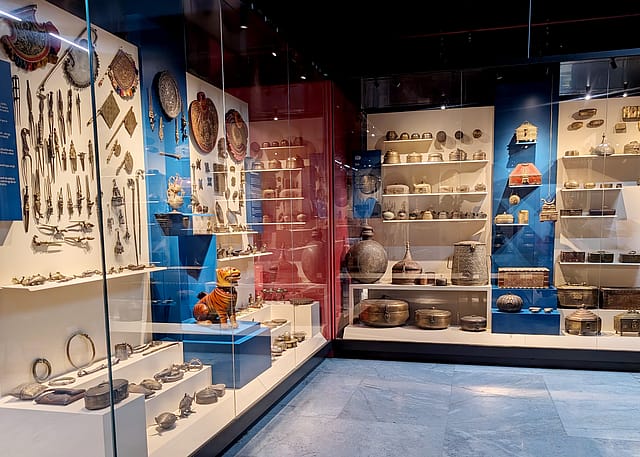
The Sanskriti Museum of Indian Textiles & Everyday Art, newly reopened at the Humayun’s Tomb World Heritage Site Museum seeks to preserve the domestic past in public consciousness.
On display is a collection accumulated by OP Jain, comprising over 2000 artefacts and 500 textiles dating from the 18th century onwards. Jain, now in his 90s and a noted art collector, patron and philanthropist, spent a lifetime collecting these objects and textiles which became part of the displays at Sanskriti Kendra, Anandgram, in Delhi. In 2023, the Sanskriti Board of Trustees gifted the collection to the nation through the Indira Gandhi National Centre for the Arts (IGNCA), which proposed its display at Humayun’s Tomb World Heritage Site Museum for an initial period of five years. A display of Ayyanar terracotta horses and animals, gifted by the Sanskriti Foundation, links the two museums—and the past with the present. Inside, the Aga Khan Trust for Culture (AKTC) has implemented the displays in collaboration with IGNCA, and the two organisations aim to continue collaborating on research, conservation and public programming focused on the collection.
Losing Memory
16 Oct 2026 - Vol 05 | Issue 42
The making of a medical and social emergency
During the opening remarks at the collection’s re-opening on July 22, Ratish Nanda—conservation architect and CEO of Aga Khan Trust for Culture—spoke on behalf of Jain, saying that at the Humayun’s Tomb World Heritage Site Museum, these artefacts “will be cared for with scholarship, integrity, and imagination, and where it will be seen and appreciated by generations of visitors from India and around the world. Here, the collection becomes part of a larger narrative of India's civilisation journey and everyday creativity.”

The collection is curated by stages of life, with the first displays featuring items from childhood: toys and writing instruments. A wooden stroller carved to mimic a warrior’s chariot; an intricately-moulded rolling camel toy made of metal—each toy is ripe with complexity and beauty. Perhaps inconveniently elaborate, these toys were meant to teach children how to live life as an adult. The only distinction between the toys in the display case and the real thing—warrior chariots, statues of camels, and so forth—is their size.
The next display case consists of farm tools and implements, showing a progression from childhood to adulthood. After the work comes play: on the other side is a display of hookahs and smoking pipes, paan daani and sarota (betel-nut cracker). In other displays, there are kitchen tools, objects of women’s adornment, traditional ovens, storage units and boxes, ritualistic objects and shrines. The objects may be varied, but they are anchored in a unifying idea—the craftsmanship and aesthetics that permeated everyday life in India.
One of the highlights of the collection is an extensive display of lotas, whose appeal has extended to contemporary design. The placard emphasises the deep importance of this traditional multi-functional metal utensil, referring to the famous story of American designers Charles and Ray Eames who, after a trip to India, wrote in The India Report, "Of all the objects we have seen and admired during our visit to India, the Lota, that simple vessel of everyday use, stands out as perhaps the greatest, the most beautiful.”
And in the display case, that is evident. The lotas are beautiful and uniquely sized, diverse in their adornments and carvings. Some are ceremonial, and others are simply meant for everyday use.
Textiles are another primary area of focus in the exhibition. The collection contains textiles from multiple different regions in India, some being extremely rare to find now, including kantha and jamdani from Bengal, phulkari from Punjab, and bandhani from Rajasthan among many more. Carefully preserved, these textiles carry the viewer through lifetimes of Indian textile traditions and women’s crafts, each unique and ornate.
“The objects are collected over the decades. Textiles, everyday artefacts, or works of craftsmanship were never acquired as possessions. They were simply in a trust,” Jain wrote in his speech. There is a value in preservation, but a larger value in making art and history accessible, “for the future of the objects themselves, and the stories they carry.”
(The Sanskriti Museum gallery will be open to the public from August 1 2026, 10am-6pm on all days except Mondays.)