Radio stations are dying a slow death but don’t blame it on video alone
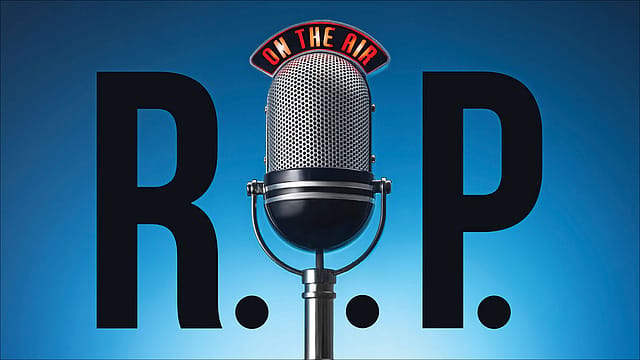
A SHAKEUP IN India’s private FM radio business has left the industry grappling with difficult questions about its future. A string of radio stations have shut down across the country: Radio Nasha in Mumbai, Radio One in Delhi, Mumbai and Bengaluru, and Fever in Chennai. Not due to license expiration or government action, these stations shut down because they were deemed financially and strategically unviable.
Pray, what happened to the good ol’ days? Radio in the 1990s and 2000s was a cathartic space—where listeners would call in to share everything from traffic updates to break-up stories. It was a breeding ground where movements picked up pace: think the 2011 anti-corruption protests, an SOS amplification channel during the Covid crisis, an awareness tool during terror attacks and, when it was not donning so many hats, a companion that never let its listeners feel lonely during long commutes and sleepless nights.
Stutee Ghosh, RJ and former programming head at Fever FM, Mumbai, looks back at those days with fondness and melancholy. “The anonymity of radio was empowering for a lot of people. They could share their story about what was troubling them without fearing judgement”. She recalls a time when people listened to the radio while they were travelling. “You would tune into the radio and it made the whole car come alive.” RJs themselves were enigmatic figures. Ghosh reminisces: “Radio used to be a theatre of the mind. You cannot see the RJ so you would build a relationship with the RJ where you imagined what they looked like”. With the advent of social media, a face was put on the voice which so far had remained elusive— RJs had no choice but to adapt to changing times. “We realised there is no point fighting the camera because it is everywhere today, including our bedrooms,” she adds.
A deeper examination of programming reveals that music is no longer the key differentiator when it comes to radio. There is a growing perception in the industry that radio stations are no longer jukeboxes but RJ-led ecosystems centred on brand integration, contests and prank calls. While there is nothing inherently wrong with this shift—barring, of course, the sexist humour that occasionally creeps into segments— music itself is no longer the USP for radio, especially with the advent of music streaming platforms like Spotify, Apple Music, Gaana and others.
IT DOESN’T HELP that programming across radio stations is synchronised almost to the minute. When one station breaks for advertisements, so do the others; when one returns to music, the rest often follow suit. For listeners, this can be frustrating. A quick scan across the dial in search of music often leads to the same commercial break playing across multiple stations, making it easier to switch off the radio altogether.
Ironically, in an era when access to music has become virtually unlimited, radio has chosen to compete on everything except the one thing it historically did best—playing music. Listeners have long complained that the same Bollywood hits are repeatedly rotated throughout the day, making stations sound increasingly interchangeable. Frequent interruptions also change the psychology of listening. Earlier, listeners stayed tuned because the next song could arrive at any moment. The countdowns, retro hours, indie showcases and genre specials that once gave listeners a reason to tune in at a specific time are increasingly disappearing.

Ghosh remembers when RJs used to ‘break’ new music on radio. Now, radio have lost exclusivity of new tracks debuting on airwaves as new releases are often available simultaneously on streaming platforms.
Beyond the obvious disruption by streaming platforms are other reasons. Abe Thomas, CEO-Music Broadcast Limited and former CEO of Radio City India feels that recent closures have less to do with the relevance of radio and more with the business strategy and market economics. “Individual station closures should not be mistaken for a decline of the medium,” Thomas says, adding that radio owners “have only given up their second brands, not the cities”. Nisha Narayanan, Director and COO at Red FM argues that these exits are not failures of creativity or editorial commitment but a result of cost structures which were decided in 2015 when digital disruption was not in the picture.
If there is an issue affecting radio negatively that both Thomas and Narayanan agree on, it is licensing fee. For the uninitiated, private FM players operate on government-issued licenses which have an expiry date. “Spotify, JioSaavn and YouTube Music operate in India without spectrum license fees, content restrictions or public service obligations,” says Narayanan. To put it simply: a medium (in this case, radio) is being asked to carry public service obligations while competing with platforms that carry none. This is not a level playing field. The closures are a result of not addressing this gap for a long time, Narayanan observes. Thomas, too, agrees that radio operates under far more regulatory constraints.
The question then remains: is streaming alone to blame or is there more than meets the eye? While Thomas agrees that streaming has increased competition for attention, he feels the bigger challenge is advertising spend being divided across multiple media platforms. “The budget advertisers would allocate to radio has been divided across different media due to the changing economy,” he says.
Thomas believes that advertisers have continued to stay because radio consistently delivers results. “The lack of listenership data is a hiccup because the stations cannot provide ‘ROI’ metric the way digital media does,” he adds while arguing that advertisers know that radio continues to be valuable. On an important note, Thomas disagrees that radio is dying. “The medium is adapting, not disappearing,” he adds.
Narayanan, too, feels that radio operates without a universally accepted measurement of ROI and that gap “hampers advertiser confidence”. The medium clearly delivers but the industry’s obligation is to make that case with not just conviction but with data and audience measuring dynamic.
It’s not all negative. Radio is no longer a standalone medium—it has digital activations, podcasts, on-ground events and culturally rooted intellectual properties. Highlighting its relevance, Narayanan argues: “When WhatsApp needed to reach mass audiences urgently with cybersecurity and anti-fraud messaging, they turned to radio. When Google Pay and Gemini needed deeper local penetration beyond metro digital reach, radio was the channel that delivered. These are not legacy advertisers defaulting to an old habit. These are among the most data-literate brands in the world making a deliberate choice about where trusted, hyperlocal communication happens at scale.”
RJ Shravan Ajay, previously with 92.7 BIG FM, Fever 104.0 and 94.3 Radio One, feels that RJs need to constantly reinvent themselves. “RJs were the original influencers,” he says. He adds that there is an element of surprise and discovery which streaming cannot replicate. Streaming platforms, like YouTube Music and Gaana, do have a ‘Discover’ feature where users, are recommended new songs based on their algorithm. But collective listening and shared community spirit has been replaced by a personalised feed and recommendations. Narayanan however notes that no platform can rebuild the trust radio has, with personalisation alone.
JIGNESH VASAVADA, who has served as Vice President of Radio Mirchi and National Programming Head—94.3 FM, feels that government policies were not radio-friendly to begin with. “Companionship was a major reason why people tuned into radio. Now, that companionship has been replaced by digital apps.” Earlier, people regarded RJs with awe. “Today, an influencer with 2 lakh followers is respected more,” he adds.
Back in 2000s, when it came to hiring RJs, their skill set was evaluated based on how quick they were when it comes to thinking on their feet and being witty while, of course, sticking to the guidelines of radio. Their language and diction were taken into account. That might not be true today. Ghosh highlights that every radio station today has an Instagram page, and a requirement that RJs must make reels. “Today, an RJ is hired based on how quickly they can shoot and edit a reel.” Gone are the days when listeners sent fan mails and entrusted RJs with their problems. Today, RJs shout out their Instagram handles on air.
Meanwhile, smartphones have evolved in a way that there is no in-built radio app for listeners to tune in. There are cars in production which will no longer have FM radio. On an interesting note, Ghosh observes that the decline in radio’s popularity coincides with a boom in a podcasts and audiobooks. There is a certain irony to this shift: listeners who once relied on RJs for short conversation between songs are now embracing podcasts where discussions can stretch for hours. On that note, Ghosh remembers Meow, India’s first talk radio station; Vasavada finds it ironic that talk radio never took off in India, a country of storytellers.
Vasavada carries optimism when it comes to community radio, “There is a huge opportunity in reviving hyperlocal radio stations, where people in smaller regions have access to radio that talk about the issues that matter to them.” For Ghosh, the grief of witnessing the medium decline runs deep but she is also hopeful. “We need help from the government and a change in listener behaviour. We must adapt to the changing times while keeping the core intact.”
What is at stake here is not a business model or frequency but a medium that once made millions feel less lonely. Try as hard as they might, personalised feeds can never replicate the magic of not knowing what comes next. As a radio station falls silent, a generation loses out on a frequency where it once met. Yet, if the voices in this story are to be believed, radio’s story is not over; somewhere in the static, there is still a signal waiting to be heard.