Beastly Love: Kalki Koechlin returns to the stage with a play in which mothers are magical creatures
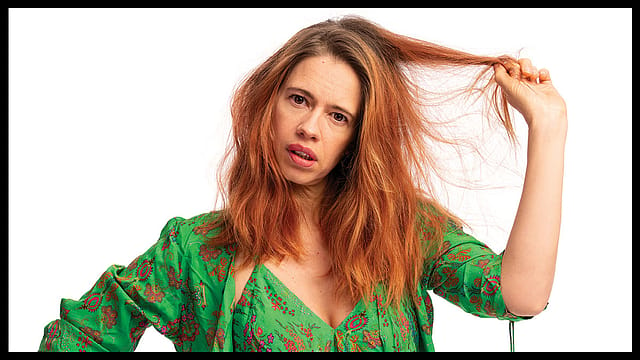
WHEN KALKI KOECHLIN decided to adapt her book, The Elephant in the Womb (Penguin, 2021), into a play, her seven-year-old daughter Sappho contributed the first drawings. “I told her I was making this play and that it was about these mothers who become these magical, mythical creatures. And I told her there’s a vampire, a unicorn, a dragon, a spider demon and a werewolf. She started drawing those creatures, which were then sent to Valeriya [Polyanychko], our illustrator, as initial inspirations,” says Koechlin. Polyanychko did all the illustrations for the book, including a monster that emerges from Dragon Queen Kalki’s womb, the nipple of a breast that fails to pump milk, and Koechlin depicted as a lonely and sleepless bartender with one regular customer.
From the isolating post-partum ordeal of being a mother during lockdown to a more universal experience assimilating testimonies from people—whether they are about hyperemesis gravidarum, C-sections, IVF pregnancies and miscarriages— Koechlin has not only made a triumphant return to theatre but also shown that it is possible to share your life with your child and encourage them to share their life with you. More than that, after her work as writer and director of her earlier play Living Room, Belly of the Beast has established her as one of the most original and authentic voices of our time, unafraid to tell the stories most people would rather leave untold.
Aadyam Theatre’s Belly of the Beast, which premiered in Delhi and will be travelling to Mumbai, is funny, infuriating, electric and astounding. “Nobody told me to prepare for an alien invasion that would turn my insides out and transform me into a human incubating system of toxic gases and chemical imbalances,” she wrote in her book and it is this sentiment that is infused in Belly of the Beast.
With a stellar cast of five women, including Koechlin, and one very talented man, Kettan Singh—who is making his theatrical debut—the play examines motherhood, “a gift like no other”, using shadow puppetry, live music (by Koechlin’s husband Guy Hershberg),
movement and humour. Unlike the rose-coloured versions we have been seduced into believing, Belly of the Beast shows what really happens to women’s bodies and minds when they are taken over by babies. From raging hormones to societal judgement, from a plethora of well-meaning advice to the not-so-invisible burden of guilt, motherhood is transformative but just not in the ways women have been told. There is pain, desire, exhaustion and fury; there is little room for politeness and poetry.
KOECHLIN SAYS SHE and the play’s director, Sheena Khalid, started with the inspiration from her book and the idea of what pregnancy was for her. Khalid, however, says the play began with readings from the book and workshopping with the actors before finally collaborating with Anurupa Roy and Ankit Ravani from Katkatha on the puppets. It helped that almost all heads of department were women, bringing a unique female gaze to the production.
“Still,” says Koechlin, “we realised that there are so many vastly different experiences. We wanted to include all kinds of different experiences of birthing, of parenting, of pregnancy. It was fantastic to research that, find real stories from people that we know. The actors came in with their own writing, with their own thoughts, and added a certain layer of very intimate, personal emotions to the script.”
Koechlin found the experience fantastic and therapeutic because, despite vastly different experiences of motherhood, there are certain universal aspects that women feel and motherhood is a real leveller—it pulls you out of whatever station you occupy in life and draws all your attention and energy into this new being, and oftentimes without the support of society.
Kettan Singh is more than the token man in the play, bringing an element of humour, playfulness and relatability to the men in the audience. Says Koechlin: “I had men after the show coming up to me and saying ‘My goodness, it’s true. I’ve also had an experience similar to what the male actor had gone through, accompanying someone for an abortion.’ Or other people came up to me saying, ‘My God, I want to call my mother.’ So this is really quite encouraging. And I think the humour in the play is what makes us feel the humanity,” she adds.
The play doesn’t shy away from heavy issues. “Something like a miscarriage can be a difficult topic to handle, and we’ve done it because there’s also this fantastic playfulness in our actors and this ability to surpass the grief through humour. I think what we hope for the play is, of course, just a consciousness and an awareness of what mothers do for us,” says Koechlin. “There’s an awareness that all of us have lived in the womb of a woman and therefore are somehow connected to this experience. And I guess, a kind of acknowledgement, of course, of what women go through. And at the same time, an acknowledgement of our own humanity and our own journey in this world, which begins through a woman, I think, unifies us.”
Amba- Suhasini K Jhala, trained at the London Academy of Music and Dramatic Arts, in the play turns into Luna, the werewolf; Rachel D’Souza, who trained at the London International School of Performing Arts, is Violet the vampire; Shanaya Rafaat, from the Royal Academy of Dramatic Arts, is Shanaya the spider demon; Shruti Vyas, who has worked with Motley, Atul Kumar, Rajit Kapur and Rajat Kapoor, is Twinkle the unicorn; and Koechlin is Kaliya, the dragon.

Belly of the Beast has mothers like us, who are wide awake after the baby is asleep; who want sex, sleep, silence and violence at the same time; who are consoling others for their own loss; who are doing everything at once; and “smiling like a saint and burning like a fuse”.
Koechlin’s relationship with her child has changed since writing the book. When she wrote it, her child was a newborn. It was lockdown—not having access to other mothers, not having access to a community, and simply being in an apartment and going through the whole postpartum alone. She recalls: “I had my partner there who was pretty hands-on, but it’s still a very difficult experience. And I think community, other mothers, other women around, really help that process. In fact, the book for me was therapeutic because I had somewhere to write down all the difficulties that I went through. Since then, my daughter and I have grown beautifully and learned to communicate. There’s this psychological landscape that you are learning when you’re a mother. You’re learning how to navigate boundaries, how to navigate the idea of encouragement, but at the same time, without simply accepting everything that your child does,” she says.
WHEN ASKED HOW she finds the balance, she says, “It’s a constant challenge, and I’m constantly reading and learning more about that. But I also think it is one of the beautiful things that has happened, a sort of collaborative experience. My daughter and I do projects together. The other day we took an old carton of milk and made a birdhouse out of it for a bunch of birds that come to our house.”
She is returning to the theatre after a while and is visibly thrilled. “I really missed the stage. I was busy being a mother. And now I can allow myself a little more time to make a play. I’ve absolutely loved it. Of course, as a writer, as a creator, I feel a kind of larger pressure to keep working, keep fine-tuning, keep editing, keep making it better,” she says. And that’s the beauty of theatre for her. Unlike a film, in which once the edit is locked and it’s released, that’s it, theatre constantly evolves year after year.
Koechlin stunned the country with her Lolita-like portrayal of Chanda in Anurag Kashyap’s Dev. D in 2009 and went on to become part of beloved movies such as Zindagi Na Milegi Dobara (2011) and Yeh Jawaani Hai Deewani (2013) and critically acclaimed films such as Margarita with a Straw (2014) and Goldfish (2023). She will soon be seen on screen again in a show called ‘Anarth’, which is coming out on Amazon Prime Video later this year. The child of French hippies who made India, specifically Tamil Nadu, their home in the 1970s, Koechlin became a familiar face on streaming, too, most successfully as the unhappy Faiza in Prime Video’s Made in Heaven (2019 and 2023).
It’s an unusual journey — and it has produced an unflinching look at one of life’s most misadvertised moments. As she says: “This isn’t a cute play on the gift of motherhood; this is you walking straight into the belly of the beast.” And she’s the dragon queen breathing fire.