Mixologists are reimagining classic cocktails with ingredients from Ladakh to the Western Ghats
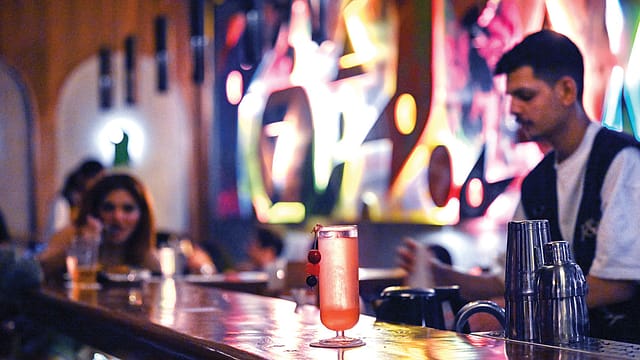
JEET RANA AND his mate, Chirag Pal, run a busy little bar at Delhi’s busiest Gen Z magnet, M-Block Market,Greater Kailash-II, so why were they tramping across Meghalaya? They were busy doing what creative (or shall we say, adventurous) mixologists love to do—foraging for unfamiliar, umami-packed ingredients to infuse new excitement into classic cocktails. Take for instance the sweet and tangy Sohiong berries, which grow in the Khasi hills of Meghalaya and are now the principal botanical going into the Cherrapunji Eastern Craft Gin—just what Rana and Pal needed for the latest edition of the Bird’s Eye Menu at Barbet & Pals.
A couple of months before Rana and Pal were in Meghalaya, their guru, celebrity mixologist Yangdup Lama, was in Nagaland on his own hunt. He was putting together a cocktail menu for his Himalayan-themed Gurugram bar, The Brook, to celebrate Nagaland’s Hornbill Festival with drinks where the base alcoholic beverage, Johnnie Walker Black Label, was pumped up with flavours from the state. Christened ‘O Soneko’ (O Beloved Ones) after the melodic Naga song by the Tetseo Sisters, the cocktails included the Sekrenyi, named after the Sanctification Festival of the Angami tribe—its star ingredients, apart from the whisky, being zutho, the local sparkling rice beer, and toasted black sesame. Likewise, Tuluni, the prized rice wine served in leaf goblets by the Sumi tribe on special occasions, is the name Lama gave to the cocktail in which he added a dollop of rosella jam and balsamic vinegar.
These cocktails come with stories around cultures and travels, becoming more than just drinks. “Each cocktail,” to quote Jeet, “becomes a journey across flavours and spaces”. At Nadoo restaurant in Delhi, chartered accountant and acclaimed exponent of South Indian cuisines Shri Bala and her business partner, Sahil Sambhi, take their guests on a journey across the tables of the southern states in their cocktail menu.
The Nadoo duo’s a-ha creation is a one-of-its-kind rum-based dessert cocktail, Sweet Silk, which recreates the taste and flavours of payasam with palm jaggery, cashew, cardamom, vermicelli milk and edible camphor. In case you don’t fancy a payasam cocktail, Shri Bala and Sambhi tempt you with a Pepper Saaru (or rasam) that pairs vodka with clarified tomato and tamarind water, pepper, a dash of citrus and curry leaf oil.
From the highlands of Meghalaya and Nagaland to the coastal states of the South, India, explains Jeet,“has a vast pantry of regional ingredients that were rarely explored in bars”. That is no longer so. Today, even a revered classic such as the Gimlet is better-known as the Totapuri Gimlet after the mango variety used in abundance to make aamras which lends the gin drink a distinct Indian character. The Mediterranean cocktail menu, recently unveiled at Grammie, chef-entrepreneur Tanveer Kwatra and his wife Ginny Kohli’s Delhi restaurant, comes with a gusty whiff of Indian flavours. Imagine the Japanese shaved ice dessert, kaki gori, flavoured with jamun and cola, as the wow ingredient of a Reposado-based cocktail named Wild Canopy.
“It is not just about drinking a cocktail, it is about experiencing it. That explains why these drinks are resonating so much,” says Pankaj Balachandran, the mixologist driving the big-ticket Goa bars Quinta Cantina, Boilermaker and The Lab via WhatsApp from Sri Lanka. He was recently in Sri Lanka for a collaboration between Quinta Cantina, celebrating Goan feni, and Ropewalk at the Galle Fort Hotel, which raised a toast to arrack, the local favourite.“It is essentially two local spirit cultures coming together,” Balachandran adds emphasising that it is “a great reflection of how regional spirits are starting to gain global momentum and recognition.”

It is precisely this understanding that encouraged the makers of Hapusa, the Himalayan Dry Gin, to host the second edition of the Forager’s Championship, a bartending platform where participants create cocktails inspired by ingredients that grow in their own regions. The seven top cocktail makers out of the 100 participants surprised the organisers with the diversity of ingredients. Jitesh Koli of Amelia One, Mumbai, for instance, drew inspiration from solkadhi, the probiotic drink popular across the Konkan region, and worked with foraged kokum and fermentation techniques passed down over generations. Priya Mili from Terra Mayaa, Guwahati’s popular rooftop bar, “reimagined the Martini through a local lens,”clarifying native tea and finishing it with jolphai, a wild regional olive.
EXPLAINING THE trend gathering momentum across the country, Vikram Achanta, whose portal tulleeho.com has been tracking alcoholic drinks and bartending since 2001, said it was “an expression of the greater confidence that we now have in our own backyard.” It makes business sense, too, because patrons are familiar with these local ingredients. “With bar takeovers becoming a common feature, these ingredients are travelling fast across the country,” Achanta added.
Most recently, Achanta was surprised to find out how a Shillong bar, Shad Skye, was using popular local brews to give their cocktail menus a welcome local twist. Two drinks in particular have got his attention. One is a highball named K&T, whose base spirit is Yiad Krai—a millet-based liquor consumed by Khasi and Jaintia tribes— paired with aromatic cardamom and the citrusy Napa basil from Nagaland. Bitchi Sour is the other drink that has made Shad Skye the talk of the bartending community. With bitchi, a soft and gently sweet rice-based fermented beverage consumed by the Garo tribes, as base, the cocktail includes whisky, citrus and foam to make it reminiscent of the Whisky Sour, but with a Meghalayan twist.
“Our guests are forever looking for something new, for stories that are different yet relatable,” explains Yangdup Lama. His search for such stories has taken him from places geographically far removed from each other—Ladakh, where he discovered a wild variety of mint; Turtuk, where he stumbled upon a mulberry with a natural caramel flavour; Nanjangud, near Mysuru, from where he sources organically grown cacao and allspice leaf, whose flavour profile is uncannily similar to that of bay leaf.
The use of such ingredients, Lama says, is important to pique the curiosity of his guests, but he is quick to add a caveat: “Understand the trend first, do not follow it blindly.” What he finds heartening, though, is the distance that mixologists have travelled to add the spark of imagination to their business.
This new excitement seems far ahead of the early buzz he was able to create when he started using ingredients such as tamarind, sugarcane juice and jaggery to cocktails in the first bar he independently owned—Cocktails & Dreams Speakeasy in Gurugram. That was 12 years ago. Around the same time, another Nitin Tiwari, was earning his initial spurs at Ek Bar, New Delhi, one the country’s earliest ‘Modern Indian’ cocktail bars operated by the restaurateur AD Singh.
At Ek Bar, Tiwari moved away from sugar syrups and experimented with ingredients such as Kumaon’s hisabu (yellow raspberries) and buransh (rhododendron), the GI-tagged Lakadong turmeric of Meghalaya, and Bengal’s aamaada (ginger with a distinctive mango flavour), gondhoraj lime peel, and toasted gobindobhog rice plus Jharna ghee, which were fat-washed to give a regional twist to the Old Fashioned. Tiwari’s lineup included the Murabba Mule at the peak of each mango season and the biryani-flavoured cocktail he appropriately christened City of the Nizams. “The ingredients created conversations around cocktails,” Tiwari says, but adds that he may have been a bit too ahead of the curve.
It was Covid, ironically, that revived this creative fervour, according to Gagan Sharma, sommelier and founder of Indulge India, a company that specialises in training beverage professionals and curating experiences. With time on their hand, he says, bartenders started to experiment. Many of them, especially those from Uttarakhand and the North-East, went back to their home towns and villages, where they began to learn more about ingredients and local drinks that they had seen and tasted when they were growing up. This outpouring of curiosity was encouraged by both bar owners and alcobev companies—post-Covid, both were looking at new stories to entice their old clientele to return to their favourite watering holes. The ingredient twist provided just that opportunity.
Balachandran, who has been playing with unusual ingredients such as red amaranth at The Lab and bitter melon at the Chef Auroni Mookerjee-led Kolkata restaurant, Yokocho, explains what the word “discovery” meant to him. “It is about just being on the ground, close to markets and farmers, having conversations with chefs, and just paying attention. A lot of the time the ingredients are already there, it’s just about how you choose to use them,” Balachandran said, adding: “I think the ingredient is already doing the work, we just try not to overcomplicate it.”
AND IT’S NOT ALWAYS about ingredients. Sharma adds a sensory element to his cocktails by engaging the sense of smell with the help of, say, a deodar-scented attar to bring the scent of the mountains of Uttarakhand to the tables of Tevar, Hyderabad, via the drink appropriately named the Valley of Flowers. Similarly, for the ‘Currency Menu’ at Ourem, Goa, he had an attar developed with a leather aroma for a drink named Leather, harking back to times when the material served as currency in certain parts of India. For the Dehradun bar, CinCin, Sharma sourced the famous ‘gillimitti attar’ from Kannauj, Uttar Pradesh, recreating the smell of a wet earthen plate traditionally used to serve biryani. A whiff of the attar accompanies Awadh, a drink that recreates the sensation of having a Lucknowi biryani in a glass by coupling a ghee-washed gin with a toasted rice-infused amaro (the Italian herbal liqueur).
The discovery of new ingredients by intrepid mixologists, who are forever stretching the frontiers of their imagination, has dramatically changed the bar experience across the country. A cocktail today is more than a drink. It’s a story that stirs together far-flung communities, lesser-known kitchens and untried ingredients into a drink driven by discovery.