From textiles to paintings, a new group exhibition in Delhi contemplates questions of home, exile and identity
“No one leaves home unless home is the mouth of a shark,” reads the bottom of the pamphlet for Overland, there’s shorter time to dream—a new exhibition at Delhi’s Latitude 28 gallery. A quote by British poet Warsan Shire, it sets a strong tone for the show.
Overland poses the question: “What does it mean to be a migrant, and how do we carry the loss of home with us as we move?” Artfully curated by Shristi Sainani, the exhibition features pieces by artists Mihika Poddar, Sudipta Das, Firi Rahman and Gaurang Naik among others. The gallery pieces show various interpretations of loss, individual growth, familial separation, and what it means to belong, using different visual modalities, such as clay sculpture, fabric pieces, paintings, photography, short film recordings, and digitised screens. “Overland, There's Shorter Time to Dream’ refers to a dreamscape that exists beyond the ‘land of origin’ which often comes along with intersections that distort language as a means of prolonged exile,” says Sainani, on the exhibition’s title, “the fissures and fault lines that serve as birthing sites for war, violence of socio-political unrest, processes/processing of the disparaged, a demand for silence, an adoption of surveillance and a homesickness, a constant yearning.”
Losing Memory
16 Oct 2026 - Vol 05 | Issue 42
The making of a medical and social emergency
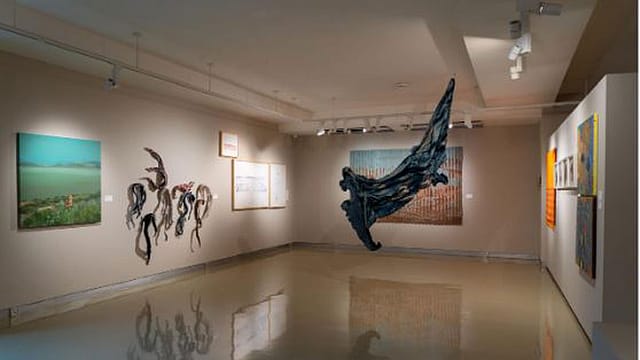
The deep sense of surveillance that Sainani discusses is ever so present in Nightlight (2024) by Mihika Poddar, a young Nepali visual artist based in New York. Nightlight takes centrestage, spanning an entire wall of the gallery. It is visually stunning, with violet, sage, and indigo hues running over the canvas, depicting a young girl upside down in a luxurious bed with twisted blankets contorting into various demonic shapes. The piece evokes the fear of what might be waiting beyond the safety of a secure space.

Poddar describes her choice of perspective in the painting as intentionally “suffocating and protective”—the bird’s eye view of the bed, stuffed with sheets and comforters creates an uneasy feeling. “Through this perspective, the viewer enters the painting and becomes part of the bedroom environment,” she says, and that “this proximity to something so intimate is meant to be unsettling because of its voyeuristic point of view.” The piece’s usage of green, often “associated with dense forests at night,” she adds, “transforms the bedroom into an extension of the wild.” The familiar domestic interior becomes unstable, no longer offering protection. At the painting’s centre, a giant upside-down hand emerges through the comforter above the girl, leaving it unclear whether the comforter is a source of safety or a threat. Nightlight pushes the viewer, then, to interrogate the duality of migration: it is a feeling of imminent danger, but also a safety blanket that perhaps feels a little too heavy.
The varying interpretations of migration are depicted throughout the gallery. Poddar interprets it as a liberation from childhood but Juhikadevi Bhanjdeo, who works primarily with textiles, has a different understanding of that childhood separation. Her piece Memories in Skin (2026), one of two textile art exhibits in the show, grapples with the wound of separation. Eight tentacle-like fabric pieces are suspended from the ceiling, with white buttons sewn like lines down each branch. Bhanjdeo distorts fabric she collected from her household into animalistic, foreign beings.
These fabric pieces are stitched tightly with the memory of its previous wearers. The piece asks the viewer: how tightly does something need to be held onto before it assumes another form? Originally beloved clothing, these tentacles now resemble nothing of the sort; they have been squeezed dry, twisted in perhaps agony or anger, and any memory of the original clothing has dissipated and become something completely different.
Sudipta Das is showcasing a work titled Soma Talav (2026), which plays with textures, dimensionality and household materials. A lateral view of an urban street captures the privacy of homes and daily life of neighbours created from glue and crumbled paper. The artwork creates a sense of separation; the artist and the viewer are both outsiders, uninvolved in the action and life belonging within the street. Its three-dimensionality pulls the viewer in, to be closer to the action, yet the paper citizens are untouchable and blissfully unaware of the foreign voyeur. The piece seems to argue that life (and a neighbourhood) moves on after someone leaves. A sense of permanent loss lingers: even if a previous resident were to come back, they would be an outsider looking in on a familiar scene, instead of someone within the scene itself.
The exhibition is poignant, moving, and diverse. Sainani’s curation seeks to push forward a wide array of voices and interpretations of exile, the bittersweet nature of homecomings, and the pain and joys of migration.
(‘Overland, there’s shorter time to dream’ is on view at Latitude 28, Delhi, till July 25, 2026)