The Villain Who Never Needed the Spotlight: Remembering Pradeep Rawat
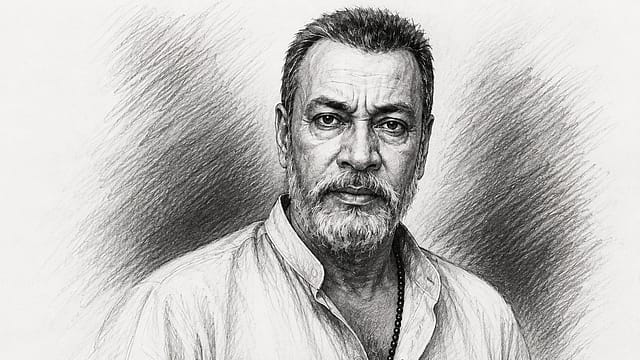
He wasn't the hero. He wasn't the superstar. But when Pradeep Rawat entered a frame, you knew the stakes had just gone up.
For nearly four decades, Rawat became one of Indian cinema's most dependable character actors, quietly stitching together careers across Hindi, Telugu and Tamil cinema. He played kings, warriors, police officers and, most memorably, villains. Yet off-screen, colleagues remember him as a gentle, warm-hearted man who rarely spoke about himself.
On Wednesday evening, some of Indian cinema's biggest names gathered in Mumbai for one final goodbye. They had come to bid farewell to Pradeep Rawat—the actor who spent four decades making heroes look vulnerable. The funeral brought together familiar faces from Lagaan—Aamir Khan, Ashutosh Gowariker, Yashpal Sharma, Daya Shankar Pandey and Rajendra Gupta. They had come not merely to mourn a co-star, but a friend whose quiet presence had stayed with them long after the cameras stopped rolling.
The Identity Project
11 Sep 2026 - Vol 05 | Issue 37
Amit Shah leads the mission for a national demographic correction
Salman Khan also looked back at their years together, sharing a still from Baaghi: A Rebel for Love on social media with a simple message that perhaps said more than a lengthy tribute could.
"Shared many good moments with you brother."
The two had worked together in Baaghi, Patthar Ke Phool and later Tiger Zinda Hai, their professional association spanning decades.
Rawat's story began long before Ghajini made him famous.
After making his film debut in Meri Jung in 1985, he became a household face as Ashwatthama in B.R. Chopra's iconic television series Mahabharat. For millions of Indians who grew up watching the epic every Sunday morning, Rawat wasn't simply portraying Dronacharya's son. He became the face of one of mythology's most tragic warriors.
Cinema soon realised what television already knew. Rawat possessed something rare: Presence. He could dominate a scene without raising his voice.
That quality found its finest expression in A.R. Murugadoss' Ghajini. His portrayal of the ruthless antagonist became so definitive in the Tamil original that when the film was remade in Hindi opposite Aamir Khan, he returned to play the same character—an uncommon honour in an industry where remakes often bring entirely new casts.
Long before Ghajini, however, Rawat had already shared screen space with Aamir Khan in Lagaan, becoming part of another landmark film that would go on to define Indian cinema.
His career stretched far beyond Bollywood.
Beginning with S.S. Rajamouli's Sye, Rawat became a familiar face in Telugu cinema before expanding into Tamil, Kannada and other regional industries. At a time when "pan-India" was not yet part of the industry's vocabulary, Rawat had already built a career that crossed languages with remarkable ease.
His filmography included Sarfarosh, Lagaan, Naayak, Sye, Ghajini, Sarrainodu, Veeram and, most recently, Vicky Kaushal-starrer Chhaava, where he portrayed Yesaji Kank.
What stood out, colleagues say, wasn't just the actor. It was the man. "He was a wonderful person and an exceptional actor," filmmaker Ashoke Pandit said after the funeral. "What set him apart was his confidence, positivity and boundless energy. He never mentioned that he had cancer. We had spoken just three or four months ago, so it came as a complete shock."
Veteran actor Surendra Pal, who lived in the same building as Rawat, remembered him as "not just a brilliant actor but also a wonderful human being."
Raza Murad perhaps summed him up best. "The industry has lost a remarkable artist, I have lost a very dear friend, and the world has lost a true gentleman."
Perhaps that explains why so many gathered on Wednesday. They weren't merely saying goodbye to one of Indian cinema's finest villains. They were remembering a man who never chased stardom, never demanded the spotlight, and yet somehow became unforgettable. Because some actors become famous. A rare few become familiar. Rawat belonged to the second category—the kind whose face audiences instantly recognised, even if they didn't always remember the name.
And that, in many ways, is a far rarer legacy.
(With inputs from yMedia and ANI)