What Makes the Geminids Meteor Shower 2025 the Most Spectacular Show of the Year?
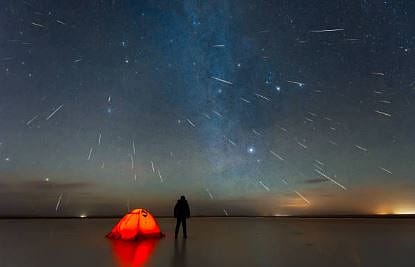
The Geminids meteor shower returns this weekend to deliver what astronomers are calling one of the most dazzling celestial displays of 2025.
As December nights deepen across the Northern Hemisphere, sky watchers are preparing for an astronomical spectacle that promises to outshine nearly every other meteor shower in India this year.
With peak activity centered on the night of December 13-14, the Geminids meteor shower offers a rare convergence of optimal viewing conditions that make this year's event particularly extraordinary.
According to astronomy publications, under ideal conditions observers could witness up to 120-150 meteors per hour during the peak. The Geminids meteor shower 2025 stands apart from typical meteor events because of its exceptional reliability and intensity, often rivaling the summer Perseids in sheer volume of shooting stars streaking across the heavens.
When is the Perfect Moment to Catch the Geminids Meteor Shower in India?
Timing is everything for meteor shower enthusiasts, and the Geminids meteor shower 2025 peaks precisely on the night of December 13-14. As per astronomical data, maximum activity is centred around 2am to 4am IST on December 14, when Earth’s rotation aligns your location with the planet’s orbital path through the debris stream.
While meteors can appear from late evening onwards, the optimal viewing window opens after midnight. By 3am local time, the radiant point in the Gemini constellation stands nearly 75 degrees high in the southwest sky, positioning viewers on the leading edge of Earth’s rotation as it plows through the cosmic debris field at 35 kilometers per second.

Survival Instinct
22 May 2026 - Vol 04 | Issue 72
India navigates global economic turmoil with austerity and smart diplomacy
For the meteor shower in India, observers should plan their viewing sessions for the early morning hours when the constellation Gemini reaches its highest point.
How Many Shooting Stars Will Light Up the Sky This Weekend?
The zenithal hourly rate--number of meteors an observer would see in an hour of peak activity--for the Geminids meteor shower potentially hits 150 under pristine conditions, though most observers in typical viewing locations can expect to see between 50-100 meteors per hour during peak activity.
The meteor shower will reportedly produce more than 100 meteors per hour during its zenith, making it widely regarded as the best meteor shower of the year.
This impressive rate stems from the dense debris stream created by asteroid 3200 Phaethon, which sheds particles as it swings close to the Sun. The meteor shower in India benefits from the same debris stream that creates displays worldwide, with Earth moving through the asteroid’s trail at tremendous velocity.
Why Do Scientists Call the Geminids the Most Reliable Meteor Shower?
What distinguishes the Geminids meteor shower from other annual displays is its origin story. Unlike most meteor showers spawned by comets leaving icy debris trails, the Geminids originate from asteroid 3200 Phaethon, a rocky body with a 1.4-year orbit that behaves more like a comet.
This asteroid sheds solid particles as it makes its closest approach to the Sun, creating a dense, stable stream of debris.
The exceptional reliability and intensity of the meteor shower 2025 has earned it top billing among astronomers. As reported by astronomical sources, in 2025 the event gains particular significance due to minimal moonlight interference.
A mere 25 percent waning crescent Moon rises around 3am local time near peak, preserving dark skies essential for spotting fainter meteors that would otherwise be washed out by lunar glare.
Where Should You Point Your Eyes During the Meteor Shower 2025?
The radiant point for the Geminids meteor shower lies near Castor, the bright star marking one of the twin heads in the Gemini constellation. Jupiter currently shines nearby at magnitude -2.7, serving as a brilliant beacon to help locate the general area.
However, astronomy experts advise against staring directly at the radiant.
For the meteor shower in India, the optimal viewing strategy involves scanning the sky approximately 40 to 60 degrees on either side of the radiant region. This technique allows observers to catch meteors with the longest visible trains as they streak away from Gemini and shoot across the celestial sphere.
The radiant rises around 6pm in the evening, climbing above 40 degrees in the east by 10pm local time.
Can You Watch the Meteor Shower in India from Your Couch?
For those unable to escape urban light pollution or preferring indoor comfort, the meteor shower in India becomes accessible through online streaming platforms.
The Virtual Telescope Project, led by astrophysicist Gianluca Masi, offers professional live feeds from their dark-sky observatory in Italy, capturing the Geminids meteor shower in real-time with high-definition telescopes and engaging narration.
Additional streams may appear on YouTube by searching for “Geminids 2025 live,” though the Virtual Telescope Project stands out for its professional setup. NASA and the International Meteor Organization occasionally provide coverage of major meteor events.
To enhance online viewing of the meteor shower in India, experts recommend shutting off room lights, following along with a star chart app to track the radiant in Gemini, and preparing warm beverages for the extended watching session.
What Makes 2025 the Best Year in Decades to See the Geminids?
The 2025 edition of the Geminids meteor shower arrives with remarkably favorable conditions. The waning crescent Moon’s late rise preserves critical darkness during peak hours, a factor that dramatically affects meteor visibility.
According to astronomical reports, the event underscores the Geminids’ status as a winter favorite, drawing enthusiasts worldwide to ponder our planet's dynamic journey through the solar system.
The meteor shower in India benefits from the same optimal conditions affecting global observers. With Earth plowing through Phaethon’s dense debris stream at 35 kilometers per second, and minimal lunar interference washing out fainter meteors, 2025 presents an exceptional opportunity for both casual stargazers and serious astronomers.
The combination of high zenithal hourly rates, stable radiant position, and dark skies creates ideal circumstances for witnessing one of nature’s most spectacular light shows.
(yMedia is the agency partner for this story)