Energy and Defence Topped Modi's Whistle Stop Five-Nation Tour
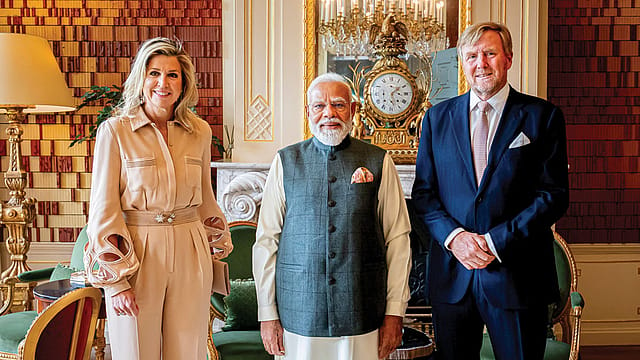
Tucked away in the list of outcomes following Prime Minister Narendra Modi’s five-nation tour that concluded on May 21 is a commitment to support safe transit and unimpeded navigation through the Strait of Hormuz in keeping with the channel’s linkage to energy, food security and regional stability.
The unsaid part of India’s support to safe and free navigation is the presence several destroyers, frigates and patrol vessels in the Gulf-Indian Ocean-Arabian Sea region that can escort commercial cargo ships once they sail out of the Strait of Hormuz. The Gulf of Oman, where the Arabian Sea meets the Hormuz bend, is a crucial patch of water where Indian naval vessels, equipped with airborne units and even marine commandos, are available for quick deployment.
Green Transition
The areas of energy security and green transition were cross-cutting themes in Modi’s itinerary but the strong defence component was not unconnected to the energy discussion. Defence industrial collaborations, training and exercises, secure communication and swift exchange of information were shared concerns and acquired a sharper profile during Modi’s visit to the United Arab Emirates (UAE) where the war in the Middle East has the most immediate fallout.
The Age of Anger
31 Jul 2026 - Vol 05 | Issue 31
A raging generation makes the government relent. What's next?
The salience of energy to the discussions was not surprising as India adjusts to the prospects of continued high oil prices that are likely to require some belt tightening but maritime cooperation and the blue economy were a “geopolitical-economic” pillar with UAE, the Nordic nations and Italy all representing interests, resources, technology and manpower in the sphere.
Dutch hand in Kalpasar Dam
Modi’s visit to the Afsluitdijk dam in the Netherlands was more than an excursion. The 32-km causeway is a successful reclamation project, a transport link and offers flood protection. The dam, which has received a facelift recently, offers learnings for India’s coastline management and specifically the Kalpasar dam proposed to be built across the Gulf of Khambat which aim to create a large fresh water reservoir that will meet drinking water and irrigation needs and encourage pisciculture as well. It dam is expected to exceed 30 km and incorporates road and rail links.
In Sweden, a virtual India-Sweden science and technology centre, an AI corridor, a start up platform, proposals for an annual India-Europe CEO roundtable and an India desk at the forum gave practical shape to the commitment of both sides to elevate their ties. Health technology and green mobility were also areas where Swedish finance and expertise can help India. Modi invited European companies to participate in India’s telecom and digital infrastructure, AI, semi-conductors, electronics, deep tech, mobility and urban transformation.
Health, mobility and Innovation
The Norway leg of his visit saw the organisation of four round tables on healthcare innovation, maritime cooperation, batteries and energy storage, digitalisation and wind energy. India pitched for Norwegian investments in the blue economy, ship building, green transition, renewables, health technology and critical minerals. The third India-Nordic summit was defined by a green technology and innovation strategic partnership which aims to combine Nordic capacities with India’s scale and talent.
The final halt at Italy was similarly packed with government-level and business engagements an defence industrial roadmap that supports co-design, co-development and co-production. This would include helicopters, naval platforms, marine armament and electronic warfare. As in other discussions, a framework for cooperation in critical minerals found due mention. An MoU between Italy’s financial investigation agency and the Enforcement Directorate explores joint action against tax crimes, money laundering and terror finance.
There is even a specific declaration that will facilitate mobility of nurses from India to Italy, an important initiative given the uncertainties in the Gulf region. Higher education institutional linkages, maritime infrastructure, agricultural research and climate change studies came in for detailed discussions while textiles, semi-conductors, automotives, pharma and ports were at the heart of India-Italy economic agenda.