Chandrayaan-3 Wins Prestigious 2026 AIAA Goddard Astronautics Award
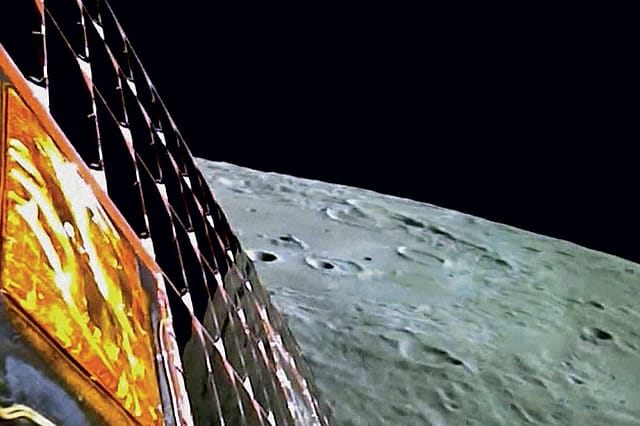
Chandrayaan-3 has been awarded the prestigious 2026 Goddard Astronautics Award by the American Institute of Aeronautics and Astronautics (AIAA), recognising the mission’s groundbreaking achievements in lunar exploration.
The award was presented in Washington DC on May 21 during the AIAA ASCEND 2026 Conference.
The recognition comes nearly three years after Chandrayaan-3 created history on August 23, 2023, by becoming the first spacecraft to successfully achieve a soft landing near the Moon’s south pole — a region considered scientifically significant and strategically important for future exploration.
The mission marked a defining moment for Indian Space Research Organisation and positioned India among the world’s leading spacefaring nations.
Why Was the Moon’s South Pole Mission So Significant?
Before Chandrayaan-3, no spacecraft had successfully landed near the Moon’s south polar region.
Scientists consider the area crucial because of its permanently shadowed craters, which are believed to contain water ice and other valuable resources that could support future long-duration lunar missions.

Greening the Future
23 Jul 2026 - Vol 05 | Issue 30
Securing a sustainable India
According to the award citation, Chandrayaan-3 delivered critical scientific data that could help support future human exploration of the Moon.
The mission also confirmed the presence of important chemical elements in the lunar south polar soil, strengthening hopes that local resources could one day be used for manufacturing operations and sustained human activity on the Moon.
The success of the landing demonstrated India’s growing expertise in precision space navigation, autonomous landing systems and deep-space exploration technologies.
Who Accepted the Award on India’s Behalf?
Vinay Kwatra accepted the award on behalf of ISRO during the ceremony in Washington DC.
During his remarks, Ambassador Kwatra highlighted Narendra Modi’s Space Vision 2047, which outlines India’s long-term ambitions in human spaceflight, deep-space exploration and expansion of the country’s commercial space sector.
He also emphasised the importance of stronger collaboration between India and the United States in space research and technological innovation.
The event reflected the growing strategic partnership between the two countries in advanced scientific and space-related fields.
What Is the Goddard Astronautics Award?
The Goddard Astronautics Award is regarded as the highest honour conferred by AIAA for exceptional achievements in astronautics.
The award can be presented either to an individual or a team for contributions that significantly advance the field of space science and exploration.
It was established in memory of pioneering rocket scientist Robert H. Goddard, whose early experiments with liquid-fuel rocket engines laid the foundation for modern astronautics.
The award was endowed by Mrs Goddard in honour of her husband’s contributions to space technology and engineering.
Its present format was introduced in 1975, when AIAA expanded the scope of the earlier Goddard Award to recognise broader achievements in astronautics beyond propulsion science alone.
What Does This Mean for India’s Space Programme?
The international recognition for Chandrayaan-3 is another major milestone for India’s rapidly growing space programme.
In recent years, ISRO has expanded its ambitions from satellite launches and planetary exploration to human spaceflight missions and commercial space ventures.
The success of Chandrayaan-3 has also strengthened India’s global standing in lunar exploration, especially at a time when multiple countries are preparing for future Moon missions and long-term lunar habitation projects.
The award further highlights how India’s space achievements are increasingly being recognised not only for technological innovation but also for their contribution to the future of global space exploration.
(With inputs from ANI)