Great Burden: British Prime Minister Keir Starmer has brought his country, his party and himself to the brink
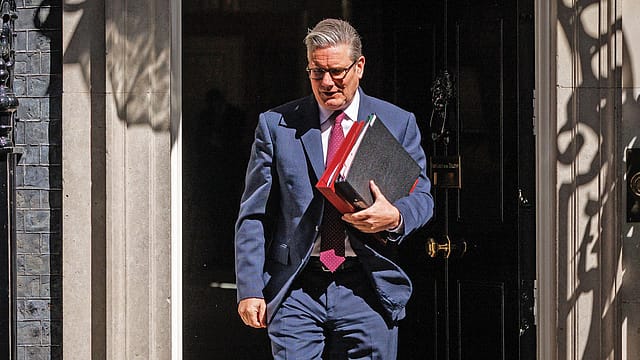
RIDDLE ME THIS. How, in the space of twenty-two months, did Sir Keir Starmer go from being the most successful Labour leader in history to the most unpopular prime minister ever? A record electoral majority in July 2024 has speedily turned into the worst recorded poll ratings for a premier, a political failure that leaves us facing some very uncomfortable questions.
Have we run out of capable leaders? Is our administrative machine still capable of producing effective government? Where does democracy come in if a parliamentary landslide degenerates so swiftly into demands for major changes of government policy?
Keir Starmer is now widely perceived as an ineffective leader. Having stood on a political platform of ‘change’, he seems to have delivered very little of it. The public have noticed, and Labour’s disastrous results in recent local elections means that he is now facing political assassination. Ninety of his own MPs have urged him to go and five ministers have resigned.
Starmer has declared that he will fight on, but he has refused to set a timetable for an orderly resignation and succession contest. So, as a country we now lack leadership until further notice.
Where, then, did Starmer go wrong?
The crisis started when a senior cabinet member, Wes Streeting, resigned and declared that he had lost confidence in Starmer’s leadership. But he did not challenge Starmer directly, leading to fevered speculation about what exactly the game was. If Streeting was not promoting himself, then what was he doing? Streeting is not widely popular within the Labour Party, because he is considered to be positioned to Starmer’s right. Starmer is already perceived as too rightwing by the party’s rank and file, so running from a position to the current leader’s right would seem to be a political dead end.
So, is there some kind of joint manoeuvre in progress? Are cabinet members trying to put together some kind of balanced, left-right dream ticket to replace Starmer?
It seems that the Labour Party isn’t yet convinced that changing either its leader or its policies will recover any level of viable popularity before the next general election, due in 2029. Unless Labour can somehow reconnect with its traditional base, opinion polls show that Reform UK, the insurgent populist rightwing party, may well grow from five seats in 2024 to a majority in 2029.
‘No drama’ Starmer has struggled from the start to project an image of strong leadership. He has always seemed somewhat miscast, and has regularly changed his chief of staff and communications team. His record in office is also littered with U-turns, such as on welfare reform, and poor judgments, such as appointing the scandal-wracked Lord Mandelson as ambassador to the US. Abandoning ‘Starmerism’ might therefore be good for the party, but the problem is that nobody really knows what Starmerism is, and the man himself has gone to some trouble to disavow the idea that there is any such thing.
So, what then would any leadership contest be about? Would it simply be the much-derided ‘popularity contest’ that serious people on the left are always trying to avoid? Currently all we know is that, as party leader, Starmer’s name will automatically be put forward in any leadership ballot, should he wish to defend his position.
British politics is ill-equipped to replace a sitting prime minister because of party discontents; the Tories dumped Margaret Thatcher in 1990 on that basis, but it was a messy business that divided the party for a generation. We are more used to electing a prime minister and seeing that prime minister standing at the next election, at which point their position is confirmed or their employment is terminated. But this is no longer the norm in British politics. Of the five changes of premier since 2010, when Gordon Brown gave way to David Cameron, it has only happened once, in 2024, when Starmer displaced Rishi Sunak.

There is a real constitutional issue here. If a prime minister is toppled, does that entitle the new leader to adopt a new set of policies? Doing so would effectively disenfranchise the electorate who chose the previous incumbent based on a manifesto which was discussed by the nation. So, a new leader elected by a party in government should either continue with the policies as confirmed by the voters at the last general election, or ‘go to the country’ to obtain a new mandate. The last thing the Labour Party seems minded to do is to call an election, in view of its recent rout in the local elections. So can Labour change course at all?
The party is in the mood to install a leader who will bend a little more to the left, which may allow it to feel good about itself till the next general election. But what, we might ask, will the British people think of a party that has essentially hijacked their mandate in order to implement policies they never would have been elected upon?
That sort of behaviour would only serve to reinforce the point currently being made by Reform UK—that the country is being led to destruction by a bunch of self-serving careerists who are contemptuous of the people’s wishes.
The plotting also means that senior Labour figures are also endangering their own political futures in ways that could be highly damaging, especially for the front runner, Andy Burnham.
Burnham, once a minister in the Blair-Brown administration, has since reaped much popularity as the metropolitan mayor of Greater Manchester, which has gone a long way to erasing the memory that he twice failed to win election as Labour leader, losing to Ed Miliband in 2010 and to Jeremy Corbyn in 2016. But with humble roots in Liverpool, Burnham comes across like a proper ‘old Labour’ figure. He also comes with an air of competence; his success in Manchester has earned him the title of ‘king of the north’.
He is therefore trying to tread the same path as Boris Johnson who, when he found his rise to senior conservative ranks baulked, spent two successful terms as mayor of Greater London before returning to the House of Commons in 2015 on a wave of popularity, ready for a run at the premiership.
BURNHAM MAY BE following the Johnson playbook, but he faces real problems. One is that Johnson had a comparatively easy transition from mayor of London to member of parliament. Having announced his intention to stand as an MP while still mayor, he was able to serve out his notice and jump from one job to the other in the general election of 2015. Burnham has missed this opportunity, and must make the sacrifice of standing down as mayor before he can become an MP, because he cannot be Labour leader, and thus prime minister, unless he is in the House of Commons.
He has tried to get there once already, when a by-election was called in the Manchester area last February, but he was unable to run for Labour in Gorton and Denton because the party’s National Executive Committee (NEC), stuffed with Starmer loyalists, refused to sanction his candidacy on the grounds that he was still mayor of Manchester, and that if he resigned it would create a vacancy which the party would have to defend, with the likelihood of losing the mayoralty to Reform.
The electoral threat from Reform is very real, and they nearly won in Gorton and Denton. Equally ominously, the Labour candidate did not win, coming third behind Reform and the eventual winner from the Green Party.
But times have changed since February. The Mandelson scandal and the local elections have weakened Starmer, and another seat in the northwest, Makerfield, has just become vacant. It is currently held by Labour with a majority of 5,000, and this time the NEC has granted Burnham permission to stand, though he must lay down the mayoral chain of Manchester to do so. We do not yet have a fixed date for the by-election, though June 18 seems likely.
The good news for Burnham is that during the last mayoral election, in 2024, he won 62 per cent of the vote in the district. The bad news is that in the local elections of a fortnight ago, Reform polled over 50 per cent. So, this will not be an easy ride for him, and it might well be that a Labour leadership election, if and when it comes, may not include him in the runners.
Observers have not failed to note the irony that in Makerfield a fortnight ago the Reform candidate was saying “Vote for me and get rid of Starmer”. Burnham will shortly be saying exactly the same thing.
Burnham’s candidacy in Makerfield is both a high-risk path for him and a moment of acute danger for Starmer. If Burnham wins, he can look forward to a coronation as the new prime minister. If he loses, he will be out of both national and regional politics, and so might miss out on the leadership contest he has long been willing to provoke. But even if he wins, he will have to beat Reform handsomely if he is to claim that he is the political Messiah who can defeat the populists and pull the Labour Party to the left while carrying the voters with him.
There are further complications for the party, because although there is no vacancy at the moment, there are other heavyweights who would enter the ring alongside the royal northerner. The biggest beasts are Wes Streeting, whose recent resignation as health minister triggered the current speculation about a leadership election, and Angela Rayner, who was until recently deputy leader of the party but had to stand down after a scandal over tax payments.
Streeting sits to the right of Burnham, and Rayner to the left; Streeting is smooth and unpopular with the party, whereas Rayner is abrasive but possibly even more popular with the party than Burnham. None of the three seems poised to continue Starmer’s line on any of the major policy issues facing the government, including the tricky subject of Brexit—how and when to get closer to the European Union (EU), if at all.
But stick or twist, stay or go, none of this manoeuvring is likely to reverse the long-term decline in the Labour Party’s popularity, so vehement is the feeling of disappointment and so intractable are the government’s problems, which include rising prices, low growth, insecure employment, unaffordable housing, high levels of informal migration, and ingrained pessimism.
The best that could happen is that a relative newcomer comes through to win and immediately begins to make changes that deliver measurable improvements in people’s lives. Who that person could be, and what those changes might entail, is anybody’s guess.
The worst thing that could happen is that Starmer decides to fight for his position and, after a protracted series of bitter public debates, somehow wins a leadership contest because the party loses its collective nerve and decides to stay with nurse for fear of something worse. This will not mend Starmer’s image problem, nor will it change the policy agenda he is (or is not) implementing, but it will make the Labour Party look weak and self-obsessed.
Within less than two years of a resounding electoral triumph, Starmer’s whole political project, his personal standing and his party’s credibility stand in danger of destruction. If Burnham wins in Makerfield, Labour members may believe that a fairytale redemption is possible, but even then, the party will not easily shake off its policy confusions, nor can it credibly swap Starmer’s caution for an ideological joyride of public spending.
The whole thing resembles nothing more than a ghastly mess, and in all events, the Labour Party risks earning the absolute contempt of a large part of the British electorate, who have seen it allow the worst kind of personal ambition played out in front of them.