Why Xi Invoked Thucydides
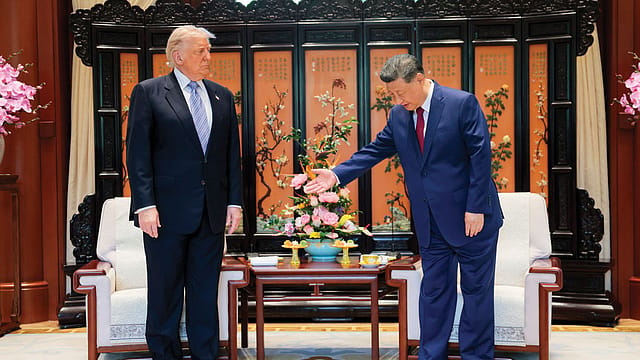
FOREIGN POLICY experts are still discussing why Chinese leader Xi Jinping brought up the concept called “Thucydides Trap” in his recent meeting with US President Donald Trump in Beijing. Was Xi suggesting to Trump that China didn’t have any intent for conflict with the US? Or was he warning them not to force one? The “Thucydides Trap”, a political theory from Harvard Kennedy School’s Graham Allison, denotes a situation in which war is inevitable between an established ruling power and a rising rival. This concept originates from ancient Greek historian Thucydides, who noted that the Peloponnesian War emerged from Sparta’s fear over the ascent of Athens.
What Xi wanted to know from Trump was whether there were ways to avoid that trap. And yet, to understand whether it was indeed a request, a suggestion or, in fact, a threat, we need to examine the Chinese way of political communication.
Chinese leaders are masters of the art of communication with their people and the world. Like the Communist Party of the Soviet Union, the Chinese communists also accepted mistakes of the past before forging ahead with reforms. But unlike the Soviets, the Chinese never delegitimised the Communist Party by trashing their icons. They engineered reforms without demoralising the people and their faith in the system, by carefully calibrating how they communicated. This statement by the great Chinese leader Deng Xiaoping, who placed pragmatism over ideology, epitomises such skills: “It doesn’t matter if a cat is black or white, so long as it catches mice.”
Relations between the US and China began to sour around 2017 after decades of rapprochement spurred by Deng’s vision for China. By the end of 2016, Americans sensed intense competition from the country with which they had established friendly relations in 1972. What followed were tensions in the South China Sea, trade disputes and technology wars. The Western media promptly began beating the drums of war even as China stood encircled thanks to American military presence in the region. All this was prompted by fear. For his part, Chinese venture capitalist and political scientist Eric Li attributes this fear to the Western mindset. According to him, Christianity is about converting people to one’s belief, which guides the West. While he says he is not passing judgement, Li adds: “The Chinese are not into it. We built the Great Wall of China to keep the barbarians out, not to invade.”
In this context, Xi was seen as projecting his country as a responsible entity interested in peaceful coexistence, placing the ball in Trump’s court to decide his country’s course of action. In his book Slogan Politics: Understanding Chinese Foreign Policy Concepts, Jinghan Zeng advises readers on how not to read slogans from the Communist Party of China (CCP). The book analyses the three most important Chinese foreign policy concepts on Xi’s watch: “New Type of Great Power Relations”, “Belt and Road Initiative” and “Community of Shared Future for Mankind”. The author argues that these concepts are used primarily to test domestic and international responses, as well as to attract sympathy.
Unlike in the ancient past, the world is at a stage where trade ties bind nations more strongly than ever before. Yet, scholars were simultaneously predicting a military confrontation between China and the US. The US strategy called “Pivot to Asia” and media hype over a “China with territorial ambitions” had begun long ago. In fact, the late John Pilger made a film in 2016 titled The Coming War on China by tracking previous American actions. But Americans have been drawn back into the Middle East following the 2023 Hamas attack. In that sense, amidst his efforts, in scholar Nathan Sperber’s words, “to reconstruct a new manner of absolutist, party-centric system”, Xi has succeeded in making the world believe that, after all, it is America’s call whether to seize this fraught opportunity—its Middle Eastern preoccupation—to rebuild ties.