West Asia Conflict: Israel Strikes Hezbollah Targets in Beirut After Rocket Fire from Lebanon
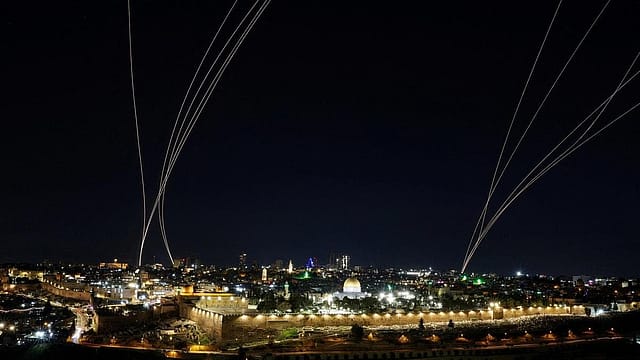
The conflict in West Asia escalated further on Monday after Israel launched airstrikes on Hezbollah targets in Beirut and other parts of Lebanon following projectile fire from Lebanese territory into northern Israel, marking a significant widening of hostilities in the region.
The Israeli Air Force (IAF) said in a series of posts on X that it carried out targeted strikes against senior members of Hezbollah in the Beirut area in response to projectile fire launched toward Israel, particularly towards the north of the country.
According to the military, several projectiles crossed from Lebanon into Israeli territory, with some falling in open areas.

Zeroing In on ECI
09 Oct 2026 - Vol 05 | Issue 41
Constitutional legitimacy versus political opportunism
In certain cases, no alerts were activated in accordance with policy. "Following alerts that were activated in several areas in the north of the country, the Air Force intercepted a launch that crossed from Lebanon; individual launches fell according to policy. No injuries or damage were reported," the IAF said in a separate post.
How Is Israel Responding to Hezbollah’s Role in the Escalation Under Operation “Roaring Lion”?
In an initial report, the Israeli military confirmed that sirens were activated in several areas in northern Israel after launches from Lebanese territory, adding that details were under investigation.
"The terrorist organization Hezbollah, operating under the auspices of the Iranian terrorist regime, opened fire against the State of Israel and its citizens. The IDF will act against the terrorist organization Hezbollah's decision to join the campaign and will not allow the organization to pose a threat to the State of Israel or harm residents of the north," the military said in another post.
The Israeli military further stated that Hezbollah was responsible for the escalation and warned of a forceful response, adding that its forces had prepared for such a scenario under Operation "Roaring Lion" and were ready for a multi-front conflict.
The latest exchange of fire comes amid an unprecedented amount of projectile firing across several regional countries and follows US-Israel joint military strikes on Iran that led to the death of the country's Supreme Leader, Ayatollah Ali Khamenei, and his family on Sunday.
Following the strikes, Iran launched a wave of retaliatory strikes, using drones and missiles targeting multiple Arab countries in the region, as a retaliatory action by the Islamic Republic.
Israel’s Ambassador to India, Reuven Azar, said his country is engaging with several nations, including India, as the situation in West Asia remains volatile following coordinated strikes on Iran.
Azar said Israeli Foreign Minister Gideon Saar and External Affairs Minister S. Jaishankar remain in touch over the developments.
"They exchanged views on the situation, and we are communicating to all our friends and colleagues, the aims of this operation, the concerns of the State of Israel and the reasons why we could no longer live with this threat," the Israeli envoy told ANI.
How Did Israel’s Envoy Justify the Strikes on Iran Over Nuclear Threat Concerns?
Defending the strikes on Iran, he said that Iranians could have become immune and developed their nuclear weapon if the status quo had continued.
"The imminent danger is that the Iranians will not only go underground, but go underground to the extent that they will be completely immune to an attack targeting their capabilities. And, they decided to build a nuclear weapon. So, we don't want to get into a situation as we have with North Korea, for example. That would be terrible for the region," he said.
"It would mean that the Iranian regime would have carte blanche to intimidate and attack any country in the region, even in a more aggressive way than the way that they've been doing that in the past. This action, I think, is going to make the entire region of West Asia a much more stable region than it was," he added.
Azar further said that the Iranian forces are a bunch of ruthless killers.
"We don't know whether they will be able to do so, because don't forget the Basij forces and the Revolutionary Guard Corps are ruthless. They are a bunch of killers. They have been, without hesitation, killing multiple people, tens of thousands of Iranians, only a few weeks back,” he said.
"They've been trying to kill dissidents all around the world for decades now. It's not an easy thing to rise up against such oppression. We hope that Iranians will do that," he added.
Calling it a moral responsibility, the envoy said Iranians should be given hope by both the US and Israel.
"We are hearing a lot of voices of thanks from a lot of Iranians around the world and in Iran itself. Many people are celebrating this moment, and I hope they will be able to turn this moment into a moment of change that will bring a brighter future and a more rosy future for the people of Iran. They deserve a better future free from this terrible oppression that they have been suffering from for decades," he added.
What Did Donald Trump Say About Possible Talks With Iran’s New Leadership?
US President Donald Trump claimed that Iran's new leadership wants to talk with his administration and that he plans to engage in talks.
"They want to talk, and I have agreed to talk, so I will be talking to them," he was quoted as saying by The Atlantic magazine.
"They should have done it sooner. They should have given what was very practical and easy to do sooner. They waited too long," Trump added, as quoted by Al Jazeera.
(With inputs from ANI)