Pakistan Sliding into Dictatorship, Says Imran Khan’s Son; Lawyer Targets Army Chief Asim Munir
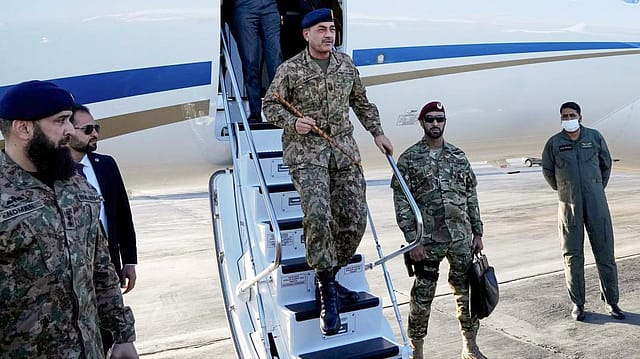
Pakistan is sliding deeper into dictatorship and the imprisonment of former Prime Minister Imran Khan is its clearest warning, his son Sulaiman Isa Khan said on Tuesday.
Speaking at a virtual press conference on Khan’s detention and health, Sulaiman accused the country’s military-led establishment of expanding its influence over governance and targeting political opponents through arbitrary detention and alleged mistreatment.
“I would say, with some of the actions we’ve seen, I think yes, undoubtedly,” Sulaiman said when asked whether Pakistan was moving towards dictatorship.

Zeroing In on ECI
09 Oct 2026 - Vol 05 | Issue 41
Constitutional legitimacy versus political opportunism
“I don’t think there’s any doubt that the whole establishment is involved,” he added.
Khan, the founder of Pakistan Tehreek-e-Insaf, has been imprisoned at Rawalpindi’s Adiala Jail since 2023. His family and legal team have repeatedly questioned his conditions in custody, access to independent doctors and the cases filed against him.
Sulaiman was joined at the press conference by his brother Kasim Khan, international counsel Jared Genser and PTI adviser Sayed Bukhari.
Genser directly accused Pakistan’s Army Chief, General Asim Munir, of presiding over an “authoritarian regime” and argued that the cases against Khan formed part of a wider assault on democratic institutions and political dissent.
“The actions that we’re seeing taken on Imran Khan and his wife’s cases are not the actions of a healthy, functioning democratic government,” Genser said.
He alleged that hundreds of cases had been filed against Khan on fabricated charges and accused the authorities of manipulating Pakistan’s institutions to retain an “iron grip on power”.
“When you’re talking about repressing the fundamental human rights of thousands of activists, but also just the wider population, and all the ways in which the entire system is being manipulated, there’s no doubt that General Munir is running an authoritarian regime,” he said.
Genser described Khan’s detention as a “bellwether” for Pakistan’s political direction. The former prime minister’s continued imprisonment, he argued, was intended to discourage others from challenging those in power.
“With him in prison, it’s very clear that the regime is trying to send a message to the people of Pakistan that they better not stand up,” he said.
“Imagine if we can do this to Imran Khan, who everyone in the world knows about. What could we do to you, someone who the world doesn’t know about?”
The allegations come amid a fresh dispute over Khan’s medical treatment.
On August 18, a three-judge bench of Pakistan’s Supreme Court directed the authorities to shift Khan to Shifa International Hospital in Islamabad within 48 hours for treatment and a comprehensive medical examination.
The court ordered that he be assessed by an independent panel consisting of a cardiologist, an eye specialist, a general physician and Khan’s personal doctor, Dr Faisal Sultan.
The direction cited a prisoner’s fundamental right to healthcare under Pakistan’s Constitution.
Khan was instead taken on August 20 to the government-run Pakistan Institute of Medical Sciences, where he underwent an examination before being declared medically fit and returned to Adiala Jail.
His legal team alleges that the authorities sent a decoy convoy towards Shifa International Hospital, creating the impression that Khan was being taken there. It claims Dr Sultan waited at Shifa but was denied the opportunity to examine him, while the independent medical panel ordered by the court was never constituted.
Khan’s Pakistani counsel is now expected to approach the Supreme Court seeking contempt proceedings over what the team describes as a failure to comply with its order.
His international lawyers are also preparing what Genser called a “sustained campaign” of legal, political and public advocacy. The effort will seek to draw the attention of foreign governments, multilateral organisations and civil-society groups to the treatment of Khan and his wife.
The UN Special Rapporteur on Torture and the UN Committee Against Torture have previously raised concerns about Khan’s alleged mistreatment, according to his legal team.
For Sulaiman, his father’s imprisonment has grown into something larger than one politician’s legal battle. It has become, he argued, a test of whether opposition, dissent and democratic competition can survive Pakistan’s tightening military grip.
(With inputs from ANI)