Donald in Wonderland: Trump Wants ‘Lake America’ as Canada Trade War Gets Curiouser
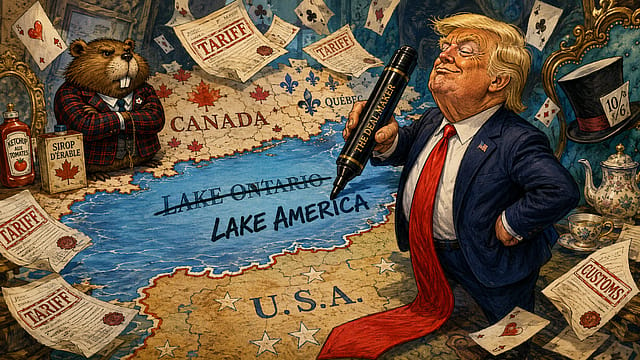
Donald Trump has found a new weapon in America’s trade war with Canada. A marker pen.
The US president now wants to rename Lake Ontario as “Lake America”, apparently because tariffs have made its existing name commercially inconvenient. “The United States is giving serious consideration to changing the name of Lake Ontario to Lake America in that we don’t expect to doing much business with Ontario any longer,” Trump wrote on Truth Social.
Trade negotiations had collapsed. Tariffs had landed. Canada had promised retaliation. French labels had entered the battlefield. So Trump did what Trump does. He took an economic dispute, poured nationalism over it and tried to redraw the map.
Welcome to Donald in Wonderland, where lakes can be renamed when trade talks fail, Canada conducts an imaginary 95% of its business with America and the French language becomes either a fundamental right or a “funny fake story”, depending on which side of the border is speaking.

Zeroing In on ECI
09 Oct 2026 - Vol 05 | Issue 41
Constitutional legitimacy versus political opportunism
The dispute is real. The geography lesson is where things become curious.
Lake Ontario is not an American lake saddled with an inconvenient Canadian name. It is shared by Canada and the United States, with Ontario on one side, New York on the other and the international boundary running through it. Its drainage basin covers parts of both countries, while its waters flow into the St Lawrence River and eventually the Atlantic. The lake covers roughly 19,000 sq km, according to the US National Oceanic and Atmospheric Administration.
Even the word “Ontario” long predates Trump’s quarrel with the province. It comes from an Indigenous name, commonly understood to mean “great lake” or “beautiful lake”.
Trump could direct US federal agencies to adopt a different name, as he did after returning to office in 2025 with the Gulf of Mexico. But that order carried authority only within the United States. Mexico, international organisations and foreign mapmakers were under no obligation to follow it, as the Associated Press explained.
The US Board on Geographic Names standardises terminology for federal use. It does not give an American president the power to compel Canada, the rest of the world or the lake itself to accept a new identity. The board describes its role as standardising, rather than regulating, geographic names, and considers proposed changes in consultation with federal, state, tribal and local agencies, according to the US Geological Survey.
Trump may be able to produce “Lake America” on American government maps. He cannot make Lake Ontario stop being Lake Ontario to Canada.
That distinction appears unlikely to trouble him. The renaming threat arrived after the United States imposed 50% tariffs on about $20 billion worth of Canadian imports following the collapse of negotiations. Trump has also threatened to raise tariffs on Canadian cars, trucks, automobile parts and steel to 50% from January 1, 2027.
Canada answered with tariffs worth C$27.6 billion, or nearly $20 billion, on more than 700 categories of American products. The measures, ranging from 15% to 50%, are scheduled to take effect on September 8 and cover goods including steel, aluminium, cheese, appliances, seafood, electronics, clothing and tools. Ottawa also announced a C$7.5 billion support package for affected businesses and workers, Reuters reported.
The trade war, in other words, has already moved well beyond social-media theatre. It threatens supply chains, factories, jobs and prices on both sides of one of the world’s most commercially active borders.
But Trump has reduced the relationship to a familiar boast. “We don’t need Canada, they need us,” he declared, claiming that Canada conducts 95% of its business with the United States while America does “the exact opposite”.
Canada unquestionably depends heavily on the American market.
The number Trump used, however, bears little resemblance to the official data. Statistics Canada says 71.7% of Canadian merchandise exports went to the United States in 2025, down from 75.9% a year earlier. The US accounted for 58.8% of Canada’s merchandise imports. Canada’s trade with countries other than the United States, meanwhile, rose to C$553 billion during the year. That is dependence, certainly. It is not 95% of all business. Statistics Canada supplies the less theatrical arithmetic.
America is hardly indifferent to the relationship either. US goods and services trade with Canada totalled an estimated $872.3 billion in 2025. American exports to Canada reached $425.9 billion when goods and services are combined, according to the Office of the US Trade Representative. Canada can be more dependent on the United States without being dispensable to it. Both statements can be true, even in Wonderland.
Then came the battle over French. Canadian Prime Minister Mark Carney said American negotiators had raised French-language product labelling and the discoverability of French and Canadian programming on streaming platforms as trade irritants. Canada recognises English and French as its official languages, while French is central to the cultural and political identity of Quebec.
Carney drew his line clearly. “For Americans, French language, the Francophone culture, the Canadian culture, these are irritants,” he said. “Here in Quebec, here in Canada, these are rights, basic rights, fundamental rights.”
In an official statement after suspending the negotiations, Carney said Canada had been prepared to compromise on tariffs and market access but would not surrender its sovereignty, weaken key industries or dilute protections for French and Canadian culture. The United States, he said, had “asked too much and offered too little”, according to the Canadian prime minister’s office.
Trump called Carney’s account a lie invented by a “weak and ineffective Prime Minister” seeking political support in Quebec. “I would never interfere with Canadians speaking French,” Trump wrote. “I love French Canadians!”
But Carney had not accused Trump of banning anyone from speaking French. The disagreement concerned regulations that require bilingual labelling and promote Canadian, French-language and Indigenous content on streaming platforms. Trump answered a broader and more dramatic accusation than the one Canada had made.
That, too, is becoming a feature of this trade war. Canada speaks about regulations. Trump hears cultural persecution. Negotiators discuss tariffs. Trump announces a new lake.
Behind the comedy lies a serious escalation. The United States and Canada have spent decades weaving together automobile manufacturing, energy markets, agriculture, defence and critical supply chains. A vehicle can cross the border several times as different components are manufactured and assembled. Tariffs do not merely punish a foreign country at the gate. They travel through factories and return in the form of higher costs, disrupted production and pressure on workers.
Canada is the largest export market for dozens of American states. The two countries also share electricity grids, energy pipelines, defence arrangements and management of the Great Lakes. A 1909 treaty established the framework through which they manage boundary waters.
Trump’s “Lake America” fantasy, therefore, captures something larger than another eccentric naming proposal. It turns interdependence into an insult and a shared geography into a possession.
The United States can tax Canadian steel. Canada can tax American cheese. Trump can instruct federal officials to type “Lake America” into American databases. But the lake will remain between two countries, fed by shared waters and indifferent to Truth Social. Donald can rename the map. He cannot rename the facts.
(With inputs from ANI)