It came for the gold, found the judges instead: Weightlifting robot crashes at World Humanoid Robot Games
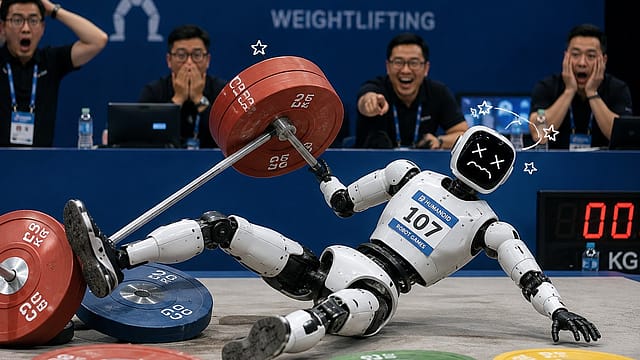
For a brief moment, it looked like the future of sports had arrived.
A humanoid robot stepped up to the platform at the World Humanoid Robot Games in Beijing, prepared to show off its strength in a weightlifting event. Cameras were rolling. Judges were watching. Engineers were hoping for a clean lift.
Then gravity entered the chat.
Instead of completing the attempt, the robot reportedly lost its balance, stumbled forward and crashed directly into the judges' table, creating one of the most memorable moments of this year's competition. Videos of the mishap quickly spread online, turning the would-be weightlifting star into the accidental comic hero of the tournament.

Zeroing In on ECI
09 Oct 2026 - Vol 05 | Issue 41
Constitutional legitimacy versus political opportunism
A robot weightlifter's big moment lasted only seconds
The incident occurred during the ongoing World Humanoid Robot Games in Beijing, a competition designed to test how closely machines can mimic human athletic and practical abilities.
According to footage shared from the event, the robot struggled while attempting a lift. Instead of stabilising itself, it pitched forward and slid into the officials' area, sending spectators into a mix of laughter, surprise and concern. No serious injuries were reported.
The scene looked less like the Olympics and more like a blooper reel.
Why do robots keep falling at robot games?
Because walking is hard.
Humans learn balance over years. Humanoid robots have to calculate it thousands of times every second.
Researchers say that while modern robots can run faster, jump higher and react quicker than ever before, maintaining stability during complex movements remains one of robotics' biggest challenges. A slight shift in weight, an unexpected force or a miscalculated step can turn a perfect performance into a spectacular faceplant.
And Beijing has seen plenty of those.
The World Humanoid Robot Games have produced both records and wipeouts
The irony is that the same event producing viral crashes is also producing astonishing achievements.
According to Reuters, humanoid robots at this year's games have broken human world records in sprinting and high jump events. One robot reportedly ran the 100 metres in 9.39 seconds, faster than Usain Bolt's world-record time. Others have impressed judges in football, table tennis, boxing and industrial task simulations.
Yet for every record-breaking run, there seems to be a robot that forgets how to stop.
Earlier in the competition, another humanoid robot went viral after crashing into a safety barrier during a running test, with sparks flying from its body on impact.
The future, it turns out, is still a little clumsy.
Why are these robot failures actually good news?
Because engineers often learn more from a crash than a victory.
The World Humanoid Robot Games are not just entertainment. They are effectively giant public stress tests for emerging technology. Every fall, collision and malfunction generates data that developers use to improve balance systems, movement algorithms and safety mechanisms. Many of the competition's most important events reportedly focus not on speed but on whether robots can perform real-world tasks reliably and recover from mistakes.
A robot crashing into a judges' table may look embarrassing.
To an engineer, it is a free lesson.
What does the crash tell us about the future of robots?
That the robot revolution is arriving exactly as technology revolutions usually do: with a mix of brilliance and chaos.
One minute a machine is breaking athletic records. The next minute it is introducing itself to a judges' table at high speed.
The Beijing games have showcased both realities. Robots are becoming faster, stronger and more capable than ever before. But they are also reminding everyone that intelligence and balance are not always the same thing.
For now, the gold medal for entertainment may not belong to the fastest robot.
It may belong to the one that accidentally tried to judge the competition from the inside of the judges' table.