Countries Like India Can Chart Their Own Course, Won’t Always Agree With US or China: Rishi Sunak
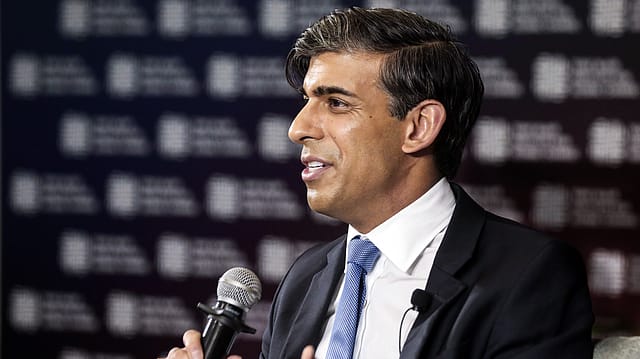
Former UK Prime Minister Rishi Sunak said on Tuesday that countries like India and those in the Gulf are increasingly able to chart their own course in a changing global order, and will not always agree with the United States or China.
Speaking at the Bloomberg New Economy Forum 2026 in the national capital, Sunak said the world is moving away from the multilateral, rules-based framework that shaped the global economy. That shift, he said, has created fresh uncertainty and risk.
Sunak said that people had long invested and operated within a multilateral, rules-based system. He said US President Donald Trump is not the cause of the change but a symptom of it. “We don’t quite know what we’ve settled down to,” he said, adding that this creates “an enormous amount of geopolitical uncertainty and indeed danger”.

Zeroing In on ECI
09 Oct 2026 - Vol 05 | Issue 41
Constitutional legitimacy versus political opportunism
CHINA AS A PEER COMPETITOR
Sunak pointed to China’s emergence as a peer competitor to the US across economic, military and technological domains. He called this a new feature of the world economy.
Sunak said countries such as India and those in the Gulf can now follow independent approaches and will make decisions in their own interest rather than automatically aligning with Washington or Beijing. “They’re going to do what they want, and that’s a new feature,” he said.
Expressing concern about the global security situation, Sunak said there are more armed conflicts now than at any point since World War II. He put the number of state-based conflicts at 61. “I look at that, and I’m worried,” he said.
He added a remark about Trump: “I think President Trump probably looks at that and thinks 61 opportunities to win the Nobel Peace Prize.”
“A WORLD GOVERNED BY FORCE”
Sunak also referred to comments by the US President’s deputy chief of staff, who said the world is governed by force, strength and power. Sunak called this view somewhat extreme but said that hard power matters more today.
States, he said, have realised that their economic security cannot be separated from their national security and technological strength. He described the result as a “cocktail of risks”.
The session, titled “The End of Predictability”, looked at what leadership means at a time when uncertainty, fragmentation and disruption define the global economy. It also featured Natarajan Chandrasekaran, Chairman of Tata Sons, and Jonathan Gray, President and Chief Operating Officer of Blackstone.
The Bloomberg New Economy Forum 2026 is being held in New Delhi from October 13 to October 15 under the theme “A World in Play: Defining the New Levers of Power”.
With inputs from ANI