Having a job isn't enough, upward mobility matters
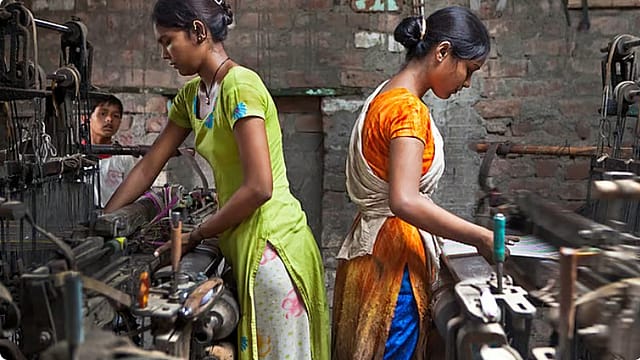
The employment challenge for India is not only about creating more jobs, but also about the quality of those jobs. A large proportion of workers continue to be employed in the informal economy, where earnings are often low and employment security is limited. For many workers, having a job does not necessarily provide an escape from poverty. What matters is not only whether people are employed, but also the kinds of jobs they have and whether they are able to move into better employment over time.
Many poor people around the world are poor not because they do not work hard, but because their work does not generate sufficient income to escape poverty. This raises an important question: To what extent are workers in India able to move from low-paid and insecure employment to jobs that offer better earnings and greater employment security? Does such movement also help their households escape poverty?

The Wealth Issue 2026
06 Nov 2026 - Vol 05 | Issue 45
Portraits of Dreamers and Doers under 35
Not all informal jobs are the same
Informal employment is often treated as a single category. However, there are considerable differences among jobs in the informal economy. Some workers are engaged in informal jobs that require skills, provide higher earnings or offer greater employment security. Other workers are engaged in low paid jobs that offer limited opportunities to move into better employment.
One way to understand these differences is to classify employment into three broad categories: formal employment, upper-tier informal employment and lower-tier informal employment. Formal employment generally offers greater employment security and social protection. Upper-tier informal employment includes jobs that require certain skills or provide additional benefits as well as self-employment involving hired workers. Lower-tier informal employment largely consists of low-paid and insecure jobs, including own-account work and contributing family work. This classification allows us to understand where workers are positioned on the employment ladder and whether they move upwards or downwards over time.
Using the two waves of the India Human Development Survey (IHDS) conducted in 2004-05 and 2011-12, we examine employment transitions across these categories. The panel nature of the survey allows us to track the same individuals employed in both survey rounds and observe changes in their employment status over a seven-year period.
Moving into better jobs is not easy
The findings suggest that movement along the employment ladder is relatively limited. Nearly 80 per cent of workers initially employed in lower-tier informal activities continued in the same category seven years later. Only about 14 per cent moved to upper-tier informal employment, while fewer than 7 per cent entered formal employment. Lower-tier informal employment may be expected to serve as a stepping stone towards better jobs. However, our findings suggest that this is often not the case. For a large proportion of workers, moving out of this category appears to be difficult.
The findings also show that workers in relatively better informal jobs do not necessarily experience upward mobility. In fact, around 44 per cent of workers initially employed in upper-tier informal jobs experienced downward mobility into lower-tier informal employment. In contrast, only about 23 per cent entered formal employment.
These findings highlight two important features of the Indian labour market. First, workers at the lower end of the employment ladder face considerable difficulties in moving into better jobs. Second, even workers in relatively better informal employment face the risk of downward mobility. Thus, the employment challenge is not simply that a large proportion of workers are informally employed, but also that opportunities to improve their employment position are restricted.
Women face greater difficulties
The scope for upward employment mobility also differs between men and women. Women are more concentrated in lower-tier informal self-employment, while men have a relatively larger presence in upper-tier informal and formal wage employment. These differences matter because the employment categories in which workers are engaged may influence their chances of moving up the employment ladder.
Our analysis also shows that women are less likely than men to move into better employment, even after taking into account differences in education, age, social background and employment status. The estimated difference is about 12 percentage points for India as a whole and about 9 percentage points for rural India.
Education also plays an important role in upward mobility. In rural India, workers who have completed secondary education or higher levels of education are more likely to move into better employment than those without schooling. However, the lower chances of upward mobility among women, even after accounting for education and other characteristics, suggest that improving educational attainment alone may not be sufficient to close the gender gap.
Does moving into better employment help households escape poverty?
A related question is whether moving up the employment ladder improves the chances of escaping poverty. Using the IHDS data, we look at whether workers belonging to poor households in 2004-05 were able to escape poverty by 2011-12 and whether this was associated with upward employment mobility.
Among workers belonging to poor households, about 77 per cent of those who experienced upward employment mobility were living in households that had escaped poverty by 2011-12. In contrast, the corresponding figure was about 61 per cent among workers who did not experience upward mobility. Thus, the difference in poverty exit rates between the two groups was around 15 percentage points. This relationship is also evident after taking into account differences in individual and household characteristics. However, the analysis does not provide clear evidence of a similar relationship between upward mobility and the likelihood of falling into poverty.
These findings suggest that moving into better employment can be important for improving the economic well-being of poor households. At the same time, employment mobility is not the only factor associated with poverty reduction. The employment status and earnings of other household members may also influence whether a household escapes poverty.
What does this mean for employment policy?
These findings raise an important question about how we assess the employment situation in India. Much of the discussion focuses on the number of jobs created, unemployment rates and changes in labour force participation. While these indicators are important, they tell us little about the quality of employment or whether workers are able to improve their employment position over time.
A person may be employed for several years without experiencing any meaningful improvement in earnings, employment security or working conditions. Similarly, shifting from one informal activity to another does not necessarily mean that the worker has moved into better employment.
Employment policy must therefore focus not only on creating more jobs but also on expanding opportunities for workers to move up the employment ladder. This requires creating more productive and better-paid jobs, improving access to skills and addressing the difficulties faced by informal workers in accessing credit, markets and social protection.
The issue is especially relevant in the context of rising female labour force participation in India. According to the PLFS, female labour force participation increased from 23.3 per cent in 2017-18 to 40 per cent in 2025. While this is an encouraging development, the nature of employment also matters. In 2025, about 64 per cent of employed women were self-employed, including around 28 per cent who worked as unpaid helpers in household enterprises. Although the share of women in regular salaried employment has increased recently, these figures raise an important question about whether increased participation is accompanied by improvements in earnings, employment security and opportunities for upward mobility.
Our findings from the IHDS suggest that women face greater difficulties in moving into better employment, while upward mobility is associated with a higher likelihood of escaping poverty. This makes the quality of employment an important consideration when assessing increases in female labour force participation.
The analysis presented here is based on employment transitions between 2004-05 and 2011-12. Although the labour market has changed considerably since then, the findings highlight the importance of looking beyond employment numbers. More recent evidence is needed to establish whether upward mobility has improved.
The challenge for India is therefore not simply to create more jobs or increase labour force participation. It is also to ensure that workers, especially women and those engaged in lower-tier informal activities, have greater opportunities to move into better employment. Without such opportunities, an increase in employment may not necessarily lead to a corresponding improvement in earnings, employment security or household economic well-being.
(Kripashree Bachaspatimayum and Rajesh Raj SN are affiliated with the Department of Economics, Sikkim University)