Trump Approval Stalls at 33% as Iran War Support Falls and Gas Prices Surge
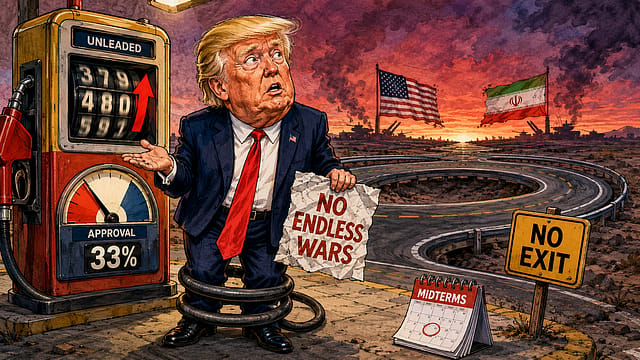
Donald Trump sold Americans two promises: Cheap petrol and no endless wars.
Six months into the US conflict with Iran, both are slipping out of his hands.
A new Reuters/Ipsos poll has found that Trump’s job approval remains stuck at 33%, matching the lowest level recorded during either of his presidencies. Support for US military action against Iran has fallen to 31%, its weakest reading since the opening days of the conflict. The two numbers measure different things. The 33% figure is Trump’s overall job approval. The 31% figure measures support for military action against Iran.
Together, however, they reveal the same political problem. The war Trump initially suggested could be resolved within weeks is now expected to drag on by 83% of Americans. Petrol costs more than a dollar per gallon above its pre-war level. Republican support for the conflict has fallen eight percentage points since March.

Zeroing In on ECI
09 Oct 2026 - Vol 05 | Issue 41
Constitutional legitimacy versus political opportunism
Trump’s political identity rested partly on ridiculing prolonged wars and blaming his predecessors for the cost of living. Iran has fused those two vulnerabilities into a single crisis. The war he promised America would avoid is becoming the war voters believe will not end. What does the latest Reuters/Ipsos poll show? Trump’s overall job approval remains at 33% for the second consecutive Reuters/Ipsos survey. That is the lowest level recorded by the polling series during either of his terms in office. Support for US military action against Iran has fallen from 37% in March to 34% earlier in August and now to 31%.
The decline has been driven partly by Republicans. In March, 77% of self-identified Republicans supported the war. That figure has fallen to 69%. This does not amount to a Republican revolt. More than two-thirds of the party’s respondents still support the conflict. But the movement matters because Trump depends on unusually high loyalty within his political base to compensate for weak support among Democrats and independents.
The poll also found that 83% of Americans expect the war to continue for an “extended period of time”, up from 80% earlier in August. Among independent voters, Democrats led Republicans by 33% to 19% when respondents were asked which party they would support in a congressional election held now. The survey questioned 1,215 American adults over four days and carried a margin of error of approximately three percentage points in either direction. Results within smaller groups, including Republicans and independents, will carry greater uncertainty and should be read as indicators rather than exact measurements.
Why is 31% support for the war particularly damaging?
Because the conflict began without a broad reservoir of public support. American wars in Afghanistan and Iraq opened with large majorities behind them, even though support later collapsed as casualties rose, objectives shifted and the conflicts dragged on.
The Iran war has followed a different trajectory. Reuters reported in July that support had remained below 40% for five consecutive months. The latest figure of 31% suggests that Trump has been unable to persuade sceptical Americans even after half a year of conflict.
The administration has argued that military action is necessary to prevent Iran from acquiring a nuclear weapon. Trump has also spoken at different times about destroying Iran’s missile capabilities, weakening its leadership and helping Iranians overthrow the regime. That shifting language has created another problem: Americans remain unsure what victory is supposed to look like.
A July Reuters/Ipsos poll found that 69% of respondents believed Trump had failed to explain the goals of US military involvement clearly. That included four in 10 Republicans. Wars become politically difficult when the public dislikes their cost. They become more difficult when the public cannot identify their purpose.
Is Trump losing his Republican base?
Not yet. But the base is showing strain. A president would normally welcome 69% support for a policy among members of his own party. The difficulty lies in the direction of travel. Republican support for the war has fallen from 77% to 69% since March. The erosion comes despite Trump repeatedly framing the conflict as necessary for American and Israeli security. The Republican coalition also contains a fault line over foreign intervention. Traditional national-security conservatives remain willing to use military power against Iran. The MAGA movement, however, has spent years attacking “forever wars”, foreign entanglements and the Washington establishment that sustained them.
Trump held those groups together by promising strength without prolonged occupation and deterrence without another Iraq. Iran is testing whether that formula can survive a real war. The unease is not necessarily driven by sympathy for Tehran. Many Republican voters remain hostile towards the Iranian regime and support preventing it from acquiring nuclear weapons.
Their concern may be simpler: What is the exit? If the conflict produces no decisive conclusion, keeps the Strait of Hormuz unstable and continues raising domestic prices, Republican voters may support the objective while turning against the execution. That distinction could become politically dangerous.
Why have petrol prices become central to the conflict?
Because foreign policy becomes domestic politics at the fuel pump. The Strait of Hormuz normally carries around one-fifth of global oil supplies. Disruption to regional exports has pushed energy prices sharply higher and filtered into American household budgets. According to Reuters, US petrol prices are now more than a dollar per gallon higher than before the war began on February 28.
That increase attacks Trump at his strongest political point. He repeatedly blamed Joe Biden for expensive petrol, inflation and the pressure facing American families. His 2024 campaign promised to bring energy costs down by expanding domestic production and reversing Democratic policies.
Now the White House owns the price board. The administration has considered measures including a temporary suspension of the federal petrol tax and releases from strategic reserves. But those tools can offer only limited relief if oil movement through the Gulf remains restricted. A May Reuters investigation found that officials were increasingly worried about petrol becoming Trump’s “Achilles’ heel”. More than six in 10 Americans surveyed at the time said higher fuel prices had hurt their household finances. Petrol prices carry an unusual political force because voters encounter them repeatedly and publicly. Inflation can appear abstract. A fuel pump displays the cost in giant numbers. Every refill becomes a referendum.
Has the war damaged Trump’s economic argument?
Yes, because it has connected a distant conflict to everyday expenses. Trump returned to office after campaigning heavily on inflation and the cost of living. Voters who disliked aspects of his personality or politics could still believe he would manage the economy more effectively.
The Iran war complicates that bargain. Higher oil prices do not stop at petrol. They affect transport, aviation, shipping, manufacturing and the delivery of food and consumer products. Businesses eventually pass at least part of those costs to households.
The White House can argue that preventing a nuclear-armed Iran justifies temporary economic pain. But “temporary” loses credibility as the conflict lengthens. Trump initially estimated that the war could last four or five weeks. It has now continued for six months, even though direct fighting has cooled during parts of that period. The poll’s most politically damaging finding may therefore be the 83% expecting an extended conflict. It shows that the administration has lost control of the timeline in the public imagination.
Why do independent voters matter so much?
Because they could decide control of Congress. Republicans enter the November 3 midterm elections defending narrow majorities. Even modest movement among independents in competitive districts could transfer control of the House or Senate. In the latest poll, independent voters preferred Democrats to Republicans by 33% to 19% in a hypothetical congressional election. That is a substantial gap, but it should not be mistaken for a complete forecast. Many respondents did not choose either party, candidate quality differs across states and districts, and national surveys cannot replicate individual congressional contests.
The finding is nevertheless a warning. Independent voters are often less ideologically committed and more sensitive to immediate conditions. They may judge the administration through the cost of petrol, uncertainty about the war and whether Trump appears focused on problems at home. A July Reuters/Ipsos poll found that independent voters also favoured Democrats over Republicans on economic policy. That combination should worry the White House. The war is not operating as a separate foreign-policy concern. It is weakening the economic case Republicans hoped to take into the midterms.
Can Trump solve the problem with more sanctions?
He is trying to shift the conflict towards economic pressure. The administration has announced new action against individuals, companies and vessels allegedly connected to Iranian weapons procurement, cyber operations and illicit oil shipments. Treasury Secretary Scott Bessent has also threatened broader secondary sanctions against countries doing business with Iran. Such measures could force governments and companies to choose between access to the American financial system and commercial relations with Tehran.
But the approach contains risks. Tough secondary sanctions could affect countries including China, India and Turkey, disrupt more oil supplies and push prices even higher. If major economies refuse to cooperate, the limits of American economic coercion will become visible. The administration must therefore balance two conflicting objectives. It wants to increase pressure on Iran without inflicting additional pain on American consumers.
The decision to threaten a wider sanctions regime without immediately imposing its harshest penalties reveals how difficult that balance has become. Military escalation could deepen public opposition. Economic escalation could raise fuel prices. A compromise with Iran could require concessions that Trump may struggle to sell as victory. Every route carries a political cost.
Does one poll prove that Trump is doomed?
No. Polls are snapshots rather than verdicts. The survey’s three-point margin of error means small movements may reflect sampling variation rather than a decisive shift in public opinion. Trump has also survived low approval ratings before. His support remains intensely committed among a large section of Republican voters, and political conditions can change quickly.
A fall in oil prices, an agreement reopening the Strait of Hormuz or a settlement presented as having neutralised Iran’s nuclear threat could improve his standing. The midterms are also not a single national election. Local candidates, turnout, redistricting, campaign spending and state-specific issues will shape the result.
But the Reuters/Ipsos findings do establish a pattern. Trump’s approval has remained at 33% across consecutive surveys. Support for the war has fallen from 37% to 31%. Republican backing has slipped. More Americans expect a long conflict. Independents currently lean towards Democrats. These numbers cannot predict the election. They can identify the danger.
What is Trump’s central political dilemma?
He must end the war without appearing to retreat.
Trump has built his politics around dominance. Compromise can be repackaged as victory, but only if the administration can point to a tangible result: limits on Iran’s nuclear programme, restored oil movement through Hormuz or a security agreement that reduces the threat to US forces and allies.
Iran, meanwhile, has little reason to offer Trump an easy exit if time is eroding his domestic support. Tehran can exploit its leverage over regional shipping, withstand pressure and wait for the political cost to rise in Washington. The weaker Trump becomes at home, the more expensive every additional month of conflict becomes. That creates the cruel logic of prolonged war.
Trump may need an agreement urgently. Iran may benefit from making him wait. The poll does not show that Americans have suddenly become sympathetic towards the Iranian regime. It shows that they are losing confidence in the conflict, its duration and its cost. Trump promised that strength would end wars. Iran is forcing him to explain why this one is still going.
(With inputs from ANI)