‘We Need to Stop Corruption’: Voters Flock Home Ahead of Nepal’s High-Stakes March 5 Election
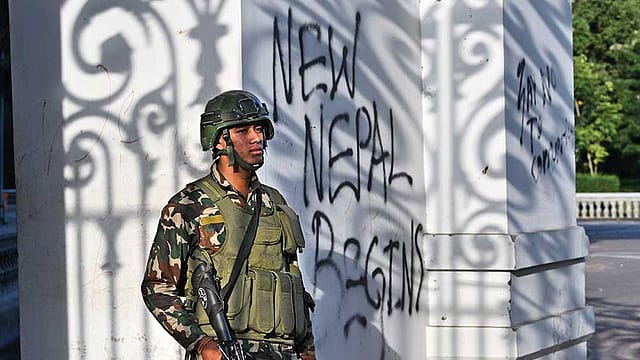
Thousands of voters have begun leaving Nepal’s capital Kathmandu for their home districts ahead of Thursday’s parliamentary election, six months after a wave of Gen Z-led protests shook the Himalayan nation’s political establishment.
Carrying bags and rushing towards vehicles, hundreds of voters departed from Koteshwor Bus Park on Tuesday morning to cast their ballots.
According to Traffic Police records, more than 300,000 people have already left the capital by road, and the number is expected to double by Wednesday as more residents vacate the valley for the March 5 vote.
The country’s poll preparations have entered the final phase, with candidates wrapping up campaigning on Monday before the two-day silence period came into effect.
How Is Nepal’s Silence Period Shaping Voters’ Decisions Ahead of the Parliamentary Election?
The silence period allows voters to make up their minds before exercising their franchise.
"I am going to my hometown to cast my vote. I have my own business here (in Kathmandu), but to cast my vote, I am heading for my voting constituency for the election," Bidur Nepali told ANI.

The MissOil Strike
03 Apr 2026 - Vol 04 | Issue 65
The War on Energy Security
"The country has traversed through a dire situation; we voters also should have an understanding of the capacity of the candidate. We have already seen the work of the old parties, but they performed very badly. Looking at the incident of September 8 and 9, I would vote for that party which really can work for the good of the country," he added.
The election comes after September’s protests, in which at least 77 people were killed. The uprising was initially triggered by a social media ban but quickly expanded into wider demonstrations against a stagnant economy and corruption among the governing elite.
The unrest forced 74-year-old Prime Minister KP Sharma Oli to resign and led to the formation of an interim government.
Why Are Young Nepalis Disenchanted with Established Political Parties Ahead of the Election?
The protests reflected deep disenchantment with established political forces, including Oli’s Communist Party of Nepal-Unified Marxist Leninist, the Nepali Communist Party comprising former Maoist rebels, and the centrist Nepali Congress party.
Many young Nepalis view these parties as an entitled and unresponsive political class prone to corruption.
Nearly 19 million Nepalis will vote to elect a 275-member parliament, with 165 members chosen through the first-past-the-post system and 110 through proportional representation.
A total of 18,903,689 citizens have registered to vote, including about 800,000 first-time voters. Around 30 percent of voters are aged under 40.
Nepal’s mixed electoral system has often produced fragmented results, making single-party majorities difficult and leading to coalition governments.
How Has Political Instability Since 2008 Shaped Nepal’s Parliamentary Election?
Since becoming a republic in 2008, the country has seen 14 governments and nine prime ministers, including the incumbent interim leader Sushila Karki.
The frequent power-sharing arrangements have fuelled public disillusionment and heightened fears of renewed instability.
In the run-up to the vote, established parties have claimed they learned lessons from last year’s uprising and pledged stronger action against corruption. Young activists remain sceptical.
For 27-year-old Rajesh Chand, a business student in Kathmandu, the vote transcends party labels.
“I am not really interested in old or new parties,” he told Al Jazeera.
“I’m interested in how we can bring this country forward in the right direction. We have witnessed the old political establishment for many years, and no one did anything. The country is sinking. We need to stop corruption. That’s the start.”
What Impact Did KP Sharma Oli’s Coalition and Actions Have on NC’s Image?
The Nepali Congress, the country’s oldest political party, was among those most shaken by the protests. It had been in coalition with the Oli government at the time.
Minendra Rijal, a senior NC leader and former information minister, acknowledged the damage.
“NC should have never been in coalition with the Oli government,” he told Al Jazeera, adding that Oli’s “hubris” during the uprising severely dented the party’s image.
Rijal said the party had since changed course. The leadership that presided during the protests, including former Prime Minister Sher Bahadur Deuba, is no longer contesting the election. In January, the party elected Gagan Kumar Thapa, 49, as its new president and prime ministerial candidate.
“We have admitted mistakes were made,” Rijal said. “We are asking for a second chance. We have apologised loudly and clearly.”
Why Do Voters Remain Frustrated Ahead of Nepal’s Parliamentary Election?
He conceded that voters remain frustrated. “When I returned to my constituency, I could sense immense frustration,” he said. “People are demanding clear explanations about our agenda and about what went wrong.”
Political scientist Sucheta Pyakurel attributed the uprising to “recklessness” within the political establishment.
“Democracy is usually a tolerant system,” she told Al Jazeera. “For citizens to become this angry, those in power must have failed them in serious ways.”
She added that while some factions appear introspective, others remain resistant to change. “Some old parties have been self-critical,” she said. “They may be reconsidering their old ways. But there are too many moving pieces to predict outcomes. It’s too early to tell.”
Young voters have emerged as a crucial constituency. Parties have tailored messages and incentives to appeal to them, including pledges of digital access and entrepreneurial support.
How Are Parties Using Digital and Financial Incentives to Appeal to Young Voters in Nepal?
Proposals include a 10-gigabytes-per-month mobile internet package for young people and $10,000 cards for young business owners.
Manifestos have been rebranded as “commitment papers” and “promise papers”, an effort critics say repackages politics in Gen Z-friendly language.
Traditional parties have also dismissed newer entrants as lacking ideology, including rapper and former Kathmandu mayor Balen Shah, 35, who joined the Rastriya Swatantra Party and is contesting against Oli in Jhapa-5, a CPN-UML stronghold about 300 kilometres southeast of Kathmandu.
Shah enjoys strong support among Gen Z voters despite his aversion to public speeches.
“I don’t know how to talk; I know how to work,” he once said, projecting it as a satire on the existing political establishment.
Under the Election Code of Conduct, all campaign materials placed within a 300-metre radius of polling stations must be removed once the silence period comes into force.
Posting, sharing or disseminating any message or campaign material in favour of or against any political party or candidate through social media, online platforms, print or electronic media is prohibited during this period.
From three hours before voting begins until completion of the process, no one may obstruct voters or officials at polling centres.
Playing musical instruments, organising singing and dancing, hosting public feasts, holding processions or any gathering, or creating disturbances are also prohibited for 48 hours before the vote.
(With inputs from ANI)