The Roller Coaster Ride That is the Iran War!
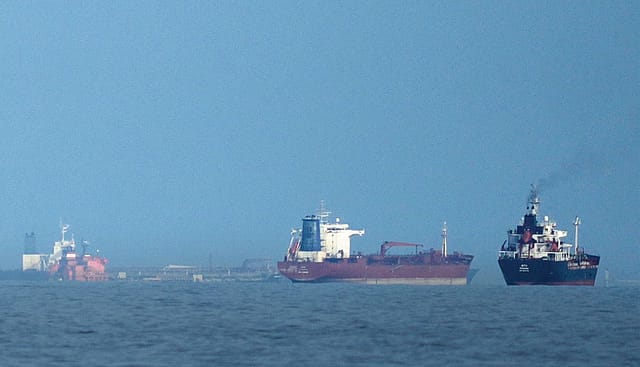
As the Iran war completes a month, no end is in sight. What is getting clearer is the murky picture that is revealing itself. Trump has not backed down out of fear. He is simply playing the same games he has played before to lull the Iranians into complacency. A major ground attack is coming fast, and it is aimed straight at the heart of the Strait of Hormuz.
The USS Tripoli has arrived in the theatre with 3,500 Marines and F-35Bs. The USS Boxer is en route for mid-April. One thousand paratroopers of the 82nd Airborne Division are positioned for deployment. JSOC’s forces are on high alert. US Total theatre strength exceeds 50,000. This is the posture of a country that wants to leave but needs to be seen as capable of staying. The nuclear dimension adds the final variable. Iran’s pre-war stockpile of roughly 200 kilograms of 60 percent enriched uranium, enough for approximately five weapons if further enriched, was partially transferred to tunnels beneath Isfahan before the first strikes.

Zeroing In on ECI
09 Oct 2026 - Vol 05 | Issue 41
Constitutional legitimacy versus political opportunism
Did the Isfahan strikes destroy this stockpile? Or will the IRGC use these to place dirty bomb warheads on its Fattah-2 hypersonic glide vehicles?
But that is not the real story. Collateral destruction is manifesting in many areas.
While the world ranted about Israeli actions in Gaza after October 2023, what is it going to say about the unfolding story in Lebanon? Israel struck a five-vehicle Hezbollah convoy in Jnah, Beirut, killing 11 persons including a high-ranking Hezbollah commander. Four Israeli soldiers were also killed in southern Lebanon by Hezbollah. Israeli Defense Minister Katz announced that every building in every village south of the Litani River in southern Lebanon will be destroyed using the Rafah model. This will permanently displace over half a million Lebanese who will be the latest unintended victims of Netanyahu’s callousness and Hezbollah’s defiance. Northern Israel will never be secure and the displaced Lebanese will never return to their homes. This is not a buffer zone but annexation for the Greater Israel project. If successful, then Hezbollah will be pushed upwards to positions on the north bank of the Litani River.
Even though Trump taunted and ridiculed Britain and her NATO allies, 18 USAF A-10 Warthog close air support aircraft landed at RAF Fairford and RAF Lakenheath for Operation Epic Fury. The A-10 was designed in 1972 to destroy Soviet tanks in the Fulda Gap a critical Cold War-era, low-terrain corridor between the former East German border and Frankfurt, West Germany. The Warthog flies low and slow. It is the one aircraft in the US arsenal that has no function in a contemporary BVR standoff air campaign. Its deployment means someone at the Pentagon is planning for the kind of close-in, low-altitude ground engagement that every Trump diatribe says is not happening. His rhetoric is contradicted by this deployment. Realizing this, France denied overflights for US weapons shipments to Israel. Spain closed its entire airspace and bases. Italy refused US access to Sigonella, the Mediterranean’s most critical staging facility.
The contradictions abound. US LNG now supplies almost 60% of EU imports, up from 21% in 2021. Qatar’s force majeure on the Ras Laffan refinery removed 9% of EU supply. Norway has confirmed zero spare capacity. Eleven cargoes have been diverted from Europe to Asia. Analysts warn gas prices could triple to 155 euros per megawatt-hour if the disruption continues past the month of June.
The world is facing a significant helium shortage amid the Strait of Hormuz's closure which has limited 30% of global helium supply. Pennsylvania based US industrial gas supplier Airgas declared a force majeure. It declared that customers would only get up to 50% of their normal monthly helium demand amid the Iran War. Airgas also told customers that it would add a surcharge of $13.50 per hundred cubic feet above the contracted price. Helium supplies which are critical for AI have been choked off. Hundreds of specialized cryogenic containers to store helium gas, each costing $1 million, are now stuck in the Middle East. Global helium supply is at risk.
The IRGC has publicly listed “enemy technology infrastructure” as legitimate targets. The list comprises Apple, Microsoft, Google, Meta, NVIDIA, Oracle, Intel, IBM, Dell, Cisco, HP, Tesla, Boeing, General Electric, Palantir, JPMorgan, Spire Solutions, and G42, the UAE artificial intelligence firm that partners with OpenAI on the Stargate campus the IRGC is now threatening to destroy. These 18 companies have a combined market capitalization exceeding $15 trillion.
The IRGC list was announced a day after the biggest bet in the history of private capital was placed on a table that was already on fire.
On 31 March 2026, OpenAI closed $122 billion in committed capital at an $852 billion post-money valuation. OpenAI’s valuation now exceeds the GDP of Saudi Arabia. ChatGPT has 900 million weekly active users. Revenue runs at $2 billion per month. The $122 billion is funding infrastructure in a war zone. Amazon committed $50 billion. NVIDIA $30 billion. SoftBank $30 billion. Three billion came from retail investors through bank channels. OpenAI will be included in ARK Invest ETFs. Ordinary Americans are now directly exposed to the risk that an Iranian drone could strike the facility their investment is funding.
Every megawatt of electricity that powers an OpenAI training run costs more today than it did on 27 February. The $122 billion buys less compute per dollar than it would have before the war started. The funding round is denominated in pre-war assumptions running on post-war energy prices. OpenAI’s Stargate pledge promises to “pay its way on energy” through self-generation and nuclear partnerships. The Stargate UAE campus is a planned 5-gigawatt facility in Abu Dhabi, the largest AI installation outside the United States, designed to train frontier models at civilizational scale. This pledge was written before Iranian missiles hit Qatar’s helium plant, before oil crossed $100, and before Trump said the strait is no longer a US problem. The pledge assumes an energy market that no longer exists. Nine hundred million users. $852 billion valuation. $122 billion in fresh capital. And the helium that cools the machines, the gas that powers them, and the security that protects them all transit through the Strait of Hormuz that nobody is responsible for anymore. The bet is that the war ends before the physics catches up.
But what if it doesn’t?
Trump’s 6 April deadline at 8 PM US Eastern Time is the means through which every contradiction resolves itself. His language is maximalist and the invariable deadline extensions that follow are pragmatic. The gap between them is the space where the possibility of a deal lives. Netanyahu’s “crushed to dust” narrative is the Israeli half of the exit. If Iran’s nuclear and missile capabilities have been neutralized, then the war’s original justification has been fulfilled and continued operations become a choice, not a necessity. The declaration is not intelligence assessment. It is political architecture designed to allow withdrawal while claiming total victory.
But herein lies the nub.
The Strait of Hormuz funds the crude that powers the OpenAI data centers that required the debt that is now necessitating unprecedented levels of layoffs in the IT industry. Follow the chain far enough and every job loss email traces back to the Strait of Hormuz. The AI revolution is being underwritten by the war it cannot afford.
Take the case of Oracle.
At 0600 on 31 March, Oracle sent identical emails from “Oracle Leadership” to between 20,000 and 30,000 employees. System access was revoked before most of the employees finished reading. 18% of Oracle’s global workforce was sacked that morning. It is argued that an estimated $8 to $10 billion in annual cash-flow savings would result from these comprehensive sackings.
Oracle needs the cash. Oracle’s five-year Credit Default Swap (CDS) spread closed at 198 basis points on 31 March. A spread is the annual cost—expressed in basis points—paid by a protection buyer to a seller to insure against a borrower defaulting on debt. It acts as a market-driven indicator of credit risk; higher spreads signify greater risk of default. It is commonly used to hedge bond portfolios. This is a record that exceeds Oracle’s peak during the 2008 global financial crisis. The company that survived the collapse of Lehman Brothers is now registering more credit stress from building AI data centers than it did from the implosion of the banking system. The market is pricing Oracle as a company whose bet is larger than the system’s ability to absorb the risk. The bet is $124.7 billion in total debt, up from $89 billion a year ago. $50 billion in capital expenditure this year, directed at AI data centers for the $300 billion Abu Dhabi based OpenAI Stargate partnership requiring 4.5 gigawatts of power and over 2 million NVIDIA GPUs. And negative free cash flow of $24.7 billion trailing twelve months, meaning Oracle spends $25 billion more than it earns while firing the people who generate the earnings.
But how does this connect to the Iran war?
Every one of those 2 million NVIDIA GPUs is manufactured by TSMC (Taiwan Semiconductor Manufacturing Company) using extreme ultraviolet lithography cooled by helium from Qatar’s Ras Laffan Refinery, which Iranian missiles struck on 18 March. The data centers those GPUs power, consume electricity generated by crude priced at $110pb Brent, driven to that level by the Hormuz closure the war created. Oracle is borrowing $124 billion to build infrastructure whose two critical inputs, chips and power, are both priced by the war. The layoffs are not about efficiency. They are about converting human salaries into cash to service debt on machines whose operating costs are rising with every day Hormuz stays closed. Oracle’s bondholders have filed a class action lawsuit alleging the company concealed $18 billion in additional borrowing when it issued notes in September 2025 for the Stargate deal.
But the price of Brent is not the only factor influencing Trump’s deal. Naphtha is constantly rising at US$ 985 PMT. Methanol is at US$ 3250 CNY/T. The helium facility is still destroyed. The mid-April corn planting window in the US Midwest is rapidly closing. The market believes the war is ending. The periodic table does not know the war started. Easter is 5 April. The deadline is Easter Monday 6 April. Three carrier strike groups. Fifty thousand troops. Ghalibaf posting stock market trading tips. Netanyahu declaring victory. And Trump who wants to leave but brought more Marines. The deal is the fiction. The fiction is the exit. And 6 April is the day the fiction is operationalized.
Last Friday afternoon, Israel struck a critical part of Iran’s ballistic missile industry—its two largest steel production plants—but to their surprise, found the strike affected far more than their military. Steel facilities sit in a gray area, somewhere between military targets—like missile factories or nuclear sites—and civilian targets, such as water desalination facilities. The Iranian industry is even grayer; there is no part of the economy that the regime has not penetrated. One of the factories was sanctioned by the U.S. in 2018, described as a critical source of funding for the Basij militia. Yet its targeting by Israel was to stop it from producing the metals used in ballistic missiles, not its cashflow. Iran is the largest steel producer in the Middle East and ranks among the top 10 globally. Those two factories alone account for billions of dollars in revenue and about three percent of Iranian GDP. The impact on the economy was a side effect Israel accepted. It now seems that the side effect may have been more powerful than the primary one. According to IDF intelligence, the regime’s political leadership now believes there is no way to repair the war damage; Iran simply lacks sufficient funds. It reportedly has broken the spirit of many in the regime.
These bombings were not just military actions; they delivered a deep blow to the global economy. Oil, natural gas, fertilizers, semiconductors, chemicals, metals, and even helium saw their supply drastically reduced. Recovery will be slow and painful. But do Ghalibaf, Netanyahu and Trump even realize that?