Pakistan Rejects Abraham Accords Push, Says Deal With Israel ‘Not Acceptable’
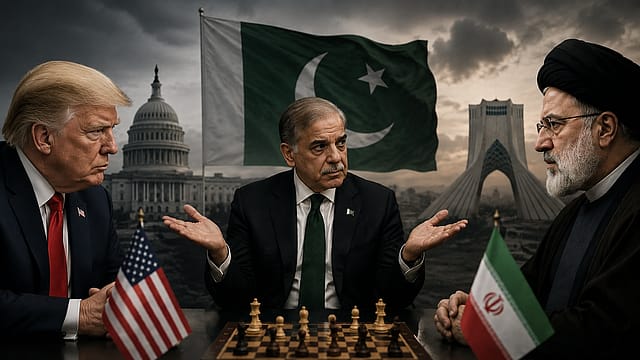
Pakistan has publicly rejected the possibility of joining the Abraham Accords after US President Donald Trump urged several Muslim-majority nations to normalise ties with Israel as part of a broader regional agreement linked to ongoing negotiations with Iran.
The sharp response from Islamabad highlights the continuing political and ideological resistance within Pakistan toward recognising Israel, despite renewed diplomatic pressure from Washington and discussions around a larger regional realignment in West Asia.
Why Has Pakistan Rejected The Abraham Accords?
Pakistan Defence Minister Khawaja Muhammad Asif made Islamabad’s position clear during an interview with Pakistani broadcaster Samaa TV.
“Personally, I don't think we should join any such accord that clashes with our fundamental ideologies,” Asif said during the interview.
Questioning the reliability of engagement with Israel, he added, “How will you sit down with those people whose word cannot be trusted even for a single day?”
Look Who's Talking Regime Change
23 Oct 2026 - Vol 05 | Issue 43
He further reiterated Pakistan’s long-standing position by saying, “We have a very clear stance that this is not acceptable to us.”
Asif also referred to Pakistan’s passport policy regarding Israel as a reflection of Islamabad’s refusal to recognise the Jewish state.
“And secondly, on our passports, we are the only country whose passports don't even include Israel's name,” he said.
Pakistan has historically linked any potential recognition of Israel to the establishment of an independent Palestinian state, making the issue deeply tied to both domestic politics and broader Islamic world sentiment.
What Did Donald Trump Propose?
Earlier this week, Trump called for an expansion of the Abraham Accords as part of what he described as a potentially transformative regional settlement involving Iran.
In a lengthy post on Truth Social, Trump said, “Negotiations with the Islamic Republic of Iran are proceeding nicely! It will only be a Great Deal for all or, no Deal at all.”
He also warned that failure to secure an agreement could mean “Back to the Battlefront and shooting, but bigger and stronger than ever before.”
Trump urged countries including Saudi Arabia, Qatar, Pakistan, Turkiye, Egypt, Jordan and Bahrain to join the Abraham Accords once a US-Iran understanding is reached.
According to Trump, the agreement could evolve into a “Historic Event” for the Middle East.
Trump Suggests Iran Could Eventually Join Framework
One of the most striking elements of Trump’s remarks was the suggestion that Iran itself could eventually become part of the Abraham Accords framework if negotiations with Washington succeed.
Trump argued that the existing accords had already created a “Financial, Economic, and Social BOOM” for participating countries.
He named the United Arab Emirates, Bahrain, Morocco, Sudan and Kazakhstan as beneficiaries of the agreement.
“The Abraham Accords have been great for them, and will be even better for everybody, and bring true Power, Strength, and Peace to the Middle East,” Trump stated.
“In speaking to numerous of the Great Leaders mentioned above, they would be honored, as soon as our Document is signed, to have the Islamic Republic of Iran as part of the Abraham Accords,” he added.
Which Leaders Did Trump Mention?
Trump said the proposal followed discussions with several prominent leaders across the Middle East and the broader Islamic world.
These included Saudi Crown Prince Mohammed bin Salman, UAE President Mohammed bin Zayed Al Nahyan, Qatar Emir Tamim bin Hamad Al Thani, Pakistan Army Chief Asim Munir, Turkish President Recep Tayyip Erdogan, Egyptian President Abdel Fattah el-Sisi, Jordan’s King Abdullah II and Bahrain’s King Hamad bin Isa Al Khalifa.
Calling it potentially “the most important Deal” in the region’s history, Trump said he had directed his representatives to begin efforts to expand the accords to additional countries.
What Are The Abraham Accords?
The Abraham Accords are US-brokered agreements signed in 2020 that normalised diplomatic, economic and security relations between Israel and several Arab nations.
The accords marked a major shift in Middle Eastern diplomacy by bringing together Israel and Arab states that had previously avoided formal ties.
The United Arab Emirates and Bahrain were the first countries to sign the agreements, followed later by Morocco and Sudan.
The agreements were widely viewed as one of the defining foreign policy initiatives of Trump’s first presidency and continue to shape regional geopolitical discussions.
Why Pakistan’s Position Matters
Pakistan’s refusal is significant because it underscores the limits of the Abraham Accords’ expansion despite renewed US efforts.
Unlike some Gulf nations that prioritised economic cooperation and security coordination with Israel, Pakistan continues to frame the issue through ideological and political solidarity with the Palestinian cause.
The statement also reflects the delicate balancing act Islamabad faces between maintaining strategic ties with the United States and responding to domestic political sensitivities around Israel and Palestine.
(With inputs from ANI)