Gen Z Pick Balen Shah Emerges as Frontrunner Ahead of Nepal’s March 5 Election
Nepal’s Interim Prime Minister Sushila Karki has urged voters to exercise their democratic rights ahead of the parliamentary election scheduled for March 5, asserting that the government has taken exhaustive steps to ensure a smooth and secure polling process amid heightened security concerns.
After rounds of meetings with security agencies on Tuesday, the interim leader of the Himalayan nation took to Facebook to assure citizens about the preparedness of the authorities.
“There is no room for doubt in the security arrangements. All mechanisms are operational with necessary vigilance, strict monitoring and effective coordination, keeping in mind the potential challenges and risks,” Karki announced.
“The government is leaving no stone unturned to ensure that the elections are held in a clean, fair, fearless and peaceful manner. I urge all citizens to exercise their right to vote with confidence and fearlessness,” the interim leader further added.
With about a week left for the elections and reports of violence in the southern plains, the government has been expediting security reviews at the highest levels on a daily basis.

The Liberation of Bengal
05 Jun 2026 - Vol 04 | Issue 74
A silent revolution ends the reign of fear
Late on Tuesday evening, Karki received a comprehensive briefing from the chiefs of all security agencies regarding election preparations and the overall security situation.
During the briefing, agencies flagged a dozen security challenges including clashes between supporters of various political parties, communal disturbances, religious tension, activities of monarchist factions, prisoners who escaped from jails during the Gen Z protests in September, and activities of political parties that have boycotted the election, among others.
The polls are being observed with caution as they come six months after the September Gen Z uprising that left 77 people dead and forced then prime minister K.P. Sharma Oli to resign.
Why has Nepal revamped nationwide security ahead of the March 5 election?
With hundreds of inmates still on the loose and a higher number of polling stations deemed sensitive compared to previous elections, security has been significantly revamped across the country.
Earlier this month, the Nepal Army was deployed for election security in line with the Integrated Election Security Plan and a Cabinet decision.
The army has deployed 79,727 personnel nationwide to support the Nepal Police, Armed Police Force, and election police in conducting the polls peacefully.
Under the endorsed plan, the army will replace police forces in airports, prisons and other sensitive areas, provide third layer security, and conduct patrols as required.
In total, 338,000 security personnel, including election police, will be deployed during the election period.
How many polling stations are classified as highly sensitive in the Nepal election?
Authorities have classified 3,680 of the country’s 10,967 polling stations as highly sensitive. Nepal Police data shows that 2,845 polling stations are categorised as normal, 4,442 as sensitive and 3,680 as highly sensitive.
The number of highly sensitive stations has increased from 3,412 in the previous election to 3,680 this time, with 268 more stations falling into the high risk category.
The total number of polling stations has also risen from 10,892 in the last election to 10,967.
The political backdrop to the election remains volatile following the youth led uprising in September. Shortly after the resignation of Oli, a 35 year old rapper turned politician Balendra Shah, popularly known as Balen, posted on social media, “Dear Gen Z, the resignation of your killer has come. Now your generation will have to lead the country. Be prepared.”
Five months on, Shah, who became mayor of Kathmandu in 2022, is dominating projections as the leading prime ministerial choice ahead of the March 5 general election, according to political analysts and local media, in the absence of reliable opinion polls in Nepal.
How could Balen Shah’s rise reshape Nepal’s political landscape after the election?
If Shah comes to power, it would mark a dramatic rise for a figure who first gained public attention through rap music critical of the establishment and later transitioned into politics.
His ascent could reshape the political landscape of Nepal, long dominated by established parties such as Oli’s Communist Party of Nepal (Unified Marxist–Leninist), seen as leaning towards China, and the centrist Nepali Congress, considered closer to India.
Shah represents the Rastriya Swatantra Party, a centrist newcomer that has stated in its manifesto it will maintain “balanced foreign relations” with Nepal’s two giant neighbours.
He joined the party last December as its prime ministerial candidate under the leadership of former TV host turned politician Rabi Lamichhane.
Part of Shah’s nationwide appeal stems from his tenure as mayor of Kathmandu, where he focused on improving urban infrastructure, including waste management, and enhancing delivery of services such as healthcare.
Why has Balen Shah faced criticism during the Nepal election campaign?
He has also drawn criticism, including from Human Rights Watch, for allegedly using police to seize the properties of street vendors and landless people.
Unlike much of Nepal’s traditional political elite, Shah largely avoids the mainstream press and instead connects directly with young voters through social media, where he has over 3.5 million followers.
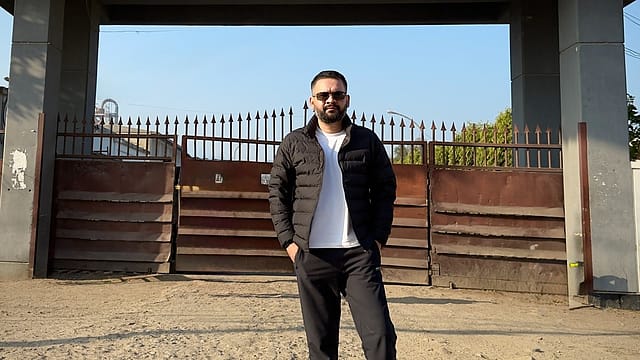
His campaign trail posts frequently feature his trademark dark sunglasses and salt and pepper beard.
Born to a father who practiced traditional Ayurvedic medicine and a homemaker mother, Shah developed an early interest in poetry that later evolved into rap music.
After completing an undergraduate degree in civil engineering in Nepal, he pursued a master’s degree in structural engineering in southern India while already gaining prominence as a rap artist.
His songs, often critical of Nepal’s ruling class, resonated widely in a country where about 20 percent of the 30 million population lives in poverty.
One of his best known tracks, “Balidan,” released in 2019, has garnered over 12 million views on YouTube.
In its election manifesto, Shah’s RSP has pledged to create 1.2 million jobs and reduce forced migration, capitalising on frustration over unemployment and low wages that have pushed millions of Nepalis to seek work overseas.
The party has also promised to raise Nepal’s per capita income from $1,447 to $3,000, more than double the economy to a $100 billion GDP, and provide nationwide healthcare insurance within five years.
(With inputs from ANI)