Watch | Stunning Earth Visuals Captured From Orion as Artemis II Heads Toward the Moon
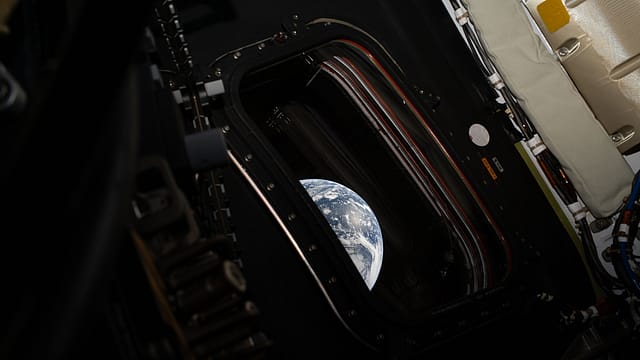
NASA has released breathtaking high-resolution images of Earth, captured from the Orion capsule as the Artemis II astronauts continue their journey to the Moon.
The photographs show a curved slice of Earth through the Orion capsule’s window and a full view of the glowing blue planet, its oceans streaked with swirling white clouds and even a green aurora shimmering above.

The space agency shared the images on its official X handle, giving the world a rare perspective of the planet from beyond.
In its post, NASA said, "Good morning, world! We have spectacular new high-resolution images of our home planet, all of us looking back through the Orion capsule window at our Artemis II astronauts as they continue their journey to the Moon."
Commander Reid Wiseman and his crew, three Americans and one Canadian, have been documenting their journey using a range of devices, including GoPros, iPhones and Nikon cameras.

Open Minds 2026
26 Jun 2026 - Vol 05 | Issue 26
The power of ideas and arguments in 50 portraits
At one point, after Mission Control adjusted the capsule’s position, the entire Earth filled the astronauts’ windows, creating a moment of collective pause.
"It was the most spectacular moment, and it paused all four of us in our tracks," Wiseman said in a TV interview.
From tens of thousands of kilometres away, capturing clear images proved difficult due to exposure settings, but the views left the crew in awe.
"We see our home planet as a whole, lit up in spectacular blues and browns. A green aurora even lights up the atmosphere. That's us, together, watching as our astronauts make their journey to the Moon," NASA added.
What does NASA’s Artemis program aim to achieve through Artemis II?
The release comes as part of NASA's broader Artemis program, which aims to return humans to the Moon and establish a sustainable presence there.
Artemis II is the first crewed mission in the program, following the uncrewed Artemis I test flight that successfully circled the Moon in 2022.
As of late Friday, the Orion capsule was more than 180,000 km from Earth and continuing its rapid approach toward the Moon, with another 240,000 km to go.
The spacecraft had earlier fired its main engine to set itself on a trans-lunar trajectory after exiting Earth’s orbit.
Astronauts aboard Artemis II are expected to carry out a series of tests in lunar orbit, helping pave the way for future missions that will include landing on the lunar surface.
High-resolution imagery like these not only provides a stunning view for people on Earth but also assists scientists in observing atmospheric and environmental phenomena from space.
(With inputs from ANI)