Indonesia Train Crash: The Failures Behind the Bekasi Disaster
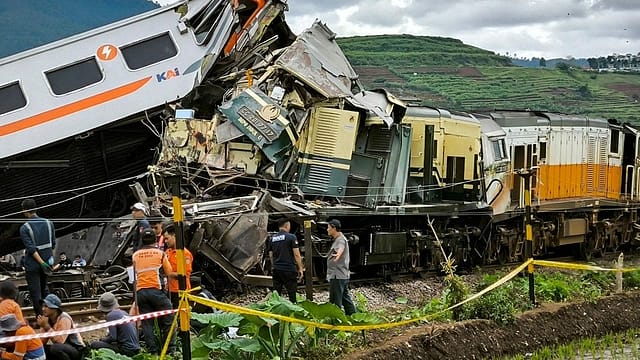
On Monday night, the Argo Bromo Anggrek express slammed into the rear of a stationary CommuterLine at Bekasi Timur Station, on Jakarta's eastern outskirts.
The Indonesia train crash killed 14 people and left 84 requiring hospital treatment.
Indonesia's National Transportation Safety Committee (KNKT) has since opened a formal investigation. Here's what we know.
What Triggered the Crash?
At 8:00 PM, a Green SM Indonesia taxi stalled at the Bulak Kapal crossing and was struck by the CommuterLine.
The impact left the commuter train stranded on track 1 at Bekasi Timur Station.

The Identity Project
11 Sep 2026 - Vol 05 | Issue 37
Amit Shah leads the mission for a national demographic correction
PT KAI spokesperson Franoto Wibowo told reporters the sequence began well before the main collision, with passengers already panicking and preparing to evacuate.
How Did the Express Train Collide With a Stationary One?
At 8:52 PM, the Argo Bromo Anggrek entered the same track and caused a train collision with the stationary commuter train from behind.
There was no advance warning to passengers before impact.
Investigators are asking why the express entered an occupied track 52 minutes after the CommuterLine stopped.
KNKT is analysing the train's black box and signaling infrastructure, Travel and Tour World reported, with early indications pointing to a brake activation failure.
Why Did the Women-Only Carriage Take the Full Force?
The rearmost carriage of the CommuterLine was a designated women-only compartment.
The train collision drove the locomotive directly into its rear, pinning passengers under crushed metal.
Police Chief Asep Edi Suheri confirmed 14 fatalities were women, with most unable to move before rescue teams arrived.
What Did Survivors Say About the Moment of Impact?
Sausan Sarifah, 29, admitted to RSUD Bekasi hospital with a broken arm, told AFP: "It all happened so fast, in a split second."
She said passengers had no time to evacuate before the train was struck, describing people piling on top of one another inside the crushed carriage.
How Long Did It Take to Free Those Trapped?
BASARNAS teams worked for nearly 12 hours, using angle grinders to cut through mangled compartments.
Chief Mohammad Syafii confirmed on Tuesday the operation was complete, telling reporters there were "no more victims to be found."
Who Is Investigating, and What Has Already Been Ordered?
The Indonesia train crash is under formal KNKT investigation.
President Prabowo Subianto visited injured patients in Bekasi on Tuesday and ordered an immediate probe into the train collision, promising state compensation for all victims.
What Does the Crash Say About Indonesia's Rail Infrastructure?
The Bulak Kapal crossing has seen prior incidents.
In 2018, the Bangunkarta train struck a car at the same unbarred crossing, killing the driver. The Bekasi-Cikarang corridor, passing through Bekasi Timur Station, runs commuter, intercity, and freight trains on shared tracks.
Prabowo ordered a flyover at the Bulak Kapal crossing and acknowledged many crossings remain poorly maintained.
(With inputs from yMedia)