US space weapons explained: Why America's first admission of weapons in orbit is a big deal
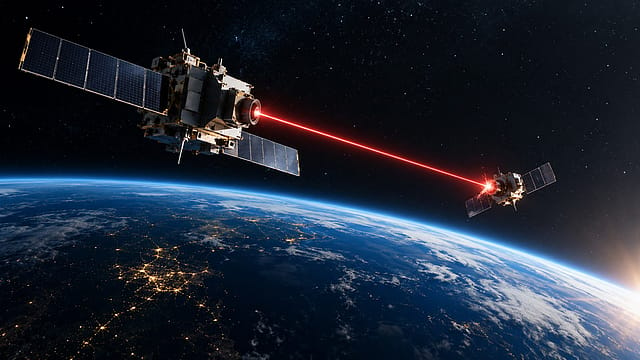
Imagine waking up to discover that one of the world's biggest military powers has quietly placed weapons above your head — not on land, not at sea, but in space.
That is essentially what happened this week when the United States publicly confirmed for the first time that it has deployed "on-orbit space control weapons", marking a major moment in the militarisation of space. The announcement, made by US Air Force Secretary Troy Meink at a defence conference, has reignited questions that once belonged to science fiction: Can wars be fought in space? What exactly are space weapons? And who is racing to build them?
What exactly did the US announce about space weapons?
Speaking at the Air & Space Forces Association conference in Maryland, Air Force Secretary Troy Meink said the United States now has "on-orbit space control weapons capable of defending the joint force against hostile adversary action." It was the first time a senior US official publicly acknowledged that America has deployed weapons in orbit.

Zeroing In on ECI
09 Oct 2026 - Vol 05 | Issue 41
Constitutional legitimacy versus political opportunism
Meink did not reveal what the weapons are, how many have been deployed, or when they entered service. However, he later indicated that the wording of the announcement had been carefully chosen and was intended to send a deterrent message.
What are 'on-orbit space control weapons'?
That is the question experts are now trying to answer.
The US government has not disclosed technical details, but defence analysts say "space control" generally refers to systems designed to protect friendly satellites or disrupt enemy space assets. These capabilities can be offensive or defensive.
The weapon could be a satellite capable of interfering with another satellite's operations. It could involve electronic warfare systems that jam communications, disrupt signals, or disable sensors. Some experts believe the system is more likely to be non-kinetic — meaning it does not physically destroy targets and create dangerous orbital debris.
Why is the US revealing this now?
The timing appears linked to growing concerns about China and Russia.
For years, US military officials have warned that both countries are developing anti-satellite technologies and conducting increasingly sophisticated manoeuvres in orbit. American officials have argued that space is no longer a peaceful support domain but an active warfighting environment.
The announcement also comes as the Pentagon expands space-based defence programmes and explores future missile-defence architectures that could involve assets operating in orbit.
In simple terms, Washington appears to be signalling that if rivals have space weapons, America wants them to know it has them too.
Does this violate international space law?
Not necessarily. The 1967 Outer Space Treaty bans nuclear weapons and other weapons of mass destruction from being placed in orbit. However, it does not prohibit every type of military system or conventional weapon in space.
That legal grey area has existed for decades. Nations have launched military satellites, surveillance platforms and space-support systems without technically violating the treaty. The debate today is whether new "space control" systems push the world closer to a future where space becomes a genuine battlefield.
Why are satellites so important in modern warfare?
Because modern militaries depend on them for almost everything.
GPS navigation, missile tracking, communications, intelligence gathering, targeting, weather monitoring and battlefield coordination all rely heavily on satellites. If those satellites are disabled, blinded or destroyed, military operations on Earth can be severely disrupted.
That is why space is increasingly viewed not as a distant frontier but as critical infrastructure.
The conflict may begin on Earth, but the first shots could be aimed at satellites.
Could this trigger a new space arms race?
Many experts worry it could. Following the US announcement, analysts warned that publicly acknowledging orbital weapons could encourage other powers to expand or reveal similar capabilities. China has already criticised the move and warned against turning space into a new arena for military confrontation.
The concern is not just about weapons themselves. Destroying satellites can create vast clouds of debris travelling at extreme speeds, threatening spacecraft, astronauts and even civilian satellites used for internet, banking and communications.
Is space already becoming a military battlefield?
In many ways, yes.
The US Space Force has repeatedly described space as a warfighting domain. Earlier this month, US Space Command conducted what it described as its first "live-fly" orbital warfare exercise, practising manoeuvres that some observers compared to aerial dogfighting — except in space.
The latest announcement suggests the conversation has moved beyond theory.
For years, governments spoke about the possibility of weapons in orbit. Now, one of the world's leading military powers has confirmed that such systems are already there.
What happens next?
The most striking part of the announcement may be what remains unknown.
The US has acknowledged the existence of orbital weapons but has revealed almost nothing about their capabilities. That ambiguity may itself be part of the strategy. A rival cannot easily counter a weapon if it does not know exactly what it is facing.
But the bigger story is that a line has been crossed.
For decades, space was presented as humanity's shared frontier — a place of exploration, science and discovery. This week's announcement is a reminder that space is increasingly becoming something else as well: a strategic military arena where the world's biggest powers are preparing for conflicts that may never be seen from the ground, but could reshape everything below it.
(With inputs from agencies)