Trump Talks Iran Deal, Demands Hormuz Payback and Takes Aim at Google
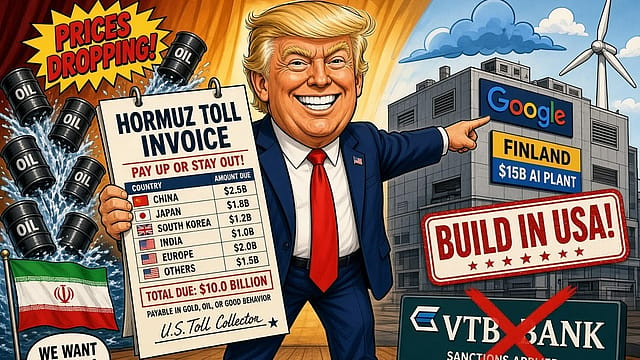
Iran wants a deal. Oil prices will fall. Countries benefiting from American protection of the Strait of Hormuz should pay up. And Google should reconsider its massive artificial intelligence investment in Finland.
US President Donald Trump delivered a flurry of demands and predictions on Monday, combining claims of military success against Iran with promises of economic relief at home and criticism of a technology giant’s overseas expansion.
In posts on Truth Social, Trump claimed Tehran was eager to negotiate and said Washington was open to engagement. He also accused other countries of failing to support American operations in the Strait of Hormuz, while insisting that they reimburse the United States for protecting the oil transit corridor.
His statements came as Washington announced fresh sanctions against Russia’s VTB Bank over its alleged assistance to Iran and the US military challenged Tehran’s account of an attack on a tanker whose crew included 14 Indian nationals.

Zeroing In on ECI
09 Oct 2026 - Vol 05 | Issue 41
Constitutional legitimacy versus political opportunism
Iran Deal Soon? Trump Predicts an Oil-Price Plunge
Trump claimed Iran wanted an agreement “quickly and badly”, while reserving the decision on negotiations for Washington.
“The failing Nation of Iran wants to make a deal, quickly and badly. I will determine whether or not the U.S.A. will choose to engage,” he wrote, adding that the United States was open to the possibility.
He offered no details of a potential agreement or a timetable for talks.
For consumers facing higher fuel costs, Trump predicted that oil would “drop like a rock” when the military conflict ended. That, he said, would “not be long”.
He blamed former President Joe Biden’s administration for price increases in the United States, claimed oil had been more expensive under his predecessor and asserted that other prices were falling sharply. Trump also credited American military action with preventing Iran from acquiring a nuclear weapon.
Alongside the prospect of diplomacy, he highlighted the continued supply of weapons to US forces.
Trump claimed American defence manufacturers were producing advanced weapons at an unprecedented pace, operating factories around the clock and expanding their manufacturing capacity. He identified Patriot and THAAD air-defence systems, Tomahawk missiles and other missile systems as production priorities.
The claims of accelerating output came amid concerns expressed by US defence officials about depleted stockpiles and stretched naval assets.
Washington and Tehran also offered competing accounts of an American underwater drone that Iran claimed to have seized near the entrance to the Strait of Hormuz.
Iranian Foreign Ministry spokesperson Esmail Baghaei described the equipment as “spoils of war”, according to Iran’s IRNA news agency. Iranian state media identified it as an uncrewed Dive-LD underwater vehicle manufactured by US defence company Anduril.
A Pentagon spokesperson said the underwater drone had suffered a technical failure more than a day earlier.
Hormuz Protection Comes With a Payment Demand
Trump’s message to countries benefiting from shipping through the Strait of Hormuz was blunt: Washington expects reimbursement. “Oil is flowing through the Hormuz Strait,” he wrote, accusing other countries of offering “no help whatsoever” during the conflict.
He said those nations “should, and will, reimburse the United States of America” once the confrontation ended. “We are doing it much more for others, than we are for ourselves, and we have been for Generations!” he added.
Trump did not identify the countries expected to pay, specify an amount or explain how reimbursement would work.
The demand came as American forces continued operations aimed at maintaining oil shipments through the passage. Tehran has imposed transit restrictions and maintains that vessels must follow routes and procedures established by Iranian authorities. Washington rejects Iran’s assertion of authority over the waterway.
The dangers facing commercial shipping were underscored by the attack on the Panama-flagged tanker El Gaia, which became the subject of sharply conflicting American and Iranian accounts.
US Central Command, or CENTCOM, rejected the Islamic Revolutionary Guard Corps’ claim that the tanker had struck a naval mine in the Strait of Hormuz.
According to CENTCOM, an Iranian missile hit the vessel last month and left it inoperable. Iran then attacked it again with a drone over the weekend while it was off Oman, the command said. “The tanker is currently being towed by a regional partner,” CENTCOM added.
Earlier, Iran’s Fars News Agency had reported, citing the Revolutionary Guards, that the El Gaia struck a naval mine, triggering an explosion and an onboard fire.
Of the vessel’s 14 Indian crew members, 13 have been rescued. Search operations continue for the remaining sailor.
Russia’s VTB Faces Fresh Sanctions Over Iran Links
As the military and diplomatic exchanges continued, Washington moved to tighten financial pressure on Tehran.
The United States announced fresh sanctions against Russia’s VTB Bank on Monday, alleging that the lender helped Iran bypass American restrictions and move billions of dollars in assets.
The US Treasury Department cited VTB’s role in “establishing correspondent relationships with sanctioned Iranian banks”. The State Department alleged that the Russian lender had opened branches in Iran, built links with sanctioned entities and “worked to move billions of dollars in Iranian assets”.
Washington urged financial institutions worldwide to sever ties with VTB and warned of consequences for others considering similar arrangements.
“Any effort to help Iran evade sanctions will carry serious consequences, including exposure to U.S. financial restrictions,” the State Department said.
VTB was already subject to full US blocking sanctions imposed following Russia’s invasion of Ukraine in 2022. Those measures froze assets under American jurisdiction. At the time, the Treasury described VTB as “one of the largest financial institutions Treasury has ever blocked”.
The latest action focuses on the bank’s alleged assistance to Tehran as Washington broadens its economic campaign during the conflict in West Asia.
US Treasury Secretary Scott Bessent has described that campaign as an “economic D-Day”. Washington has also targeted external institutions, including Turkey’s Golden Global bank, as it seeks to restrict Iran’s access to financial channels.
Google’s Finland AI Bet Draws Trump’s Fire
Trump’s criticism extended beyond the war to Google’s plans for a major expansion of its AI infrastructure in Finland.
The president urged the company to reconsider, claiming that difficulties securing permits in the United States were driving its decision to invest overseas.
“Google has recently stated that they want to build a massive Plant in Finland, all because they are finding permitting too difficult in the United States. I am not happy about this, and want them to change their thinking,” he wrote.
According to The Wall Street Journal, Google announced plans last week to invest at least $15 billion in Finnish data centres and digital infrastructure, describing it as its largest single capital commitment in Europe.
The investment includes Google’s existing facility in Hamina, on Finland’s southern coast, which occupies a former paper mill acquired in 2009, as well as other locations. The infrastructure will support services including Gemini, Search, Maps and YouTube.
The project is expected to support more than 37,000 jobs during its initial construction phase and about 7,000 through long-term operations.
Google’s plans also include additional energy capacity, grid improvements and affordability initiatives. The Wall Street Journal reported that the company had signed agreements with Finnish onshore wind suppliers alongside plans for a battery installation connected to the national grid.
Shares of Nordic utility Fortum rose more than 8 per cent after it announced a 22-year supply agreement supporting the extension of its Loviisa nuclear facility. Under the arrangement, Google will buy half the station’s output from 2030 through 2049.
Trump, meanwhile, portrayed AI and data centres as potentially the greatest economic development engine in history, claiming their impact would exceed that of oil or the internet.
He also dismissed fears that AI could threaten humanity, following calls from industry executives for development pauses.
“AI taking over the World, destroying Humanity, and all other things bad, is a HOAX,” he wrote.
With inputs from ANI