EXPLAINED | How Pakistan’s First Astronaut Got a Seat on China’s Space Station
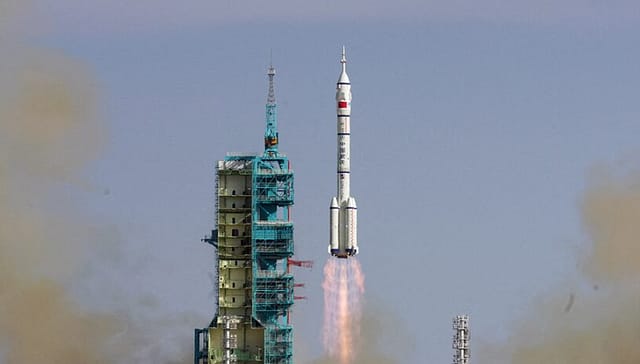
The first Pakistani astronaut is due to leave Earth in one Chinese spacecraft and return in another. He will travel to Tiangong, China’s space station, on Shenzhou-24. After a short stay, he will come back aboard Shenzhou-23, the spacecraft that carried the previous crew up in May. China’s crewed space agency confirmed the plan on November 7. If the flight goes ahead as planned, he will be the first foreign astronaut to board Tiangong.
There are two Pakistani candidates for the flight, Khurram Daud and Muhammad Zeeshan Ali. Both went through training in China. One will fly and the other will be the backup. The announcement settled which mission would take the astronaut. It left the choice of astronaut and the launch date open.

The Era of Forever Wars
30 Oct 2026 - Vol 05 | Issue 44
Coping with an explosive Middle East
How did Pakistan get the seat?
Pakistan’s space agency, SUPARCO, signed an agreement with China’s crewed space agency in Islamabad in February 2025. It covered the selection and training of Pakistani astronauts and participation in a mission to the Chinese station. In April 2026, SUPARCO named the two candidates. China’s November announcement assigns the seat to a specific flight, Shenzhou-24.
The agreement gives Pakistan access to an orbital laboratory and a crewed transport system that China already operates. Pakistan can train someone to run experiments there while China provides the launch, spacecraft and station. The mission is also the first time China plans to include a foreign astronaut on one of its crewed flights.
What did the two candidates have to learn?
They had to learn to work in a Chinese spacecraft and alongside a Chinese crew. Pakistani space officials told Reuters that the two pilots had spent months training in Beijing. That included learning Mandarin and getting used to the physical demands of launch and to tasks they would have to perform in weightlessness.
A visiting astronaut needs to be able to follow instructions when the crew has little time to explain them. Learning how to run an experiment is only part of the preparation. So is knowing how to move around the station, handle its equipment and follow the crew’s procedures. China says the candidate who does not fly will serve as the mission backup.
What will the astronaut do up there?
He will serve as a payload specialist. A payload is what a spacecraft carries for the mission, such as scientific equipment. His job will be to run experiments, with the spacecraft’s flight assigned to its flight crew.
In September, a SUPARCO official told Reuters that Chinese institutes had selected four biotechnology experiments from more than 300 proposals submitted to Pakistan’s space agency. Another official said the experiments were built and tested in Pakistan before Chinese engineers signed off on them. The November 7 announcement confirmed the astronaut’s role. It did not list the experiments, so the four should be treated as the reported plan until the agencies publish the final list.
Why will he come home in a different spacecraft?
The visit is planned around a handover. Shenzhou-24 brings the next crew and the Pakistani astronaut to Tiangong. Shenzhou-23 is already there. It is the spacecraft China says will bring the visitor back after his short stay. An astronaut can arrive during one crew’s flight and leave with members of the previous crew.
Pakistani officials had told Reuters in September to expect a stay of about a week. China’s November statement described a short stay and gave no exact length. The distinction matters when reading the schedule. A spacecraft’s mission can last months while a visitor aboard the station stays for days.
Has India done something similar?
Twice, with different roles and partners. Rakesh Sharma became the first Indian in space in 1984, flying on a Soviet Soyuz spacecraft to the Salyut 7 station. He went through the Soviet Interkosmos programme, which opened flights to astronauts from partner countries. That is the closest Indian parallel to Pakistan’s first flight through a government-to-government arrangement.
In 2025, Shubhanshu Shukla flew to the International Space Station as pilot on Axiom-4. He worked on seven experiments developed by Indian research institutions. One examined how methi and moong sprout in the conditions aboard the station. ISRO says the mission gave it experience relevant to Gaganyaan, India’s programme to fly astronauts using its own spacecraft and rocket. The Indian examples show what can come home from a borrowed seat: research, flight experience and procedures that a space agency can use again.
Is November 25 the launch date?
It is the date Pakistan’s planning minister, Ahsan Iqbal, gave publicly in October. China’s November 7 announcement named Shenzhou-24 without giving a launch date or naming which candidate would fly. The flight plan is public. The remaining details to pin down are who takes the seat, when the rocket lifts off and which experiments make it aboard.