US-Israeli Strike Near Tehran, Drone Attack in Kuwait Deepen Regional Crisis; Civilian Toll Rises
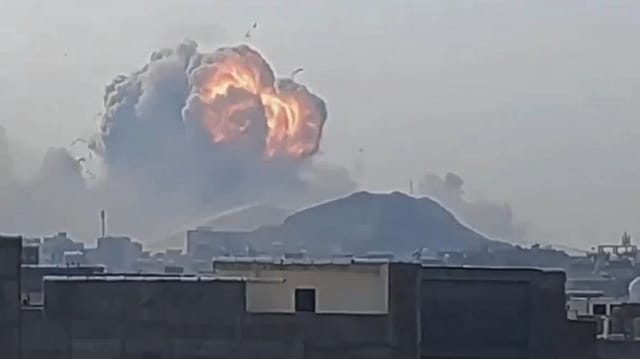
A US-Israeli strike hit an industrial area in Rabat Karim, about 27 km southwest of Tehran, early Thursday, intensifying the ongoing conflict across West Asia even as a drone attack struck a residential building in southern Kuwait, adding to the mounting casualties and damage in the region.
According to Al Jazeera, citing Mehr News Agency, the strike targeted the industrial outskirts of the Iranian capital during the early hours of Thursday.
Local officials said authorities were closely monitoring developments as reports of the attack surfaced through state-linked media.
Regarding the impact of the raid, "the city's deputy governor said an abandoned warehouse was one of the targets struck." No further details on additional sites were immediately available.

Zeroing In on ECI
09 Oct 2026 - Vol 05 | Issue 41
Constitutional legitimacy versus political opportunism
The humanitarian toll of the conflict has continued to rise sharply. Iran's Permanent Representative to the United Nations, Amir-Saeid Iravani, estimated that the civilian death toll is nearing 1,350.
The escalating crisis has drawn increasing international diplomatic attention.
On Wednesday, the 15-member UN Security Council adopted a resolution condemning what it described as "egregious" attacks by Iran on Gulf Cooperation Council countries and Jordan.
The resolution demanded an immediate halt to all hostilities by Tehran and warned against threats to close the strategic Strait of Hormuz.
India joined more than 130 countries in co-sponsoring the Bahrain-led resolution, which passed with a 13-0 vote, while permanent members China and Russia abstained.
The UNSC resolution condemned Iran's attacks on the territories of Bahrain, Kuwait, Oman, Qatar, Saudi Arabia, the UAE and Jordan "in the strongest terms," stating that such actions violate international law and pose a threat to global security.
How has the Iran conflict spread to Iraqi waters with tanker attacks off the Iraqi coast?
Al Jazeera, citing Mehr News Agency, reported that the conflict has spilled into Iraqi waters where two tankers were attacked off the Iraqi coast.
The incident led to the evacuation of 38 crew members and the death of one person. Saad Maan, head of Iraq's Security Media Cell, condemned the attack as a violation of national sovereignty.
The Islamic Revolutionary Guard Corps announced on Thursday the launch of the 40th wave of "Operation True Promise-4", targeting US bases in the region and locations in Tel Aviv, Haifa and other occupied territories.
News reports said the Islamic Resistance Movement deployed "Ghadr", "Emad", "Kheybar Shekan" and "Fattah" missiles in an operation codenamed "First Imam of All Believers, Imam Ali (AS)".
The strikes targeted both the occupied territories and US regional bases.
Shipping disruptions and the possibility of the Strait of Hormuz being closed have already begun affecting global oil supplies, sending crude prices higher.
What did Iran claim about IRGC attacks on oil tankers in the Persian Gulf?
State broadcaster Press TV released footage of the "Defenders of the Persian Gulf" operating speedboats and claimed that the IRGC had struck 14 oil tankers, including two belonging to the United States.
The New York Times reported that Iranian retaliatory strikes have damaged at least 17 US military and diplomatic facilities across West Asia.
Based on satellite imagery and official statements, the report said US bases in Bahrain, Jordan, Qatar, Kuwait, the UAE and Saudi Arabia were hit.
Among the reported losses were radars associated with the US THAAD missile defence system, along with strikes on diplomatic missions in Iraq and several Gulf countries.
Despite the widespread damage and ongoing Iranian operations, US President Donald Trump said on Wednesday that the United States had already "won the war" in Iran.
He added that American troops would remain deployed until the mission was fully completed.
What happened in the drone strike on a residential building in southern Kuwait?
Meanwhile, a separate aerial strike hit a residential building in southern Kuwait on Thursday morning, causing casualties and significant property damage.
According to the country's Ministry of Defence, an "enemy drone targeted a residential building" in the south during the dawn hours. In a post on X, the ministry confirmed that at least two people were wounded and were receiving "the necessary treatment."
Officials said the strike also caused significant material damage to the premises. Authorities have not yet released further details regarding the origin of the drone as they continue to assess the situation.
The attack follows revelations that an earlier Iranian drone strike in Kuwait, which killed six US service members during the initial hours of the conflict, was far more severe than previously reported.
CBS News reported that multiple sources said dozens of personnel suffered serious injuries including "brain trauma," shrapnel wounds and burns.
The report also indicated that at least one individual "may require the amputation of a limb."
What injuries did US troops suffer after the Kuwait drone strike?
Sources described a "grim and chaotic scene" following that strike, which targeted a tactical operations centre at the Shuaiba port outside Kuwait City on March 1.
Rapidly spreading smoke filled the structure and severely hindered rescue efforts for those trapped inside.
By Tuesday night, more than 30 military members remained hospitalised with "battle injuries" related to the Kuwait attack.
They are receiving treatment at facilities including Brooke Army Medical Centre in San Antonio and Walter Reed Medical Centre in suburban Washington, DC.
Another 25 personnel are being treated at Landstuhl Regional Medical Centre in Germany, according to CBS News.
About 20 of them arrived on Tuesday aboard a C-17 military transport aircraft with injuries the military classified as "urgent" and "requiring evacuation."
Three sources confirmed that these cases involved "traumatic brain injuries, memory loss and concussions." To manage the influx of patients, more than 100 medical personnel were deployed to the German facility.
Initially, the Defence Department had not released detailed casualty figures. On March 1, officials said five personnel were "seriously wounded" while "several others sustained minor shrapnel injuries and concussions."
How did the Iranian drone breach US air defences during the Kuwait attack?
CBS News later reported that two service members were originally missing after the explosion and were only "later found under the rubble."
US Secretary of War Pete Hegseth previously acknowledged the difficulty of intercepting such attacks.
He said that while air defence systems destroy most incoming threats, occasionally "one, unfortunately, we call it a squirter, that makes its way through."
Hegseth said the drone "happened to hit a tactical operations centre that was fortified, but these are powerful weapons."
Despite the military maintaining "robust air defences" to protect US personnel from Iranian strikes, sources told CBS News that some weapons still manage to breach defensive systems.
Pentagon spokesman Sean Parnell said on Tuesday, the 11th day of the conflict, that around 140 US service members had been injured so far.
He added that the "vast majority of these injuries have been minor," noting that 108 personnel have already "returned to duty."
However, Parnell confirmed that "eight service members remain listed as severely injured and are receiving the highest level of medical care."
According to CBS News, Pentagon spokespeople did not immediately respond to further questions regarding the specific locations where the injuries occurred.
(With inputs from ANI)