US-Iran Talks in Pakistan: Inside the 10-Point vs 15-Point Clash
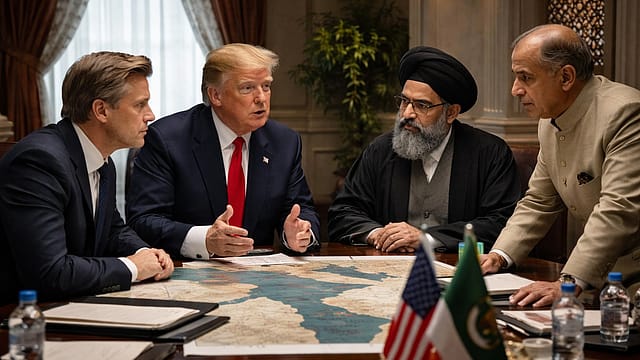
A high-stakes diplomatic moment is unfolding in Islamabad as delegations from the United States and Iran arrive for crucial ceasefire and maritime security talks. With tensions still simmering, the outcome could reshape regional stability.
A US delegation led by Vice President JD Vance landed in Islamabad earlier on Saturday to engage in negotiations with Iran. The Iranian side is headed by Parliament Speaker Mohammad Baqer Qalibaf.
The talks follow a fragile ceasefire announced last week, with Iran’s Supreme National Security Council indicating that negotiations could continue for up to 15 days. Pakistan has emerged as a neutral venue, with Prime Minister Shehbaz Sharif calling the discussions “make or break.”
According to reports, security has been exceptionally tight. The Iranian delegation’s aircraft was escorted into Pakistani airspace by AWACS systems, electronic warfare aircraft, and fighter jets, underlining the sensitivity of the talks.

Zeroing In on ECI
09 Oct 2026 - Vol 05 | Issue 41
Constitutional legitimacy versus political opportunism
“Iran's negotiating team led by Parliament Speaker Mohammad Baqer Qalibaf arrives in Islamabad. Accompanying Qalibaf are Foreign Minister Abbas Araghchi, Defense Council Secretary Ali Akbar Ahmadian, Central Bank Chief Abdolnaser Hemmati, and several lawmakers,” Iran’s Embassy in India said in a post on X.
What Are the Key Differences Between the US and Iran Proposals?
At the heart of the dispute lies a sharp divergence in proposals.
Iran has presented a 10-point plan, which Donald Trump has described as “workable.” The proposal includes demands such as lifting all sanctions, continuing uranium enrichment, and maintaining control over the Strait of Hormuz.
“Iran's 10-point conditions that the US has accepted as 'workable': The US is fundamentally committed to: Non-aggression; Continuation of Iran's control over the Strait of Hormuz; Acceptance of enrichment; Lifting all primary sanctions; Lifting all secondary sanctions; Termination of all UN Security Council resolutions; Termination of all IAEA Board of Governors resolutions; Payment of compensation to Iran; Withdrawal of US combat forces from the region; Cessation of war on all fronts, including against the heroic Islamic Resistance of Lebanon,” Iran in India posted on X.
In contrast, the US has proposed a 15-point framework with stricter conditions. These include halting uranium enrichment, handing over enriched stockpiles to international authorities, and ending support for regional proxy groups.
“Iran commits to never developing nuclear weapons; Iran must also no longer enrich uranium within the country, and hand over its stockpile of already enriched uranium to the International Atomic Energy Agency (IAEA),” according to reported elements of the US plan.
“Tehran would also commit to allowing the IAEA to monitor all elements of the country's remaining nuclear infrastructure; Reopening of the Strait of Hormuz; Ending Iran's support for regional proxies such as Hezbollah in Lebanon and the Houthis in Yemen,” the points further said.
“A removal of all sanctions imposed on Iran, alongside the ending of the United Nations mechanism that allows sanctions to be reimposed; Limits on the range and number of Iran's missiles,” the US-floated peace plan said.
Confusion has deepened due to discrepancies between Persian and English versions of the proposals, particularly on Iran’s right to enrich uranium.
Vice President Vance dismissed the circulated version of Iran’s proposal, calling it “little more than a ‘random yahoo in Iran submitting it to public access television’.”
Trump later clarified the US position, stating, “There is only one group of meaningful 'POINTS' that are acceptable to the United States, and we will be discussing them behind closed doors during these Negotiations.”
How Do Regional Tensions Impact These Talks?
Even as negotiations unfold, tensions in the region remain high. Israeli Prime Minister Benjamin Netanyahu has made it clear that military operations will continue despite the ceasefire.
He stated that while Israel welcomes the ceasefire, attacks on Lebanon would not stop and efforts to dismantle Hezbollah would continue.
On the ground, violence persists. An Israeli air strike in southern Lebanon reportedly killed three people and destroyed a residential building, highlighting the fragile and volatile backdrop against which these talks are taking place.
Meanwhile, Islamabad has gone into lockdown mode, with roads leading to the diplomatic enclave barricaded as Pakistan hosts one of the most consequential negotiations in recent years.
(With inputs from ANI)