Who’s Running Iran?
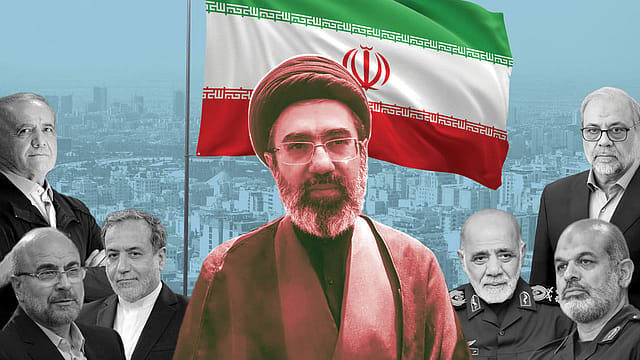
EVEN AS THE Trump administration finds itself in a quagmire of its making over the Strait of Hormuz, after Iran stunned the world and itself by discovering and demonstrating to what extent it could use the vital waterway as leverage, whom exactly was Washington dealing with in Islamabad and who will be the Islamic regime’s real decision-maker hereafter?
The regime in Tehran today is not a government but a fractured and contested command structure. The Islamic Revolutionary Guard Corps (IRGC) has the guns: directed at Hormuz literally and at the civilian administration figuratively. The missing Mojtaba Khamenei has theoretical (and theological) legitimacy, having been anointed successor as Supreme Leader to his assassinated father Ali Khamenei at the insistence of the IRGC. The moderates are subject to public humiliation and political straitjacketing.
The hardliners are fighting each other as a clear division forms between the pragmatists led by Mohammad-Bagher Ghalibaf, the speaker of parliament, and the hawks of IRGC Commander Major General Ahmad Vahidi.
And President Masoud Pezeshkian is locked out of the structure altogether, reportedly failing to evoke even a response to his repeated requests for an audience with perhaps a wholly incapacitated Mojtaba Khamenei.
On April 17-18, as the IRGC chastised Foreign Minister Abbas Araghchi and rolledback his announcement on X that the Strait of Hormuz was “completely open”, shelling and seizing ships in violation of the blockade, it came out as the power behind whatever face Tehran was projecting to the world. Araghchi certainly was not a man in control of his assignment. From the looks of it, such agency now lay with a military council comprised of Vahidi and senior IRGC officers.
And yet, Araghchi, with a little help from Ghalibaf, managed to push back against Vahidi’s insertion of Mohammad Bagher Zolghadr, secretary of the Supreme National Security Council, as his spy within the Islamabad delegation to report back on any deviation from the line laid down by the IRGC. Incidentally, Zolghadr was the one to fire the first salvo against Araghchi’s ‘opening’ of Hormuz. While Araghchi didn’t quite win the tussle, the fact that he still had a voice loud enough to underscore Zolghadr’s lack of diplomatic experience indicates something else.
The fact is that the IRGC is in command but not in full control. Vahidi may have made it clear to Ghalibaf and Araghchi that no decision can be taken without the IRGC’s approval and insisted on the IRGC also making all critical appointments and managing the regime’s position on sensitive matters till the war officially ends. Yet Ghalibaf, himself a hardliner but with a more flexible approach to Washington who would prefer to slow down the pace of confrontation, has enough clout to make Vahidi and Ali Abdollahi Aliabadi, commander of the Khatam al-Anbiya Central Headquarters, a member of Vahidi’s inner circle and reportedly the second most powerful man in Tehran today, constantly look over their shoulders.
What Tehran says and does, or doesn’t, hinges largely on the contest between these two hardline camps right now. The Vahidi camp does have one additional advantage apart from the guns. During his years as his father’s underling, Mojtaba Khamenei had built a strong personal and professional relationship with precisely the category of men doing the bullying in Tehran today: the Tier 2 of IRGC commanders who have succeeded to office after the serial assassinations of their superiors. Having the new Supreme Leader out of sight but attributing policy and action to him suits Vahidi and his men. But then those second-order commanders are now competing for more power and power over each other and the country’s future. The superlative ‘most powerful’, too, is a relative term within the regime.
Nevertheless, a military authority that isn’t totally in control brings its own dangers. If nobody is fully in charge, the unpredictability and likelihood of misunderstanding, with a fragile diplomatic process on hold and a paused war at stake, multiply. The reality is perhaps starker: the regime in Tehran appears to be more centripetal than it was before February 28 but it is actually being pulled apart by centrifugal forces. In other words, chaos rules Iran. The authoritarian regime may have become a more closed system but it is also a fragmenting system, with the elite battling itself. It can retain its coercive capacity for a while but is unlikely to hold on to power for much longer.
Adividedrulingelite, asevere economic crisis, an unresolved contest for de facto leadership are classic triggers for regime collapse. That doesn’t mean the regime is collapsing tomorrow.
Under such circumstances, what are the likely scenarios? The first and most probable scenario is continuity of the fragile and fragmented system. The IRGC subdues whatever prerogative the civilian and clerical institutions still retain and suppresses popular protests with violence. As and when a ceasefire deal is ultimately made, it offers conditions and concessions acceptable to the IRGC. The regime survives through 2026 but only just: intact but a ghost of its former self, weakened beyond a full recovery. The second scenario takes off from the Vahidi camp’s current advantage of having Mojtaba Khamenei as an absent but invoked figurehead. It establishes a military dictatorship, not overnight but incrementally, consolidating itself over weeks and months.
In this case, Iran still remains a theocratic state on paper but the ayatollahs are effectively sidelined with some semblance of authority but no real power. It is possible that Iran becomes an even more radical exporter of terror and enabler of regional and perhaps even global proxies once the IRGC gets its military state. A lot will depend on how quickly Iran’s friends help rebuild the country and pump money into the regime’s coffers apart from what it earns from oil and the chokehold on Hormuz.
A third probability is a managed collapse wherein the war-and-sanctions-wrought economic devastation and elite fragmentation brings about a transformation from within, with the weakening of the IRGC’s initiative and a reassertion of the pragmatists’ ability to negotiate with the US.
It’s difficult to see this scenario unfolding without a resumption of the war as Iran’s energy resources, industrial capacity and military capability need to be sufficiently degraded for the IRGC to lose its grip on power. A complete collapse of the regime without the resumption of the war is the fourth scenario but highly unlikely.
However, this too would be protracted as it would need the IRGC itself to splinter from defections, perhaps after someone in authority confirms the impossibility of the Supreme Leader ever returning to public life. This scenario certainly calls for popular protests even if the IRGC responds with mass arrests and executions. External incitement to regional separatism, as with the Baloch or Kurds, too could undermine the regime beyond recovery but Iran is nowhere close to such largescale and regimethreatening insurgencies yet.
While a resumption of the war may certainly be on the cards, the IRGC surviving by rallying the population and uniting the country is the least likelyscenario. Thereisnodoubt that this is precisely what Vahidi would like: that Donald Trump would bomb the IRGC into rebirth. But it may not have the sinews to withstand another round of US-Israeli assault. As the Strait of Hormuz stalemate becomes a battle of wills, the question is not whether Iran will change. Rather, it is how long that transformation will take and how violent it will be.