US-India Trade Deal Intact? Trump Says “Nothing Changes” After SC Tariff Setback
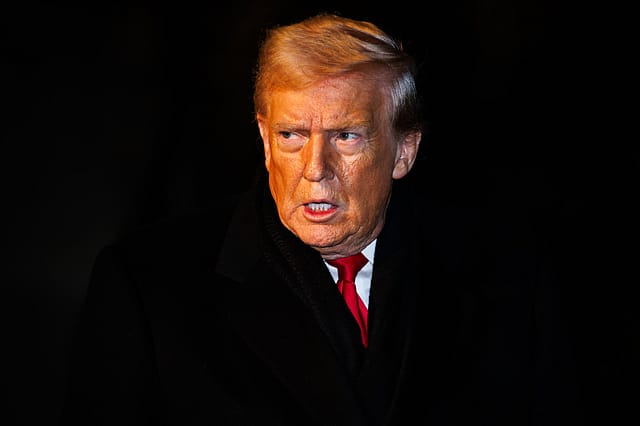
In a landmark decision that could reshape America’s trade policy and ripple across global markets, the US Supreme Court has struck down most of President Donald Trump’s sweeping tariffs, prompting a sharp response from the White House and raising fresh questions over the future of the US-India trade deal.
Why did the Supreme Court strike down Trump’s sweeping tariffs?
In a major blow to Trump’s signature trade policy, the Supreme Court invalidated most of the administration’s broad tariff measures, ruling 6-3 that the President did not possess the authority under the 1977 International Emergency Economic Powers Act (IEEPA) to impose extensive import duties on goods from nearly all US trading partners.
The Modi Years
02 Oct 2026 - Vol 05 | Issue 40
A Nation Rebuilt
The judgement is expected to have wide-ranging consequences for global trade, businesses, consumers, inflation trends and household finances across the country.
The verdict also marks a notable shift from a series of recent wins for Trump at the apex court. Over the past year, the justices had largely sided with the administration in interim orders, allowing policies such as a ban on transgender troops serving in the military, granting the United States DOGE Service access to sensitive data, and enabling significant cuts to the Education Department while legal challenges continued.
The financial implications are substantial. The tariffs covered trillions of dollars in trade, and the US government collected nearly USD 134 billion in levies through December 14 under the contested authority. According to estimates by the Tax Foundation, Trump’s trade war will cost American households approximately USD 1,100 each in 2025.
Reacting strongly, Trump said, "The Supreme Court's ruling is deeply disappointing, and I am ashamed of certain members of the court for not having the courage to do what is right for our country..."
What did Trump say about the impact on the India trade deal?
The ruling came just days after the United States and India announced a framework for an Interim Agreement on reciprocal and mutually beneficial trade, reaffirming their commitment to a broader U.S.-India Bilateral Trade Agreement (BTA) launched by Trump and Prime Minister Narendra Modi on February 13, 2025.
Under the interim framework, India agreed to eliminate or reduce tariffs on all US industrial goods and a wide range of US agricultural and food products, including dried distillers’ grains (DDGs), red sorghum for animal feed, tree nuts, fresh and processed fruit, soybean oil, wine and spirits, and additional products.
In return, the United States agreed to impose a reciprocal tariff of 18 per cent on goods originating in India, including textiles and apparel, leather and footwear, plastic and rubber products, organic chemicals, home décor, artisanal goods and certain machinery. The US had earlier imposed a 50 per cent tariff on Indian goods, including a 25 per cent tariff for importing oil from Russia.
Despite the Supreme Court’s ruling, Trump insisted that the India arrangement would stand.
"Nothing changes. They'll be paying tariffs, and we will not be paying tariffs. This is a reversal of what used to be. PM Modi is a great gentelman a great man. He was much smarter than the people he was against. In terms of the US, He was ripping us off. So we made a deal with India. A fair deal now. We are not paying tariffs to them, and they are. We did a little flip," Trump said.
What could this mean for global trade and American households?
The court’s decision injects uncertainty into US trade policy at a sensitive moment. The tariffs in question spanned nearly all major trading partners, meaning their rollback could ease pressure on businesses reliant on imports and potentially soften inflationary trends.
However, the administration’s insistence that specific bilateral arrangements—such as the India interim deal—remain intact suggests a complex legal and diplomatic road ahead.
A Joint Statement had said that the Interim Agreement between the United States and India will represent a historic milestone in our countries’ partnership, demonstrating a common commitment to reciprocal and balanced trade based on mutual interests and concrete outcomes.
The framework also states that, subject to the successful conclusion of the Interim Agreement, the US will remove the reciprocal tariff on a wide range of goods identified in the Potential Tariff Adjustments for Aligned Partners Annex to Executive Order 14346 of September 5, 2025, including generic pharmaceuticals, gems and diamonds, and aircraft parts.
With billions of dollars in revenue at stake and household costs projected to rise, the ruling sets the stage for a renewed political and legal battle over the limits of presidential trade powers—and the future direction of America’s economic engagement with the world.
(With inputs from ANI)