Trump Claims 78% Drop in US Trade Deficit, Credits Tariffs as Economists Flag Volatility
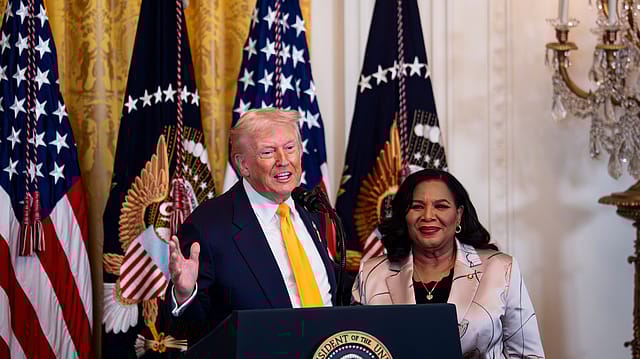
US President Donald Trump claimed that the nation’s trade deficit has contracted sharply by 78 per cent, attributing the shift to tariffs imposed on companies and countries and describing it as a first in many decades.
Sharing the development on Truth Social, the US President wrote, “The United States trade deficit has been reduced by 78% because of the tariffs being charged to other companies and countries. It will go into positive territory during this year, for the first time in many decades. Thank you for your attention to this matter!”
His remarks came ahead of the official trade data for December, which is due on Thursday. Investing.com reported that the United States is expected to post a monthly trade surplus of about $55.5 billion, which, if confirmed, would mark the country’s first monthly trade surplus since 1975.

The Modi Years
02 Oct 2026 - Vol 05 | Issue 40
A Nation Rebuilt
These assertions follow nearly a year after his administration initiated the “Liberation Day” tariffs targeting over 100 countries.
While introducing these “reciprocal tariffs” on April 2, 2025, the President hailed the policy as America’s “declaration of economic independence,” with duties varying between 10 per cent and 50 per cent.
Did Donald Trump’s tariffs on over 100 countries reshape US trade dynamics?
“It’s one of the most important days in American history. We are going to make America great again. Greater than ever before… we will supercharge our domestic industrial base… More production at home will mean more competition and lower prices for consumers,” he said at the time.
After announcing tariffs on more than 100 countries, he later declared a 90-day pause to allow nations to secure trade deals with Washington to substantially reduce tariff rates.
The deadline ended in July, with many countries reaching agreements that brought their tariff levels down.
Although several of the highest tariffs were subsequently rolled back, the punitive measures did lead to a noticeable decline in imports, especially from China.
US goods imports from China fell to $288 billion between January and November 2025, compared with $401 billion during the same period in 2024.
Why did the US trade deficit widen in November 2025 despite tariff measures?
However, government data showed that much of the reduction in Chinese imports was offset by higher purchases from other Asian and European countries.
According to projections, the United States is expected to record a trade deficit of more than $800 billion in 2025, lower than the record $1.2 trillion shortfall reported in 2024.
Much of this year’s gap has been attributed to a sharp rise in imports during the first quarter, when businesses rushed to bring in goods ahead of the April tariffs.
Official data from the US Census Bureau showed that Washington’s trade deficit widened in November 2025 to $56.8 billion, up from $29.2 billion in October 2025.
The country exported goods and services worth $292.1 billion in November, $10.9 billion less than in October, indicating a drop in overseas sales, while imports rose to $348.9 billion, $16.8 billion more than the previous month.
The rise in November’s overall trade deficit was mainly driven by a sharp increase in the goods shortfall, which grew by $27.9 billion to reach $86.9 billion.
How did falling exports and rising imports widen the US trade deficit gap?
At the same time, the surplus in services edged up slightly by $0.3 billion to $30.1 billion. Commerce Department data also indicated that exports fell by 3.6 per cent to $292.1 billion, while imports grew by 5 per cent to $348.9 billion, widening the gap between what the United States imports and what it exports and reversing the narrower deficit seen in October.
For the year so far, the combined goods and services trade gap has expanded by $32.9 billion, marking a 4.1 per cent increase compared with the same period in 2024.
During this period, exports climbed by $185.7 billion, a 6.3 per cent rise, while imports increased by $218.6 billion, up 5.8 per cent year on year.
Reports by The New York Times noted that the November rebound highlighted intense volatility in trade flows as tariff policies continued to trigger sharp fluctuations.
Economists cited in the report warned that the earlier decline in the deficit was largely due to temporary fluctuations in trade in certain products such as gold.
Why did the US trade deficit remain higher in 2025 despite aggressive tariff measures?
For the first 11 months of 2025, the total trade deficit remained 4.1 per cent higher than the previous year’s levels.
The administration’s tariff strategy has also reshaped trade partnerships. Between January and November, the US trade deficit with China stood at $189 billion, falling below the deficit recorded with the European Union.
The report added that the effective US tariff rate has now reached nearly 17 per cent, its highest level since 1932.
Research cited by the Financial Times indicated that American businesses and consumers paid nearly 90 per cent of the cost of tariffs last year, challenging claims that the burden would fall mainly on foreign companies.
A study by the Federal Reserve Bank of New York found that during the first 11 months of 2025, most of the costs from US tariffs were borne by American consumers and businesses rather than foreign exporters, though overseas suppliers began absorbing a larger share as the year progressed.
Looking ahead, the legal outlook remains uncertain, with the Supreme Court expected to rule soon on the administration’s use of a 1970s emergency law to impose the levies.
The White House has indicated it will seek “legal workarounds” to maintain the tariffs if they are struck down.
(With inputs from ANI)